Today’s post comes to you from Kim Tyo-Dickerson & Helle Kirstein
Echoes in the Empty Theater: Grief, Independence, and Magical Realism
It is fascinating to watch the journey of translated literature from its native culture to the global stage. For us, and for Job Roggeveen, a colleague and parent at the International School of Amsterdam, one Dutch children’s book has become a vital part of our community this year.
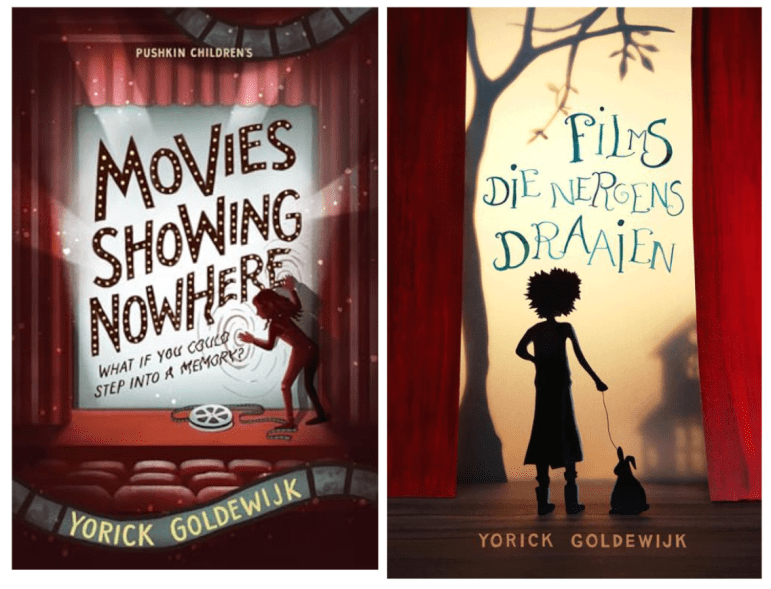
Movies Showing Nowhere (2024), originally published in Dutch as Films die nergens draaien (2021), is a spellbinding, emotionally resonant novel by Yorick Goldewijk, beautifully translated into English by Laura Watkinson.
After winning the prestigious Dutch Gouden Griffel award in 2022, the book found its way into our international school libraries and award lists, first winning a spot on the 2026 IRIS Book Award ES Chapter Books list and then making it onto the shortlist for the Global Literature in Libraries Initiative (GLLI) Translated Young Adult Book Prize.
Below we explore the book’s themes, its unique cultural context, and the impact it has made on young readers. But first, let us tell you about how we discovered Movies Showing Nowhere by going back to its Dutch beginnings.
The Spark of Discovery: From Host Culture to Library Shelves
The spark began during Kinderboekenweek (Dutch Children’s Book Week), an annual celebration where our libraries and Dutch team celebrate local literature with our international students. Every year, we invite Dutch-speaking colleagues to read to our classes.
Job Roggeveen, our Facilities Coordinator, chose to read from Films die nergens draaien, a book he discovered after its 2022 Gouden Griffel win. He picked it up to read with his daughter and was instantly intrigued by its style.
Job brought this story to our fifth graders because of its respectful treatment of 8-to-12-year-olds. Goldewijk balances fantasy and reality to capture authentic emotions with impactful sentences. Job found himself carried away by an unpredictable plot that defies readers’ expectations, finding the protagonist Cate’s psychological layers brilliant and the conclusion profoundly moving.
Job’s enthusiasm reached the library team. While the Dutch version was already in our collection, Helle spotted Laura Watkinson’s English translation at Waterstones and immediately bought copies. Knowing Watkinson’s work on titles like Lampie, we knew this book would have a huge impact.
A “Prickly” Protagonist and the Reality of Childhood
At the heart of the novel is a girl who defies traditional, lovable tropes. Cate is introduced as a “prickly” twelve-year-old. Helle notes that Cate’s personality challenges the reader, which is precisely why the book is so compelling.
Cate carries a heavy burden: her mother died the day she was born, leaving her with an emotionally distant father. She copes with sadness and subconscious guilt by pushing others away. Her only companion is her rabbit, Beggar So, making the attentions of a neighbor, Cornelia, even more repulsive to her.
Goldewijk’s refusal to sanitize grief is a trademark of European children’s literature, showcasing flawed children without forcing immediate likability.
A Cinematic Multiverse: Traveling Through Time and Loss
Cate enters an abandoned theater run by the mysterious Mrs. Kano. This is a multiverse where the movie screen acts as a meeting point in the space-time continuum.
Cate becomes a guide for visitors who return to previous lives to relive moments with lost loved ones or pets, offering a final chance to say what was left unsaid.
The theater offers Cate the ultimate temptation: meeting the mother she never knew. The narrative unfolds like a puzzle, culminating in a poignant twist that explores loss and the difficulty of truly knowing our parents and ourselves.
“A mysterious newcomer opens a cinema in her town and offers Cate the chance to learn the ropes. But this screen projected interactive reels of people’s pasts – and viewers could step inside them. Does Cate dare follow? The persistence of the past and the need for wish fulfilment are this excellent outing’s powerful themes” (Kitty Empire, “The best children’s and YA books of 2024”)
Cultural Independence and The Anxious Generation
The novel also reflects Dutch norms regarding childhood autonomy. Cate routinely bikes unsupervised to the theater without causing her father panic. In Dutch society, children are trusted to manage their time and navigate neighborhoods by age twelve. This mirrors Jonathan Haidt’s philosophy in The Anxious Generation, suggesting that freedom to explore builds resilience. As Kim notes, in the Netherlands, adults wouldn’t stop children from traveling across time if it encourages their independence.
Young Readers’ Responses
Helle’s nomination of the book to the IRIS Book Award has introduced it to hundreds of students ages 9 – 11. While some younger readers find the perspective adult-like, mature readers appreciate its sophisticated metaphors and emotionally resonant style that avoids condescension.
The book succeeds because it is an authentic story written about a child, rather than just for them, challenging young readers to see beyond their own perspectives.
Final Thoughts
For the GLLI committee, Movies Showing Nowhere stood out as an eloquent, meta-textual meditation on life, time, and human connection, earning it a spot on our 2026 shortlist. By blending the cultural independence of Dutch childhood with a magical-realist multiverse, Yorick Goldewijk and Laura Watkinson have created an unforgettable story for readers all over the world. It proves that when we trust young readers with complex structures and difficult emotions, literature can become a powerful mirror for healing.
This post was developed from a recent discussion and interview transcripts generated via interviews, a voice-to-text app, and drafting and editing assisted by Google Gemini.
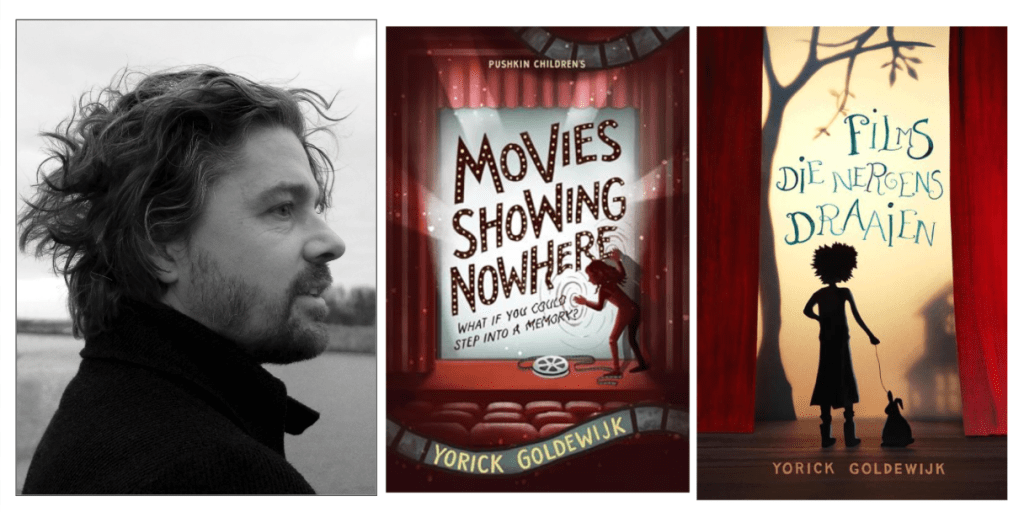
TITLE: Movies Showing Nowhere: What if you could step into a memory?
AUTHOR: Yorick Goldewijk
ILLUSTRATOR: Yvonne Lacet
TRANSLATOR: Laura Watkinson
PUBLISHER: Pushkin Children’s Books
ISBN: 9781782694106
REVIEWS:
- De Volkskrant (Dutch) – 18 Sep 2025
- The Times – “Movies Showing Nowhere by Yorick Goldewijk review — a superb weepie in a magical cinema” – 27 Apr 2024
- Kirkus Reviews – “Quirky, original, and cathartic” – 1 Oct 2024
- Financial Times – Best summer books of 2024: Children’s – 20 Jul 2024
INTERVIEWS:
- WorldKidLit: Meet the Author & Translator: Yorick Goldewijk & Laura Watkinson
- Yorick Goldewijk’s Inspirational Book in Translation
Ronja the Robber’s Daughter, Ronja Rövardotter, by Astrid Lindgren (YouTube) - Oxford Centre for Fantasy – Mythmakers Podcast Season 5 – “Movies Showing Nowhere: Yorick Goldewijk and Memories in Fantasy”
- Eerdlings, The official blog of Eerdmans Books for Young Readers – Interview with literary translator Laura Watkinson
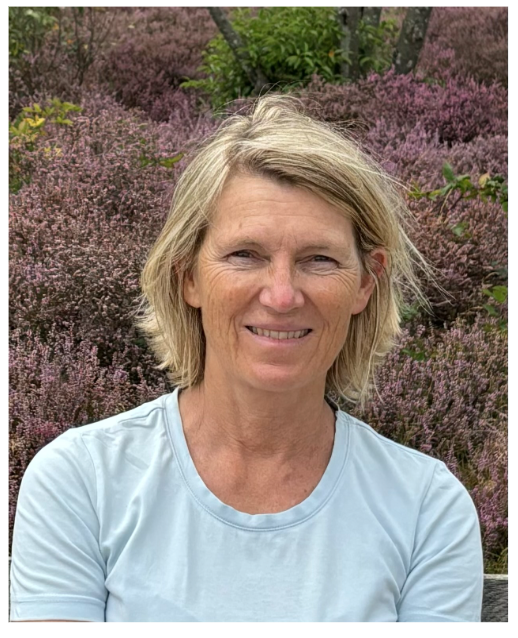
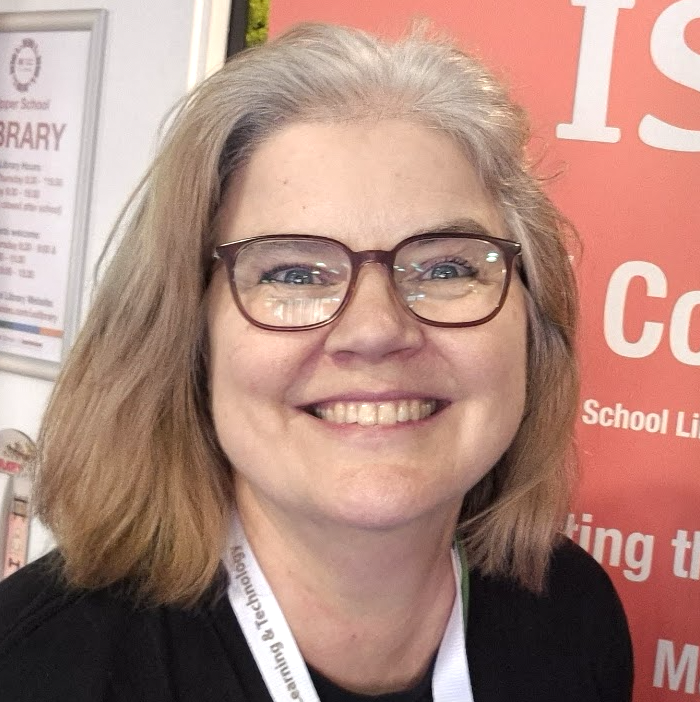
Helle Kirstein is a teacher librarian currently serving as the Lower School Librarian at the International School of Amsterdam. She holds a Master’s degree in Business, Language, and Culture from the University of Southern Denmark, a BA in Teaching from Blaagaards Seminarium, and a Master’s degree in Teacher Librarianship from Charles Sturt University. A polyglot who reads fluently in four languages, she focuses her professional work on encouraging students to read in their home languages, while also championing translated books and international stories as essential tools for building empathy and understanding across cultures. She hopes to bring to the committee the perspective of an educator who views global culture as a vital component of the modern school library.
Kim Tyo-Dickerson is the Head of Libraries and Upper School Librarian at the International School of Amsterdam, with over 25 years of experience across North America, Europe, and Africa. She holds an MLIS from Syracuse University and an MA in English from Miami University in Oxford, Ohio. Her practice is deeply informed by her Ethiopian American family and is centered on social justice, the freedom to read, and fostering environments of belonging. A passionate advocate for global literature, Kim’s professional and personal journey is rooted in the belief that language and literature are the essential tools for making sense of our world through the stories we share. You can connect with Kim on LinkedIn.
Disclaimer: The opinions and views expressed are the author’s and do not necessarily reflect those of GLLI.


One thought on “#IntYALitMonth: GLLI 2026 Shortlist: Movies Showing Nowhere”