by Leah Janeczko
Dear reader, October has been quite a month! San Girolamo – St. Jerome, patron saint of translators – has accompanied us down a long, scenic, winding path through the Italian literary landscape on a discovery of great Italian books in English translation. Long, not because it has lasted thirty-one days but because in this time we’ve shared so many posts: fifty in all. Scenic, as our view has been painted by literary translators using the palette of their linguistic creativity. Winding, because day after day I guided you back and forth, from fiction to non-fiction, from art books to children’s books, from graphic novels to poetry and more.
Before sitting down to write this closing article as your guest curator, I looked back over Italian Lit Month. I was surprised to discover that up to and including our last post (number 49, Michael Palma’s piece on Dante), I had presented you with thirty-three contributors and seventy-seven authors – far more than I had anticipated. I was also amused to note that the number of books, journals, websites and podcasts featured in our posts totaled ninety-nine – the same number as the main cantos in The Divine Comedy. And just like Dante added an introductory canto to his ninety-nine, bringing the total to a perfect one hundred, I decided to add one more to mine.
For our fiftieth post, for our hundredth canto, for our grand finale, what could I possibly recommend from the world of Italian literature that we hadn’t mentioned earlier this month? There was a natural choice: something about an author without whom no celebration of Italian books could be truly complete, and with a theme particularly fitting for followers of the Global Literature in Libraries Initiative: the film Umberto Eco: A Library of the World.

Umberto Eco: A Library of the World
- A film by Davide Ferrario
- Genre: Documentary
- Original title: Umberto Eco. La biblioteca del mondo
- Official Selection – Rome Film Festival
- English subtitles by Davide Ferrario
- Duration: 80 minutes
- Released: April 2, 2024
- Treat your movies shelf to a taste of Italy! Order the film here!
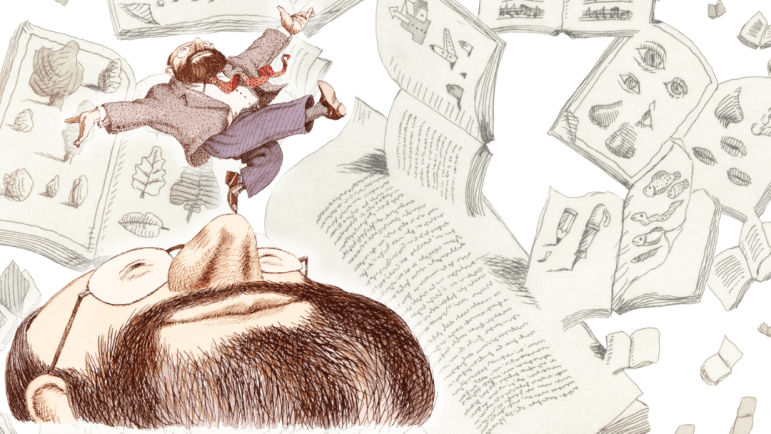
Before his passing in 2016, Umberto Eco compiled an astoundingly varied book collection in Milan consisting of over 30,000 modern titles and 1200 ancient volumes. Filmmaker Davide Ferrario takes us on a tour of this private library, examines its categories and their contents, and collects testimony from Eco’s family and friends, and from his fellow writers and scholars. In interviews and archive footage, the author underlines libraries’ fundamental connection to mankind, describing them as our “common memory”, and referring to the final canto of The Divine Comedy, in which Dante finds himself in the presence of God:
Within its depths, the leaves that are strewn wide
across the universe are there bound by
love in one single volume, unified.
(Paradiso, Canto XXXIII, lines 85-87; tr. Michael Palma)
Eco advocated reading everything – not only “important” books, literary works of art, but books of all kinds, of all genres, on all topics, even those written solely for the sake of entertainment, because the events we read about, be they real or fictional, give us more to remember, give us “stolen memories” that make our life experience feel fuller, longer and richer.
Italian Lit Month has just offered you a hundred different opportunities to experience a fuller, longer, richer life, but so much more is waiting to be discovered. An Italian library is a treasure chest brimming with riches; ask any Italian-to-English literary translator, and they’re bound to tell you about an outstanding author or book that has yet to be translated, or has been translated yet has gone unnoticed.
Perhaps one day we can continue our journey together so I can share even more with you, but for now it’s time for me to say goodbye. Before I do, here are a few ways you can make this celebration of Italian literature continue even after we part.
Check the list at the end of this piece – which contains all fifty Italian Lit Month articles, complete with descriptions and links – for any pieces you’ve missed. They might just be about books that are perfect for you!
Create an Italian Lit folder in your browser, bookmark the links below for easy reference, and check back with them periodically (perhaps over an espresso break?) for fresh content:
- the bilingual literary magazine The Florence Review (see post n.4)
- the YouTube channel Translators Aloud (post n.8)
- the website NewItalianBooks.it (post n.20)
- the literary journal Reading in Translation (post n.29)
- the literary podcast Harshaneeyam (post n.48).
Keep your eyes open for shelfworthy new Italian reads through the shortlists of these six Italian literary and translation awards: the IPTA, the John Florio Prize, the Bridge Book Award, the Premio Strega, the Premio Campiello and the Premio Andersen.
Stay on the lookout for new Italian titles. A surge of wonderful books from Italy is currently making its way through the publishing pipeline thanks to the 2024 Frankfurt Book Fair, at which Italy was country of honor (a privilege that promises the start of a new golden era of Italian publishing) and thanks to the generous translation funding awarded in recent years.
We Italian-to-English literary translators were so pleased to take part in this important celebration by networking with the GLLI. We all want Italian books to be translated, published, bought, borrowed, read, reviewed, discussed, understood and loved, so please help us spread the word about this blog and our books! Talk about them on review sites, on social media, with your family and friends, at book clubs, with the owner of your corner bookshop, with your local (or fellow) librarian. Send them the list of our fifty articles and dare them to take the “Italian Lit Month Challenge” by reading through our entire blog in the span of any given month.
If you find they’re interested in some of the same authors and titles as you, why not start up a book club dedicated entirely to Italian literature in translation? Oonagh Stransky and Clarissa Botsford have already prepared discussion questions for you about Domenico Starnone’s The Mortal and Immortal Life of the Girl from Milan and Viola Ardone’s The Unbreakable Heart of Oliva Denaro.
A world of thanks to them and to all our contributors, talented literary translators whose dedication, expertise and passion are truly remarkable. It’s been a privilege to work with them, to learn from them and to be inspired by their works and their words. Such lovely voices, each so unique, yet singing with such lovely harmony in our choir.
My endless thanks go to GLLI Executive Director Karen Van Drie, who has been an incredibly gracious, supportive host, and who has gone above and beyond by tirelessly editing and posting our not twenty or thirty or even forty but fifty articles!
Again thanks to our patron saint, San Girolamo, whose feast day was celebrated on September 30th, the day before our blog began, and now thanks must be given to Tutti i Santi (All Saints), who are being celebrated the day after our blog finishes, the two dates making auspicious bookends for Italian Lit Month. November 1st is a public holiday here in Italy, and I must admit I’m looking forward to the chance to rest. This long celebration has left me very tired, but happily so.
Dear reader, thank you for following us during Italian Lit Month. It has been an honor and a delight for me to write and curate for you, and I’ll treasure this time spent in your company.
And so, here at post number 50, our long journey comes to an end. As the sun sets and All Saints’ Eve begins, we Italian-to-English translators take our leave, giving you the opportunity to settle into a cozy chair, rest your weary legs, enjoy an aperitivo, and perhaps turn to the first page of what might well become your new favorite Italian book.
Until we meet again. Arrivederci,
Leah Janeczko
“Every translation is a journey, and translators are inveterate travelers in the marvelous world of words and emotions.” —Lori Hetherington
“I have always considered it a great honor to translate Italian literature, but without a doubt translating Abandonment, by Erminia Dell’Oro, has been one of the most powerful and meaningful experiences of my career.” —Oonagh Stransky
“We want to build bridges for the ‘pontiffs’ of literature, to allow Italian books and writers an ever wider outreach.” —Ilide Carmignani
“The English language became far richer in the 16th century thanks to translations of the literary masterpieces of the Italian Renaissance. Today’s translators continue that tradition by bringing into English some of Italy’s most innovative and daring writers, exposing us to completely new approaches to story-telling and to the novel.” —Michael F. Moore
“A native speaker of Bulgarian who lives in an English-speaking country, I found my creative voice by reading and translating Italian literature.” —Stiliana Milkova Rousseva
“Italian literature today can count on authors of great value. Among novelists, I would like to mention at least Antonio Franchini, Helena Janeczek, Francesco Pecoraro, Emanuele Trevi and Vitaliano Trevisan. Among poets, Antonella Anedda and Eugenio De Signoribus.” —Paolo Grossi
“It’s so wonderful to see Italy as the country of honor in Frankfurt this year!” —Nanette McGuinness
“The music in Insana’s work is also something I needed to be mindful of, I wanted to keep as much ‘noise’ in my translation as possible.” —Catherine Theis
“In the case of work by Edith Bruck, the author I’m translating, there is an urgency to bring more attention to it while this 93-year-old Holocaust survivor is still alive.” —Jeanne Bonner
“I consider myself a re-creator of Italian literature, and by that I mean that I derive creative gratification from working to make the experience of reading the English version parallel to the Italian one.” —Oonagh Stransky
“Italy’s extraordinary cultural history is reflected in a long tradition of producing beautiful art books whose appeal transcends frontiers: everyone needs wonderful things to look at and read about.” —Emma Mandley
“Every text has its secret… The translator’s task is to tease out that secret. And share it.” —Anne Milano Appel

“There are so many undiscovered jewels of Italian literature, and I’m eager to help their voices be heard in English.” —Leah Janeczko
Leah Janeczko, guest curator of Italian Lit Month, has been an Italian-to-English literary translator for readers of all ages for over 25 years. Originally from Chicago, she has lived in Milan for three decades. Her recent translations include Glowrushes by Roberto Piumini, recipient of the Rodari Lifetime Achievement Award; At the Wolf’s Table (The Women at Hitler’s Table) by Campiello Prize winner Rosella Postorino; and Veronica Raimo’s Lost on Me, for which she and Veronica were longlisted for the 2024 International Booker Prize. Leah also writes English song lyrics for Italian rock bands. Follow her on social media @fromtheitalian and read more about her at leahjaneczko.com.
Italian Lit Month: All Posts (n.1 to n.50)
n.1 Leah Janeczko, guest curator, introduces you to the GLLI’s first-ever celebration of Italian literature in English translation and invites you to listen to the song of Italian Lit Month: A Chorus of Voices, as its contributors, Italian-to-English literary translators, sing the praises of the books they so love.
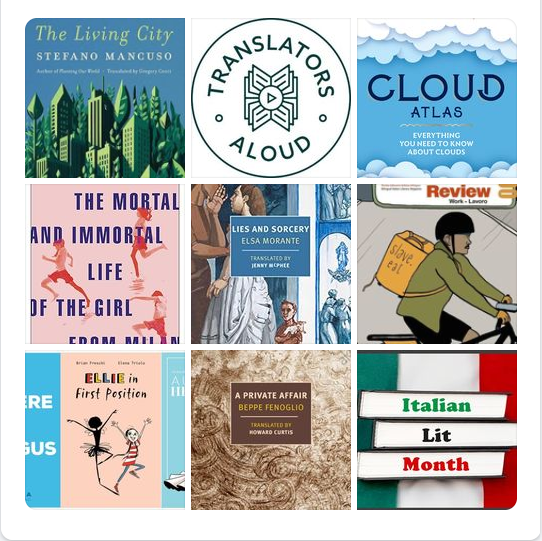
n.2 Howard Curtis, who has translated hundreds of books, mostly fiction, presents his English version of Beppe Fenoglio’s A Private Affair. This 1963 novel about a personal conflict unfolding as World War II and the partisan struggle rage in the background is such an important classic of modern Italian literature that it has been filmed three times.
n.3 Nanette McGuinness shares with us not one or two titles but Three Fun, Fascinating Italian Books for Children and Young Adults: a picture book introducing youngsters to the world of fungi; a middle-school graphic novel about a girl who dreams of learning ballet; and a YA biographical graphic novel about Audrey Hepburn, with a preface written by her son.
n.4 Johanna Bishop introduces us to The Florence Review, Italy’s First Bilingual Literary Mag showcasing Italian prose and poetry. The parallel texts by expert authors and translators is a precious resource particularly for students studying Italian who want to get a feel for the varied landscape of the country’s contemporary literature.
n.5. Lisa Mullenneaux conducts an Interview with Jenny McPhee, Translator of Elsa Morante’s Lies and Sorcery. It took Jenny over five long years to complete this 800-page masterpiece, which parodies a mix of styles, including popular romantic fiction, epic poetry, tragic myth, the epistolary novel, the picaresque, and the heroic adventure novel. Her hard work was rewarded with the 2024 Italian Prose in Translation Award.
n.6 Oonagh Stransky, who was longlisted for this year’s International Booker Prize for Domenico Starnone’s The House on Via Gemito, celebrates her forthcoming translation of another work by Starnone by sharing with us an excerpt of her Reader’s Guide to The Mortal and Immortal Life of the Girl from Milan. In it she explores elements of the symbolism, humor and language encountered in this 2021 novel.
n.7 Emma Mandley turns readers young and old into lifelong sky-gazers with her translation Cloud Atlas: Everything You Need to Know About Clouds, a delightfully illustrated picture book written by Sarah Zambello and illustrated by Susy Zanella.
n.8 Leah Janeczko, Tina Kover and Charlotte Coombe offer a look at (and a listen to) the YouTube channel Translators Aloud and Its Italian Playlist, on which literary translators read excerpts of their works. Our Italian Lit Month blog could fit only 33 contributors into its 31-day lineup of articles, but happily the channel’s Italian videos add many other voices to our chorus of translators!
n.9 Gregory Conti previews an important non-fiction title in his piece Plants Are Us: Stefano Mancuso’s Phytopolis, a book that discusses not only the problem of urban warming but also its potential solutions. As readers await the book’s April release, he invites them to delve into his three previous translations of Mancuso, who is Italy’s best known botanist.
n.10 and n.11 Katherine Gregor delves into The Sorrows and Joys of Translating Italian Dialects. In part one she introduces us to its challenges and potential solutions, and in part two hears from fellow translators Emma Mandley, Oonagh Stransky, Richard Dixon and Clarissa Botsford about their personal approaches.
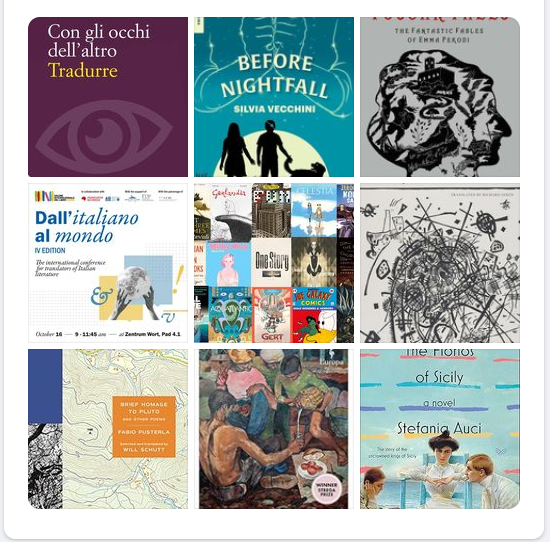
n.12 Will Schutt brings the blog its first Swiss Italian author with his piece On Fabio Pusterla’s Brief Homage to Pluto and Other Poems, and lets us enjoy a sample of the author’s work with his translation of “Up and Down the Steps of Albogasio”.
n.13 Jamie Richards, winner of the 2024 National Translation Award in Prose, writes about Italian Graphic Narrative in Translation and gives comics lovers an exciting (and generous!) reading list.
n.14 Richard Dixon celebrates the centenary of Paolo Volponi’s birth with his piece on The Nature of Reality and the Human Condition in 1950s Rural Italy in Paolo Volponi’s The World Machine, a novel that won Volponi the prestigious Strega Prize.
n.15 Leah Janeczko explains how From Italian to the World: Literary Translators Help Italian Books Travel the Globe thanks to Ilide Carmignani’s Dall’Italiano al Mondo conference at the Frankfurt Book Fair, at which speakers discussed scouting activities and presented exciting books that have yet to be translated.
n.16 Lori Hetherington treats readers young and old to a taste of 1800s Italian storytelling with her self-published translation of Tuscan Tales: The Fantastic Fables of Emma Perodi.
n.17 Chenxin Jiang Interviews Geoffrey Brock on His Translation of Silvia Vecchini’s Young Adult Novel Before Nightfall, a YA graphic novel told in verse, prose and sign language.
n.18 Ruth Chester describes Encounters Through Translation and her truly “meta” experience of both translating this book about translation and encountering its author, Stefano Arduini, to probe the concepts behind his concepts.
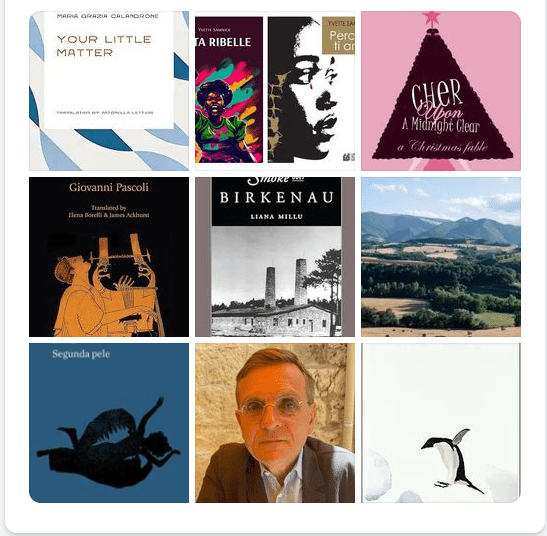
n.19 Anne Milano Appel shares with us an obsession she calls My White Whale: Translating Daniele Del Giudice and her quest to find a publisher for this award-winning author’s award-winning novel Orizzonte mobile.
n.20 Paolo Grossi, editorial director and founder of Newitalianbooks.it: Your Portal to the World of Italian Publishing, describes his website’s incredible trove of information about Italian books, authors, translators, funding programs, publishing news and more. This is a website to bookmark!
n.21 Karen Whittle writes about Exorcising the Fear of What Is Different: The Art Book Segunda Pele by Zoè Gruni, an Italian artist whose “second skin” is expressed through photography, drawing, sculpture, video and installation.
n.22 Scott Belluz takes us off the beaten track so we can explore Italy’s literary landscape through the eyes of his essay Translation as Travel Escapism: A Cautionary Tale, which encourages us to consider books that defy genre categorization.
n.23 Jeanne Bonner devotes special attention to Liana Millu, Edith Bruck and Giuliana Tedeschi in Women and the Holocaust: Overlooked Stories, as female survivors are less likely than males to be published, be cited in scholarly studies, and stay in print.
n.24 Elena Borelli and her co-translator James Ackhurst bring us something special: a translation of Convivial Poems by Giovanni Pascoli and the Podcast “An Ancient Language for a Modern Soul”, featuring readings, interviews, and harp music.
n.25 Wendell Ricketts contrasts The Two Lucas: one the subject of an ex-gay anthem sung at the Sanremo music festival, and one, in a fable by Matteo B. Bianchi, a boy who asks for Christmas presents that grown-ups always deem too “girlish” to give him.
n.26 Lisa Mullenneaux interviews Yvette Samnick in Born a Rebel Is a Cry for Gender Justice, the Cameroonian author’s two books in Italian (as of yet unpublished in English) aiming to empower women in their battle for self-determination.
n.27 Antonella Lettieri tells us about Maria Grazia Calandrone’s Your Little Matter (the “little matter” being the author’s mother being driven to suicide by Italian society in the mid 1900s), with its blend of archival research, investigative journalism and exquisite prose.

n.28 Leah Janeczko shines a light on the 1987 classic Glowrushes by Roberto Piumini: A Timeless Italian Masterpiece written for children and adults by an author nominated three times for the Hans Christian Andersen Award.
n.29 Stiliana Milkova Rousseva introduces us to her online journal, a precious source of expert literary reviews, particularly of works from Italy, in her piece Reading in Translation: Shaping a Culture of Reviewing Italian Literature in Translation.
n.30 Johanna Bishop serves us a veritable feast of Italian verse collected in the Tempo anthology edited by Luca Paci and presented in her piece An Enticing Introduction to Contemporary Italian Poetry.
n.31 Clarissa Botsford not only introduces us to her translation of Viola Ardone’s novel The Unbreakable Heart of Oliva Denaro, but also provides us with inspiring discussion questions in No Means No, or Does It? A Moving Testament to a Young Woman’s Courage.
n.32 Emma Mandley, in Translating Art Books: Inside Pompeii by Luigi Spina, takes us on an exploration of this fascinating, world-famous archeological site’s mosaics, frescos and streetscapes, including many that are inaccessible to most visitors.
n.33 Oonagh Stransky recovered a gem from the Italian postcolonial literary canon – Abandonment: An Italian-Eritrean Story – and persevered in finding a good home for this novel by author Erminia Dell’Oro.
n.34 Stiliana Milkova Rousseva and co-editor Saskia Elizabeth Ziolkowski make important Italian research available in English and build on significant international discourses in Natalia Ginzburg and Italian Women Writers in Translation.
n.35 Katherine Gregor and Babas discuss How to Train Your Human: A Cat’s Guide in a delightful video interview between this Italian artist and her English translator.
n.36 Karen Whittle describes the perils of Walking the Philosophical Tightrope as she meticulously translates books by Italian philosophers, with focus on five contemporary titles by Elena Pulcini, Francescomaria Tedesco, Guido Cusinato, Nicola Emery and Corrado Claverini.
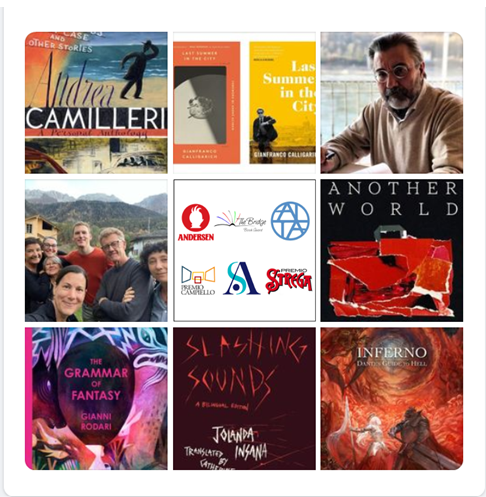
n.37 Alex Valente has fun Playing Pretend in Dante’s Inferno (and Other Italian Stories) as he integrates and emulates Longfellow’s 1867 translation in a role-playing game during an era that is proving to be a veritable renaissance of RPGs from Italy.
n.38 Catherine Theis probes how poets and their translators, through their written words, engage in Conversations: A Look Inside Jolanda Insana’s Slashing Sounds.
n.39 Ruth Clarke describes the experience of undergoing an emotional struggle as she was forced to research far-right thinking when Translating Sensitive Content in From Another World by Evelina Santangelo.
n.40 Jack Zipes, an expert on folklore and children’s literature, describes his Encounters with Gianni Rodari and His Grammar of Fantasy, and how they influenced the very purpose of his life and work.
n.41 Richard Dixon talks about a special workshop in Switzerland at which Italian-to-English translators help English-to-Italian translators and Vice Versa: Translators Across the Language Divide.
n.42 Lori Hetherington conducts An Interview with Italian ‘Authorpreneur’ Filippo Iannarone, whose historical mysteries are set in dictatorial 1930s Italy and the country’s often overlooked postwar revival era.
n.43 Howard Curtis shares a rediscovered classic set in the “tender beast” of Rome at the tail end of the dolce vita: Gianfranco Calligarich’s Last Summer in the City.
n.44 Stephen Sartarelli takes us on a deep dive into rendering the unique dialect of the Inspector Montalbano series in his piece On Translating Camilleri: Notes from the Purer Linguistic Sphere of Translation.
n.45 Leah Janeczko recommends that you keep your eyes on the prize when browsing books and be on the lookout for Six Italian Literary and Translation Awards You Should Know About.
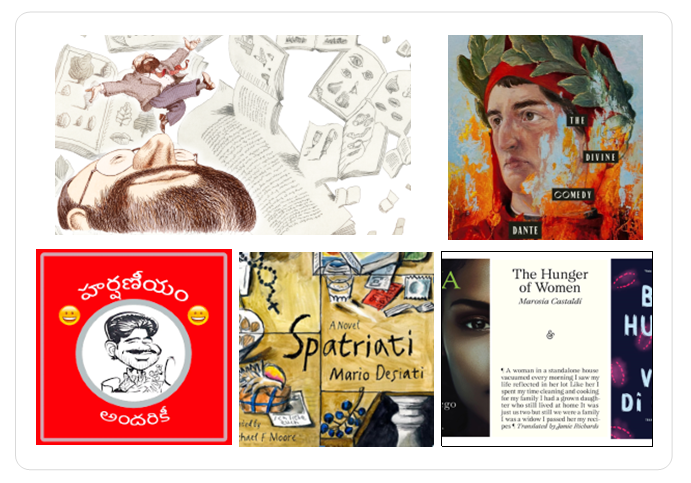
n.46 Jeanne Bonner conducts a Q&A with Jamie Richards, translator of works by some of Italy’s most celebrated contemporary writers and winner of the 2024 National Translation Award in Prose for Marosia Castaldi’s The Hunger of Women.
n.47 Michael F. Moore prepares to translate a novel by visiting a small Apulian town with its Strega Prize-winning author, whose prose celebrates the dialect, poetry and history of the region, an act of Reclaiming Puglia in Mario Desiati’s Spatriati.
n.48 Leah Janeczko celebrates The Harshaneeyam Podcast and Its Italian Literature Playlist, five episodes in their tour de force of interviews with English literary translators working from 56 different languages.
n.49 Michael Palma presents A New Translation of Dante: The Music I Kept Hearing in My Head while working on his forthcoming translation of The Divine Comedy, in which he achieved the rare feat of preserving Dante’s original rhyme scheme.
n.50 Leah Janeczko, Italian Lit Month guest curator, before wishing you arrivederci, shares with you the hundredth of our One Hundred Cantos in our celebration of Italian literature in English translation: Davide Ferrario’s documentary film Umberto Eco: A Library of the World.


Thank you for this lovely series, Leah! It’s been bery enjoyable.
LikeLike
Thank you! It’s been a pleasure!
LikeLiked by 1 person