by Lori Hetherington
The old woman finished peeling a chestnut and, after handing it to the youngest of her grandchildren, began to speak with her sweet voice and the pure accent of Tuscany’s mountain people…
Stories told by an old grandmother exist in virtually every culture. Some are part of the oral tradition, some are written, and many of them start in a similar way:
You must know that a very long time ago in Montecornioli an old man appeared with a white beard, hair that nearly reached his belt, a long cloak made of silk clasped around his shoulders, and a turban on his head. He arrived astride a white mule and behind him rumbled a covered cart pulled by two oxen and driven by another old man.
The tales that grandmother narrators tell may be different but the storytelling technique is common: the young listener is drawn in to then be filled with awe and a sense of mystery, and in the end the story passes on wisdom or a warning:
The people of Montecornioli have never again seen the demons with flaming swords guard the cavern, but no one dares dig into the mountain to recover the riches. Only once did two thieves come from afar to steal the treasure but, as they stood at the mouth of the cavern, they were struck by a bolt of lightning and reduced to ashes.
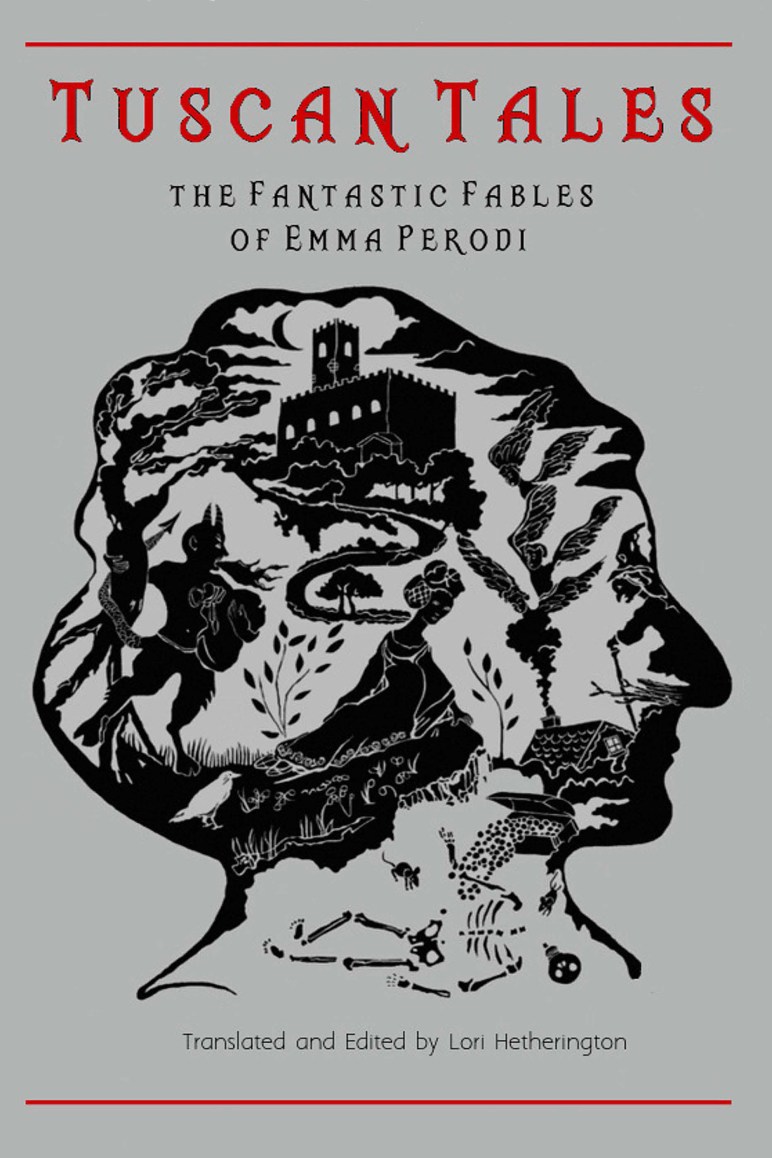
These are extracts from the first chapter of Tuscan Tales: The Fantastic Fables of Emma Perodi, a condensed translation of a collection of late-19th-century Gothic novellas.
Emma Perodi (1850-1918) reinvented herself and her writing style numerous times in order to make a living as an author at a time when a cigar-smoking, unwed mother and tireless professional did not align with typical female roles in Italy. She’s credited with roughly eighty books, four hundred articles and essays—many under pseudonym and mostly for young readers—as well as fifteen translations from German, English, and French. Perodi’s most famous book, Le Novelle della Nonna (Grandma’s Tales), was first published in serialized form in 1892, a decade after Italy’s most beloved title for children, The Adventures of Pinocchio. This was an important time for young people in Italy as literacy rates were rapidly expanding thanks to the adoption of mandatory schooling throughout the country. Like Pinocchio, Perodi’s volume is a long-seller, having been reprinted dozens of times over the decades by some of Italy’s best-known publishers. While Italians have loved the author’s tales for more than a hundred years, prior to my translation, the stories had never appeared in English.
One of the charms of Perodi’s collection lies in how, via a two-plane narrative, she fuses together the story of a peasant family—the Marcuccis and their matriarch, the story-telling grandmother Nonna Regina—with tales of fantasy set in medieval times in the same geographical location: a mountainous area located nowadays one hour by car east of Florence. By setting her highly imaginative tales within the context of a frame story—a storytelling device used famously, for example, by Giovanni Boccaccio in his classic masterpiece The Decameron—she builds bridges between her present and a historic past, between the worlds of daily life and mystery, between the people who worked the land and the noble class. What she does is not so different from what translators do when they reach across the void to connect foreign readers with an otherwise inaccessible text.
My first challenge as a translator was to decide how to present Perodi’s massive four-part text: a total of more than 500 pages! It would take years to translate the entire work and, besides, mainstream 21st-century readers would surely feel overwhelmed by such a tome. Furthermore, my aim was not academic but rather to introduce English-language readers to the author and her times, to her territory and cultural environment, and to her stories with ties to genres that are widely popular today—fantasy and magic realism—without destroying the beauty and originality of her work. Clearly, Perodi consciously chose to place a spiritual, fantasy world on equal footing with the everyday, otherwise she would have written a straightforward collection of fairy tales. And in order to be faithful to her work, I felt I had to find a way to do the same.
After much trial and error, I came up with an unusual approach: translation of the first part of the original work (the frame story + fairy tale combination), creation of a summarizing chapter written in similar style that covered the vicissitudes of the Marcucci family as told in parts 2, 3, and 4 of the frame story, and translation of Perodi’s original epilogue to complete the volume. In other words, a sampling of her dark fairy tales within the grandmother’s tale context followed by the full narrative arc of the Marcucci family in which local traditions exist alongside universal human experiences such as birth, death, tragedy, and triumph. The result allows modern readers to appreciate her fairy stories full of magic, saints, skeletons and phantoms and also enter into the life of an Italian family in a rural setting at the end of the 19th century.
Another challenge in translating this work was how to bridge the gap between Perodi’s young Italian readers and today’s international readers of all ages. There is no shortage in her stories of figures and objects that are unknown outside Perodi’s time and place and to explain them I chose words that lend an antiquated tone or are typical of oral traditions, relying on vocabulary that is within reach for current readers over the age of about ten. As confirmation that I met my objective, one adult reader wrote: “I picked up [the book] last month to read to our kids in the evening and they love it. My husband found it hilarious too.”
Translators take pride in knowing they’ve bridged the divide but it is difficult to place translated literature with traditional publishers who frequently see it as too niche or not commercial enough for their business model. In the case of this translation, I even had a literary agent’s support but to no avail. After almost three years of searching for a publisher, I opted to self-publish professionally. This entailed engaging an editor who had experience with fairy and folk tales, a cover artist who grasped the spirit of the stories, and an expert formatter to do the layout. Yes, it required investment on my part, but leaving my translation buried amongst the files in my computer, out of readers’ reach, was not an option.
I hope this article inspires librarians, teachers, parents, and others to explore books that don’t fit the standard model, and encourages translators to consider alternative paths to publishing and getting unknown stories into the hands of readers.
Tuscan Tales: The Fantastic Fables of Emma Perodi
- Translated from the Italian and edited by Lori Hetherington
- Author: Emma Perodi
- Original title: Le novelle della nonna (1893)
- 178 pages
- Publisher: Lori Eileen Hetherington
- ISBN: 9791220076968
- Publication date: December 29, 2020
- Treat your bookshelf to a taste of Italy! Order the book here.
Lori Hetherington holds a Bachelor of Arts degree from the University of California Berkeley and is a freelance Italian>English translator living in Florence, Italy. Her early years as a translator were spent working on scientific texts while more recently her primary efforts have been with entrepreneurial authors of fiction and narrative nonfiction as well as ghostwriting memoir. She is a founding member of the Florence Literary Society and organizes and facilitates regular brainstorming sessions for writers at the British Institute in Florence.
More at lhetheringtontranslation.com

“Every translation is a journey, and translators are inveterate travelers in the marvelous world of words and emotions.” – Lori Hetherington

Italian Lit Month’s guest curator, Leah Janeczko, has been an Italian-to-English literary translator for over 25 years. From Chicago, she has lived in Milan since 1991. Follow her on social media @fromtheitalian and read more about her at leahjaneczko.com.


One thought on “#ItalianLitMonth n. 16: Translating Tuscan Tales”