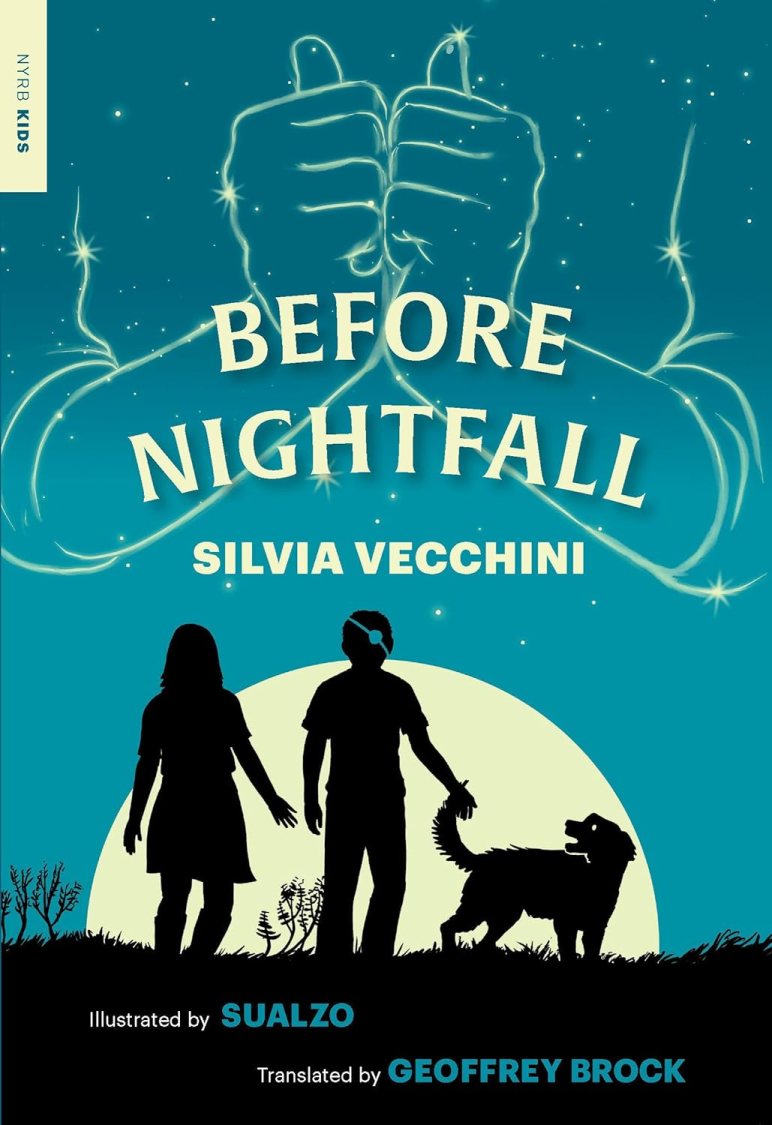
Chenxin Jiang talks to Geoffrey Brock about his translation of Silvia Vecchini’s Before Nightfall, a young adult novel about the siblings Carlo and Emma.
Carlo is a teenager who happens to be hearing-impaired and can see only out of one eye. Now that eye is failing, and Carlo must have an operation to try to save his vision. His fierce and funny sister Emma, Carlo’s closest companion, begins writing poems that express the fear she works hard to hide, while his seeing-eye dog Lulù remains steadfastly at his side. But even with the support and affection of his family, how can Carlo face such uncertainty?
Chenxin: What drew you to translating Before Nightfall? It’s a book with both prose sections and poems – how would you describe the voice of the poems that Emma writes?
Geoffrey: I’m always interested in stories I haven’t heard before, or haven’t heard often enough, and I found this story of Emma and her older brother Carlo to be a sweet and surprising portrait of siblinghood and of how one family member’s disability can reshape, in difficult but sometimes also beautiful ways, an entire family and even a community. It wears its heart on its sleeve in a way that feels earned. I was also intrigued by the fact that it’s a prosimetrum – a book that alternates between prose and poetry. I’ve long been intrigued by that mode, which in Italian of course goes back famously to Dante’s Vita Nuova.
Before Nightfall alternates between short third-person prose sections, which focus mainly on the adults that orbit Emma and Carlo’s world, and Emma’s poems, which focus mainly on her brother (and also on a budding romance). The poems are diaristic but also playful, linguistically and otherwise: they make very casual use of punctuation and casual but noticeable use of rhyme, and they sometimes include elements of visual or shaped poetry. Both the rhymes and the visual elements add elements of pleasure and style to the text and presented, for me as a translator, challenges I particularly enjoyed.
Chenxin: In the preface, Silvia Vecchini writes: “these siblings … are the first homes that take in [kids with disabilities], the first windows opened to the outside world.” What do you find compelling about siblinghood as home in Before Nightfall?
Geoffrey: Yes, I too was struck by that idea of siblinghood as home. That’s something that I haven’t experienced firsthand, but I have seen it play out in various siblings I’ve known, and it can be a very beautiful thing. Siblinghood, of course, often devolves into rivalry or even enmity, and literature has always been rich with stories about this kind of siblinghood – Cain and Abel come immediately to mind. But siblinghood can also evolve into a potent us-against-the-world alliance, and often it is shared trauma of some kind – e.g., illness, divorce, death – that tips the scales toward alliance. Such trauma can bring siblings closer together, causing them to form a kind of mutually protective bond that can function like a home, or like a safe haven within a home – a panic room, say, or a bomb-shelter – a refuge from the shocks of the outside world. I found the portrait of the close bond between Carlo and Emma genuinely moving, perhaps in part because it’s so different from my own experience.
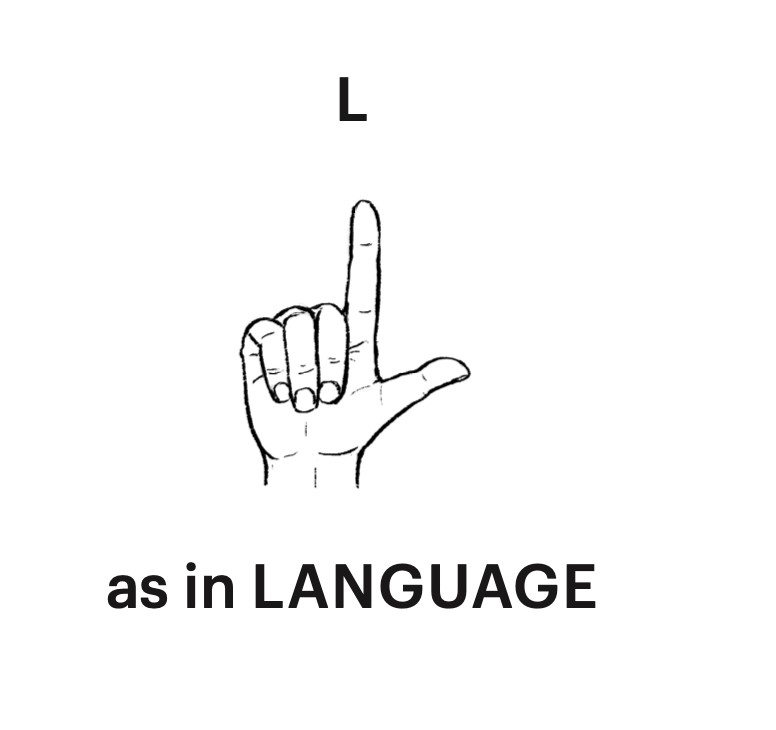
Chenxin: How did you decide to stick with LIS (lingua dei segni italiana) rather than ASL (American Sign Language) for the chapter headings of the book?
Geoffrey: There’s a lot of overlap between LIS and ASL, but there are also differences, and since the book is in part about the various kinds of language that Carlo and Emma must learn and navigate, the editors at NYRB and I decided we wanted to highlight rather than hide or elide the differences between LIS and ASL. We didn’t want, in other words, to pretend that sign language is just one thing. I hope such matters will be of interest to readers who encounter them in a story like this.
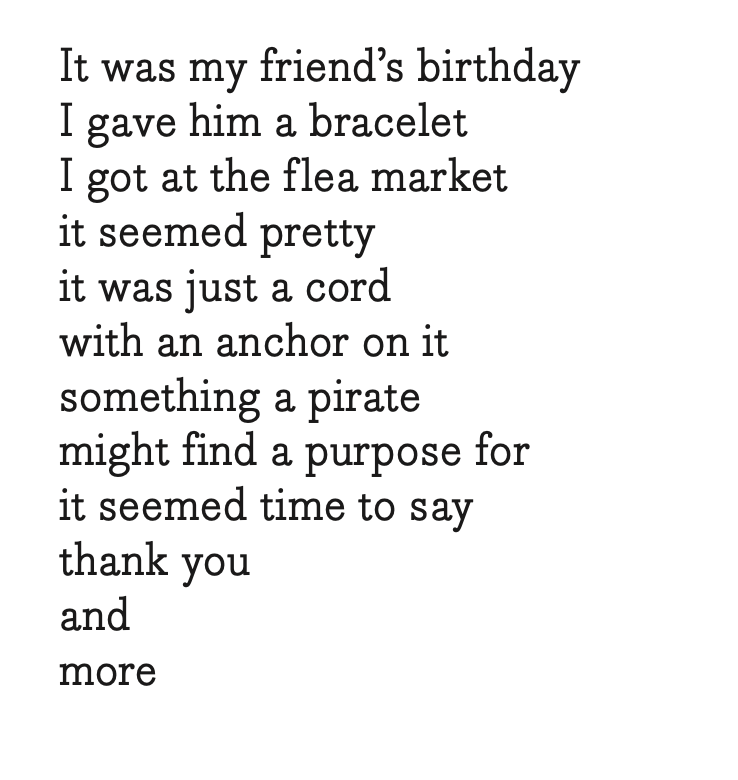
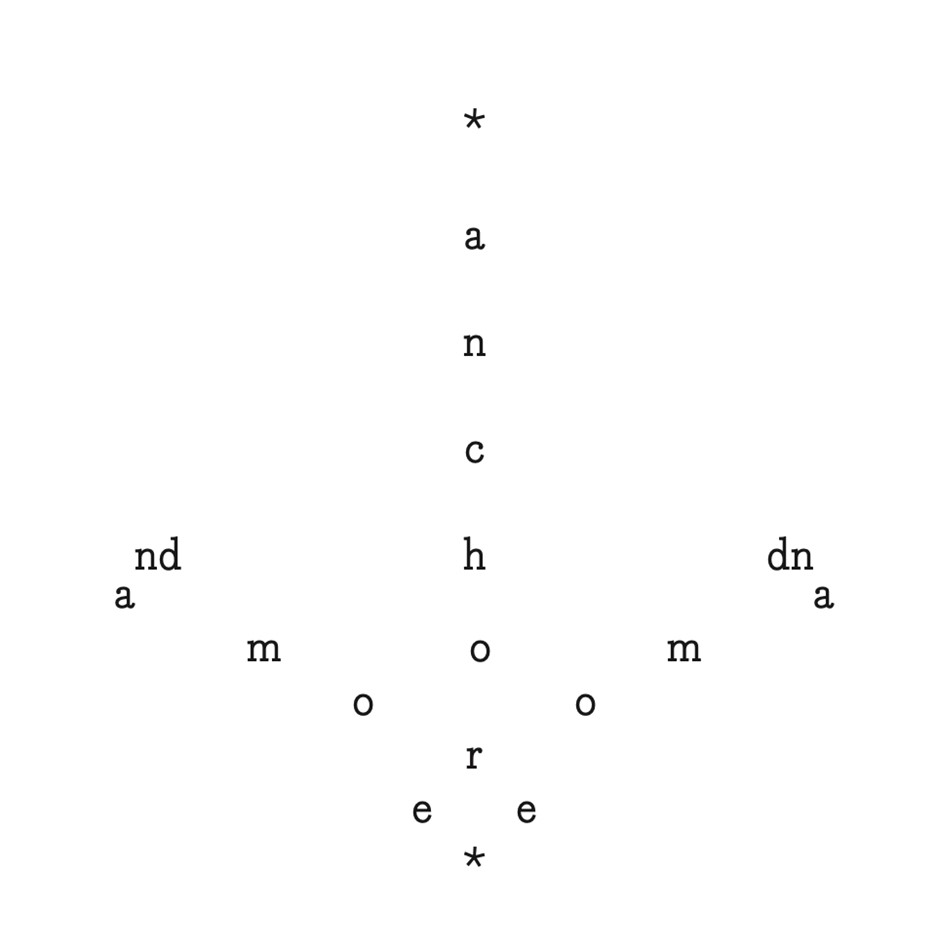
Chenxin: Another problem in visual translation is posed by the poem that you translate as “anchor and more.” Your English version evokes “amore” for me but I suspect that’s just me…
Geoffrey: I’m so glad you noticed that “amore” Easter-egg lurking in the anchor poem! I couldn’t of course retain the particular wordplay of the original, which relies on two words that are homographs in Italian [Ed: àncora/ancora] and that, when arranged on the page in the shape of an anchor, become a striking two-word love poem. For quite a while I had no idea what to do with that particular piece, but eventually I came up with a way to turn Vecchini’s poem into a three-word visual poem with that Italian word hiding in plain sight in the English, as if to voice the poem’s subtext.
As I think often happens with the “untranslatable,” the seeming impossibility of translating Vecchini’s clever little poem was precisely what forced me (freed me?) to look for a solution that, while obviously not literal, hopefully serves the story in a similar way and provides a similar kind of pleasure to Anglophone readers (especially if they spot, as you did, that little Easter egg).
Before Nightfall
- by Silvia Vecchini
- Illustrations by Sualzo
- Translated from the Italian by Geoffrey Brock
- Original title: Prima che sia notte
- 128 pages
- Publisher: New York Review Books Press (NYRB Kids, 2024)
- ISBN: 9781681377926
- Treat your bookshelf to a taste of Italy! Order the book here.
This book has been translated thanks to a contribution awarded by the Italian Ministry of Foreign Affairs and International Cooperation.
Silvia Vecchini was born in 1975 in Perugia. She loves poetry and has written several books for children and young adults. She regularly holds workshops and events based on her works, as well as designs courses for schools and runs teacher trainings.
Antonio “Sualzo” Vincenti is an author and comics illustrator. He won the Festi’DB di Moulins in 2009, best screenplay category, for L’Improvvisatore, and was named finalist in the Micheluzzi Award in 2010.
Geoffrey Brock is a poet and a translator of poetry, prose, and comics, mostly from Italian. His recent books include a new collection of poems called After (Paul Dry Books, 2024), as well as translations of Chantal Montellier’s graphic novel Social Fiction (New York Review Comics, 2023) and Silvia Vecchini’s Before Nightfall (NYRB Kids, 2024). His version of Giovanni Pascoli’s Last Dream (World Poetry Books, 2019) received the Raiziss/de Palchi Book Prize from the Academy of American Poets, and his version of Giuseppe Ungaretti’s Allegria (Archipelago, 2020) received ALTA’s National Translation Award for Poetry. He has also translated books by Cesare Pavese, Umberto Eco, Roberto Calasso, Italo Calvino, and others, and he is the editor of The FSG Book of 20th-Century Italian Poetry (FSG, 2012) and the founding editor of the Arkansas International. His website is geoffreybrock.com.
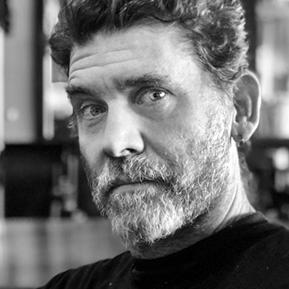
“Over the last 800 years, Italian and its dialects have produced one of the world’s richest bodies of literature, and recent decades have seen it growing more diverse in exciting ways. It’s a great time to translate from Italian!” —Geoffrey Brock
Chenxin Jiang is a PEN/Heim-winning translator from Italian, German, and Chinese. Her most recent translation from Italian was Tears of Salt/Lampedusa (HarperCollins, 2019 and MacLehose, 2018) by Pietro Bartolo and Lidia Tilotta, shortlisted for the Italian Prose in Translation Award. Chenxin was born in Singapore and grew up in Hong Kong. She’s always looking for ways to build community with and advocate for fellow translators through her work with the American Literary Translators Association, for which she serves as president of the board.


Italian Lit Month’s guest curator, Leah Janeczko, has been an Italian-to-English literary translator for over 25 years. From Chicago, she has lived in Milan since 1991. Follow her on social media @fromtheitalian and read more about her at leahjaneczko.com.


One thought on “#ItalianLitMonth n. 17: Geoffrey Brock on His Translation of Silvia Vecchini’s Young Adult Novel Before Nightfall”