Rongorongo. Source: Wikipedia. Even though my work is more about endangered scripts than those no longer in use, I love Rongorongo, a glyph system discovered over a century ago on Rapa Nui, a.k.a. Easter Island., which recently returned to the news through a rather breathless article in Smithsonian magazine. What makes Rongorongo, which has so … Continue reading #EndangeredAlphabets: Two Cheers for Rongorongo
#EndangeredAlphabets: The Survivor Script
Article One of the Universal Declaration of Human Rights in Samaritan. Carving and photo by the author. During the current catastrophe in the Middle East, it may be reassuring to hear a story of survival. Let’s go back two thousand years to the region confusingly called the Holy Land—confusing, because it was (and is) considered … Continue reading #EndangeredAlphabets: The Survivor Script
#EndangeredAlphabets: Succeed at Your Peril
Topographic map in the Bamum script from early 20th-century Cameroon. Image courtesy of the Incunabula Library. Creating a new script for an indigenous people during a colonial era is a two-edged sword. The desire to claim and assert one’s cultural identity may provide the driving force that sustains an author through the long, hard work … Continue reading #EndangeredAlphabets: Succeed at Your Peril
#EndangeredAlphabets: The Songbook Scripts
Zhuang Musicians in Longzhou. Source: Wikipedia Those of us from Western Europe and the Americas use a script that is so widely used we barely recognize it as a script. In fact, we often refer to it as “the” alphabet, as though there were only one. For us, our script is writing itself; most of … Continue reading #EndangeredAlphabets: The Songbook Scripts
#EndangeredAlphabets: Whatever You Do, Don’t Call It Picture-Writing
Papyrus painting. Photo by the author. Today this column ventures through not only space but time—to ancient Egypt, or more accurately to a papyrus painting in the style of Egyptian hieroglyphics, kindly given to me by the parents of a student graduating from my writing program, a decade ago. Like most people, I know … Continue reading #EndangeredAlphabets: Whatever You Do, Don’t Call It Picture-Writing
#WorldKidLit Wednesday: The Ferris Wheel
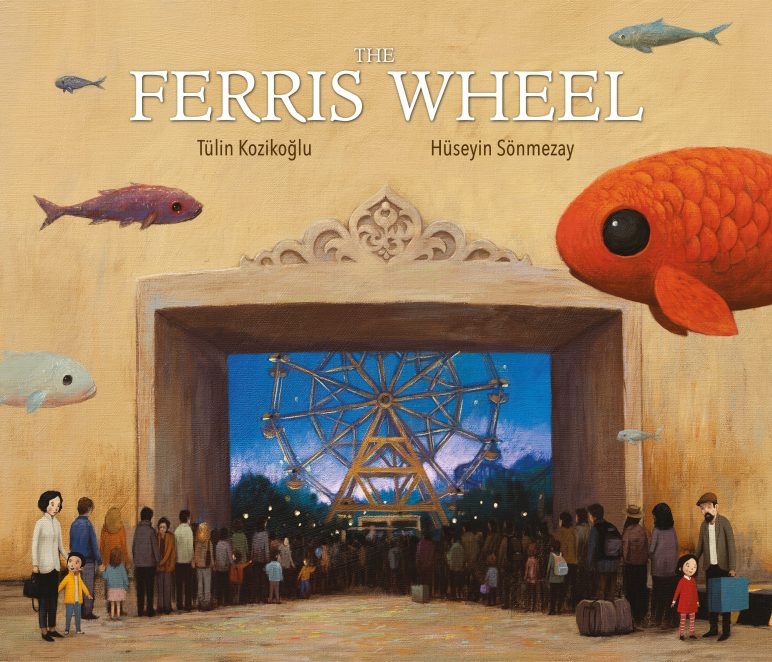
On one side of the world, a boy looks out his window to watch colorful fireworks burst in the sky. In another part of the world, a girl presses her face to her window as she sees rockets and bombs strike her neighborhood. Their lives are so very different, yet in the Turkish picture book … Continue reading #WorldKidLit Wednesday: The Ferris Wheel
#EndangeredAlphabets: The Man Who Invented Everything
Photo courtesy of the Borneo Post Authors of writing systems need to be as creative as they are linguistically knowledgeable. A little self-promotion helps, and a lot of perseverance is vital. Of all the script creators we know about, though, nobody was as inventive as Dunging Anak (son of) Gunggu, known as "Aki," creator of … Continue reading #EndangeredAlphabets: The Man Who Invented Everything
#EndangeredAlphabets: Petros
The Baška tablet, found in the 19th century on Krk. Source: Wikipedia. Last September I was in the Balkans, specifically in Montenegro, looking for traces of the Glagolitic script created (probably) about 1200 years ago, (probably) a few hundred miles south of here, (quite likely not) by the brothers Cyril and Methodius who (probably) didn’t create Cyrillic … Continue reading #EndangeredAlphabets: Petros
#EndangeredAlphabets: When Alphabets Are Codes
A table of Buginese cypher script with equivalent in standard Buginese script cited by B F Matthes in his book "Eenige proeven van Boegineesche en Makassaarsche Poëzie", 1883. Source: Wikipedia In a sense, every script is a code, comprehensible to some, incomprehensible to those who don't know its workings. We tend to think that writing … Continue reading #EndangeredAlphabets: When Alphabets Are Codes
#EndangeredAlphabets: The Saddest Scripts
"Thank you all" written in the Nüshu syllabary. Photo and carving by the author. Over the past decade, my research for the Endangered Alphabets project has found scripts that are exclusively sacred or spiritual, others used only for magic and divination, some employed solely for accounting and bookkeeping, some even for notating songs. Writing, then, … Continue reading #EndangeredAlphabets: The Saddest Scripts
 Global Literature in Libraries Initiative