Papyrus painting. Photo by the author. Today this column ventures through not only space but time—to ancient Egypt, or more accurately to a papyrus painting in the style of Egyptian hieroglyphics, kindly given to me by the parents of a student graduating from my writing program, a decade ago. Like most people, I know … Continue reading #EndangeredAlphabets: Whatever You Do, Don’t Call It Picture-Writing
Articles
#WorldKidLit Wednesday: The Ferris Wheel
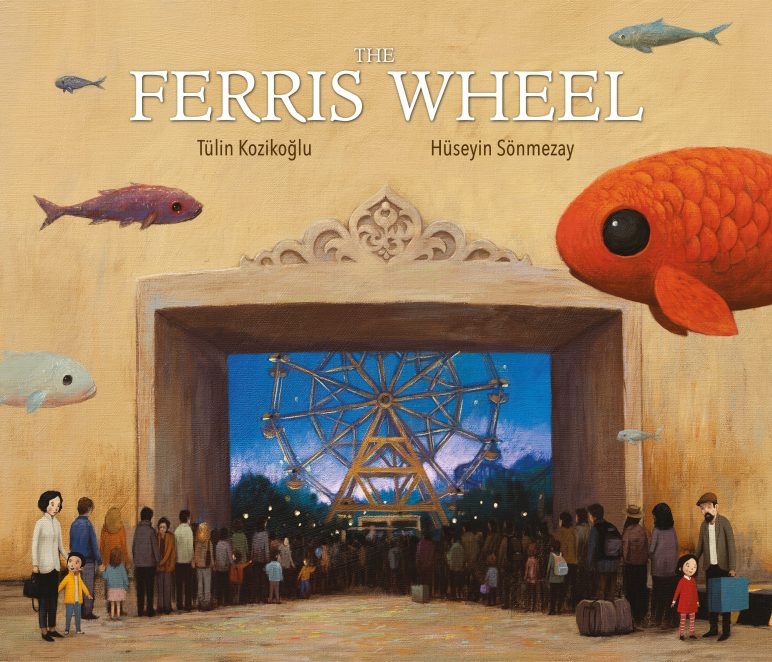
On one side of the world, a boy looks out his window to watch colorful fireworks burst in the sky. In another part of the world, a girl presses her face to her window as she sees rockets and bombs strike her neighborhood. Their lives are so very different, yet in the Turkish picture book … Continue reading #WorldKidLit Wednesday: The Ferris Wheel
#EndangeredAlphabets: The Man Who Invented Everything
Photo courtesy of the Borneo Post Authors of writing systems need to be as creative as they are linguistically knowledgeable. A little self-promotion helps, and a lot of perseverance is vital. Of all the script creators we know about, though, nobody was as inventive as Dunging Anak (son of) Gunggu, known as "Aki," creator of … Continue reading #EndangeredAlphabets: The Man Who Invented Everything
#EndangeredAlphabets: Petros
The Baška tablet, found in the 19th century on Krk. Source: Wikipedia. Last September I was in the Balkans, specifically in Montenegro, looking for traces of the Glagolitic script created (probably) about 1200 years ago, (probably) a few hundred miles south of here, (quite likely not) by the brothers Cyril and Methodius who (probably) didn’t create Cyrillic … Continue reading #EndangeredAlphabets: Petros
#EndangeredAlphabets: When Alphabets Are Codes
A table of Buginese cypher script with equivalent in standard Buginese script cited by B F Matthes in his book "Eenige proeven van Boegineesche en Makassaarsche Poëzie", 1883. Source: Wikipedia In a sense, every script is a code, comprehensible to some, incomprehensible to those who don't know its workings. We tend to think that writing … Continue reading #EndangeredAlphabets: When Alphabets Are Codes
#EndangeredAlphabets: The Saddest Scripts
"Thank you all" written in the Nüshu syllabary. Photo and carving by the author. Over the past decade, my research for the Endangered Alphabets project has found scripts that are exclusively sacred or spiritual, others used only for magic and divination, some employed solely for accounting and bookkeeping, some even for notating songs. Writing, then, … Continue reading #EndangeredAlphabets: The Saddest Scripts
#EndangeredAlphabets: Beyond the Alphabet
The Adinkra symbol Aya, the fern, which stands for resilience and resourcefulness. Carving and photo by the author. My book Writing Beyond Writing came about because of the Adinkra symbols of Ghana. These are remarkable symbols, each of which is a kind of graphic shorthand for a proverb or piece of traditional wisdom—not a letter … Continue reading #EndangeredAlphabets: Beyond the Alphabet
#Endangered Alphabets: The Gnostic Script
Article One of the Universal Declaration of Human Rights in the Mandaic script. Carving and photo by the author. Many, many of the world's less-known scripts might change the way you think about writing, but none more so, I suspect, than the Mandaic. The Mandaeans have possibly the most exquisite awareness of the importance of … Continue reading #Endangered Alphabets: The Gnostic Script
#WorldKidLit Wednesday: All in a Day
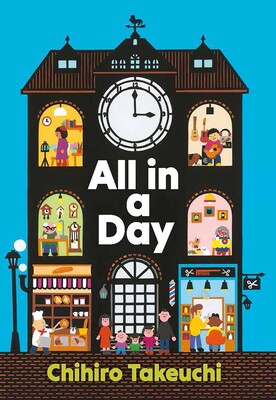
So much can happen in a day! Especially for the residents of a busy apartment block and the surrounding community. In her picture book All in a Day, renowned Japanese paper-cut artist Chihiro Takeuchi invites readers to explore the concept of time in the beautiful neighborhood she has created. The focal point of the story–and … Continue reading #WorldKidLit Wednesday: All in a Day
#EndangeredAlphabets: Is it Ogham Or Ogam? And In Any Case, How Do You Say It?
“At the Edge of the Wood” (2009) by Irish sculptor Fidelma Massey. It spells TAOBH NA COILLE, the name of the Gaelscoil in Beallairmín, An Chéim / Belarmine, Stepaside, Co. Dublin, in vertical Ogam.http://www.fidelmamassey.com/large-works Today's post has a serious part and a light-hearted part. Leave 'em laughing, they say, though whether what goes for vaudeville … Continue reading #EndangeredAlphabets: Is it Ogham Or Ogam? And In Any Case, How Do You Say It?
 Global Literature in Libraries Initiative