Today’s post comes to you from Kate London
‘Things Have a Soul’ – Werner Abresch (1941 – 2024)
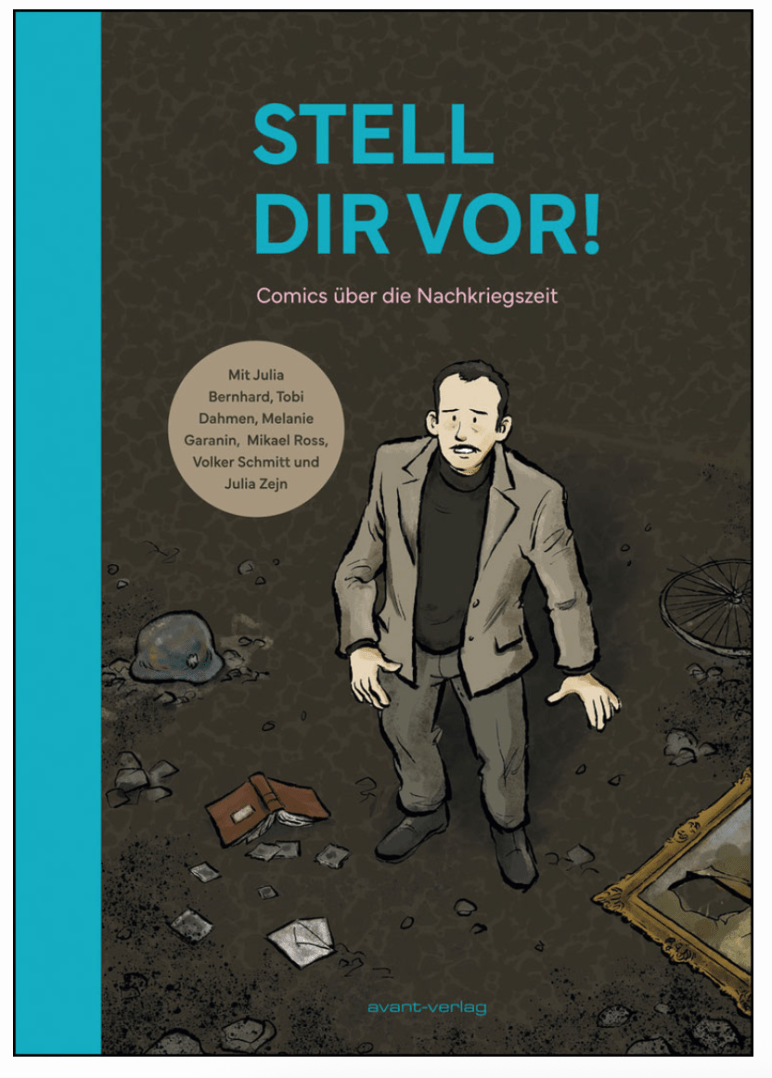
Stell Dir Vor! Comics über die Nachkriegszeit (Imagine! : Comics about the postwar period) by Tobi Dahmen, Julia Bernhard, Melanie Garanin, Mikael Ross, Volker Schmitt, and Julia Zejn
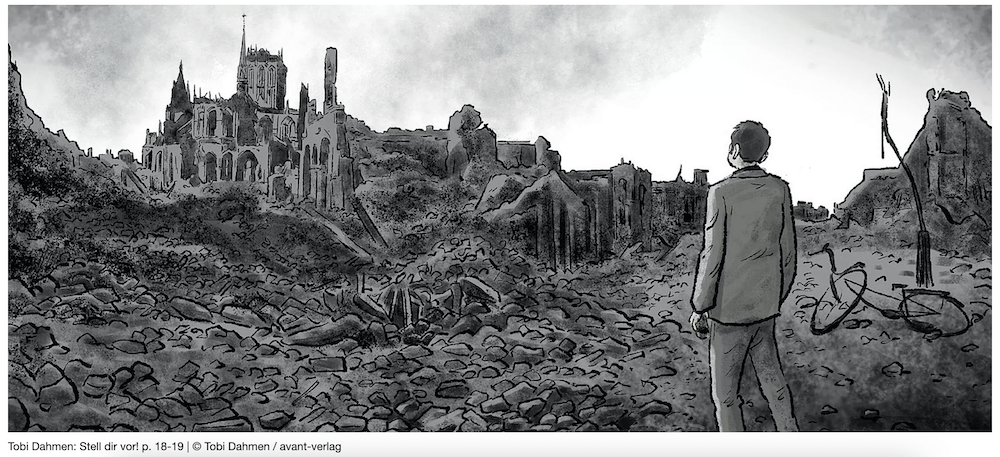
Werner Abresch was a pastor and avid collector of memories. Whilst living in Wesel he started a collection of objects; artillery shells became vases, a Wehrmacht helmet became a kitchen sieve, a parachute became a wedding dress. These repurposed objects carried the lives and stories of the people that owned them. Tobi Dahmen read about Abresch’s collection and in 2024 created Stell Dir Vor (Imagine That!) with five other comic artists: Julia Bernhard, Melanie Garanin, Mikael Ross, Volker Schmitt, and Julia Zejn. It has been nominated for the Arbeitskreis Jugendsliteratur award and is for young adults aged 14 and up.
Reading this novel had me thinking about Germany’s culture of remembrance. Erinnerungskultur is an important part of education and life. It is focused on remembering individuals within the turmoil of the war and holocaust as well as the societal, political and cultural contexts of the before, during and after. Historic responsibility is considered an important aspect of preventing war in the future. This novel is an example of that culture. It holds the personal stories of people and objects within the wider context of the post war period.
Resilience is a common theme within Stell Dir Vor!. The protagonists face the postwar difficulty of daily life with ingenuity and the objects themselves show resilience in how they have been upcycled and repurposed for the everyday. The creativity of people in crisis and the deep connection they hold to these objects is exemplified within The Tailor Who Fell From the Sky (Bernhard and Schmitt). The comic depicts two soldiers who must jump from a plane with a shared parachute which ends up saving them both as they hide within the silk folds of the material. One of the soldiers is engaged and the other is a tailor. The tailor repurposes the parachute into a wedding dress which sees two brides, across three generations of the same family, wearing it. The first wedding is sombre with the bride and groom’s guests injured from war with eyes downcast. The second wedding represents modern Germany with joyous faces celebrating two brides as they wed in a church.
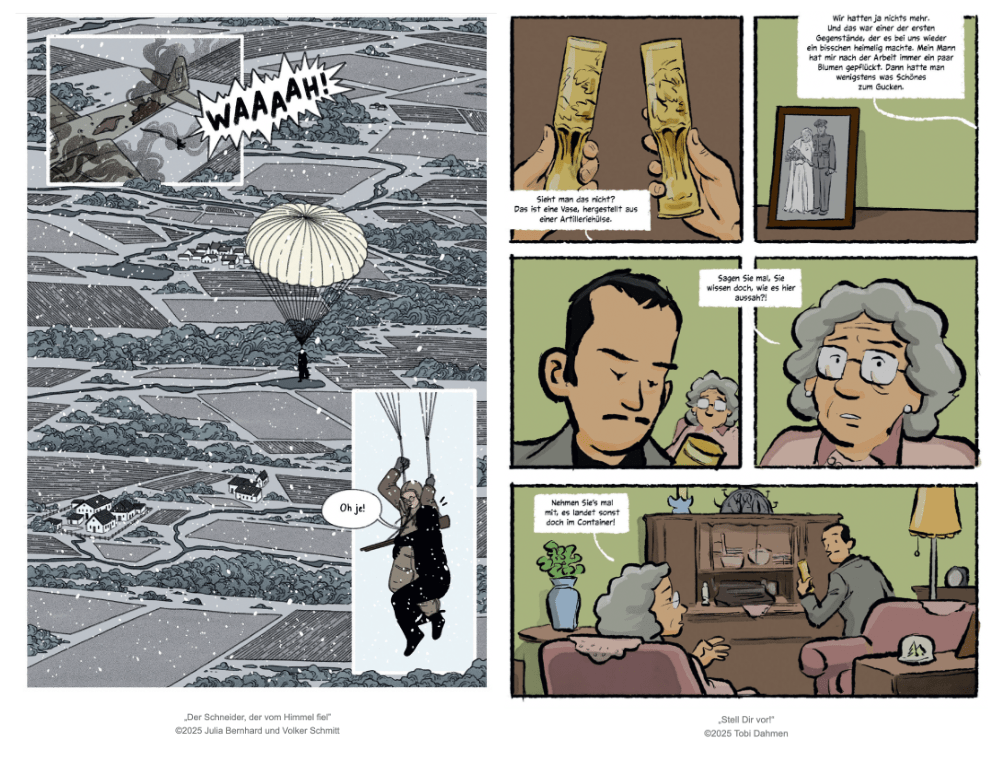
Having several contributing artists means different styles of illustrations are used within the comics. The stories and styles are nestled within each other, connected through the life of Werner Abresch which book ends the anthology. The photographs of the objects at the beginning of each story ground the comics within reality but it is very much the people who are foregrounded. The different connections between objects and protagonists are used to explore love, hunger, trauma and the difficulty of speaking to your family about your war time experiences.
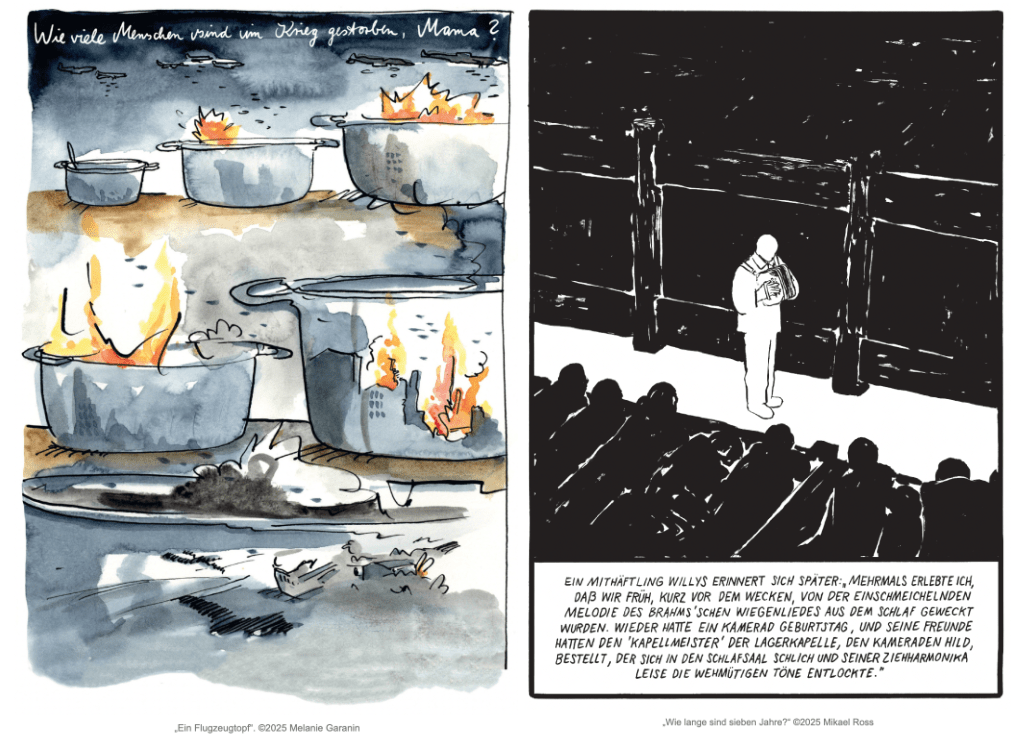
In the two biographical sections about Abresch, Dahmen tells us that Abresch is losing his memories. Dementia slowly stealing all of the stories he has collected, all of the people he has helped through connection and recognition. This really punctuates the importance of his collection and remembrance culture as there are less and less people with memories of the second world war and its aftermath. To truly remember, we are reliant on memorials, books, archives, and the many stories and objects passed down through generations.
After reading Stell Dir Vor, I couldn’t help thinking about the library collections that I have worked within, American and German, and the differences in how they remember history and war. This novel gave me a greater appreciation for the importance of personal stories within the overarching context of struggle and crisis to illustrate our collective humanity. How we choose to honour and remember those narratives is an important aspect of collection development. How is war represented within your collection?
Stell Dir Vor! has not yet been translated into English. I have asked the publishers and will update when I get a response.
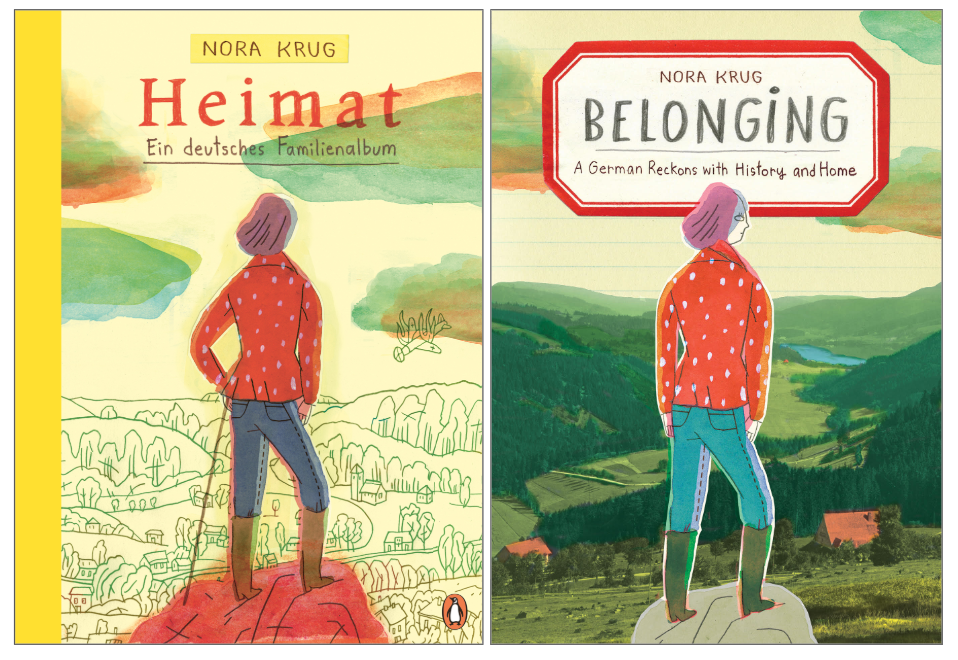
Nora Krug’s wonderful memoir Belonging / Heimat (2018) explores similar themes through autobiography and is recommended for 12 and up.
It is a very personal questioning of historical responsibility, guilt, remembrance and family in modern Germany. This is a graphic novel and the illustrations are textured, layered and multi-faceted – much like the story. Krug is fluent in both German and English so has written both versions of the book.
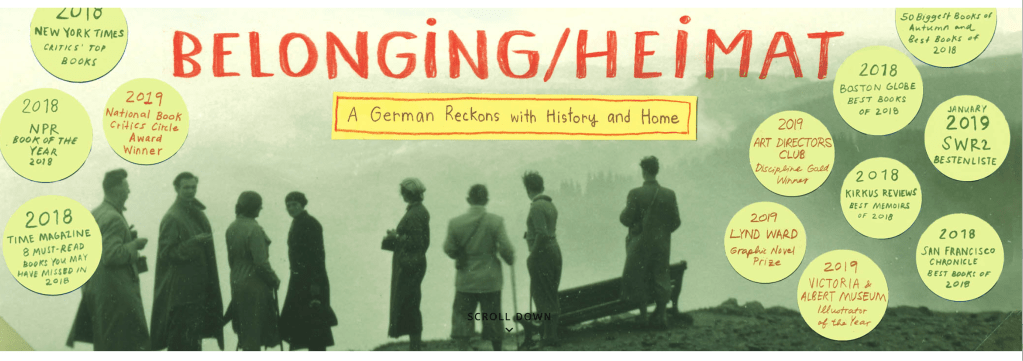
See Nora Krug’s website for detailed information about where this book has been published and how many awards it has received.
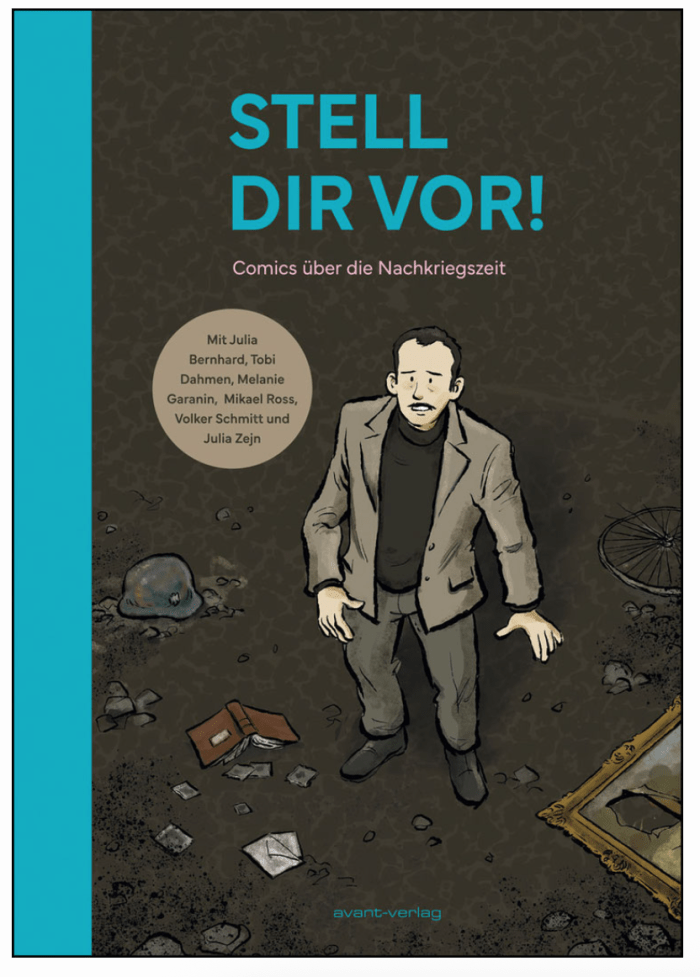
TITLE: Stell dir vor! Comics über die Nachkriegszeit
CONTRIBUTORS: Tobi Dahmen, Julia Bernhard, Melanie Garanin, Mikael Ross, Volker Schmitt, and Julia Zejn
PUBLISHER: Berlin: avant-verlag, 2025. 184 p.
ISBN: 978-3-96445-139-2
REVIEWS / AWARDS:
- Nominated in the YA category for the 2026 German youth literature prize: Arbeitskreis Jugendsliteratur
- Goethe Institute review, July 2025

Kate London is a lower school librarian working at the American School in London. Before moving to London, Kate spent seven years in Singapore as a teacher and as a librarian and was the secretary of the International School Libraries Network during this time. Before Singapore, Kate studied children’s literature in Cambridge and will happily discuss books anywhere, any time.
Disclaimer: The opinions and views expressed are the author’s and do not necessarily reflect those of GLLI.


One thought on “#IntYALitMonth: How Germany Remembers”