Today’s post comes to you from Kim Tyo-Dickerson
Alchemy and Identity: How Rebis: Born and Reborn Reimagines the European Witch Trials in Medieval Italy
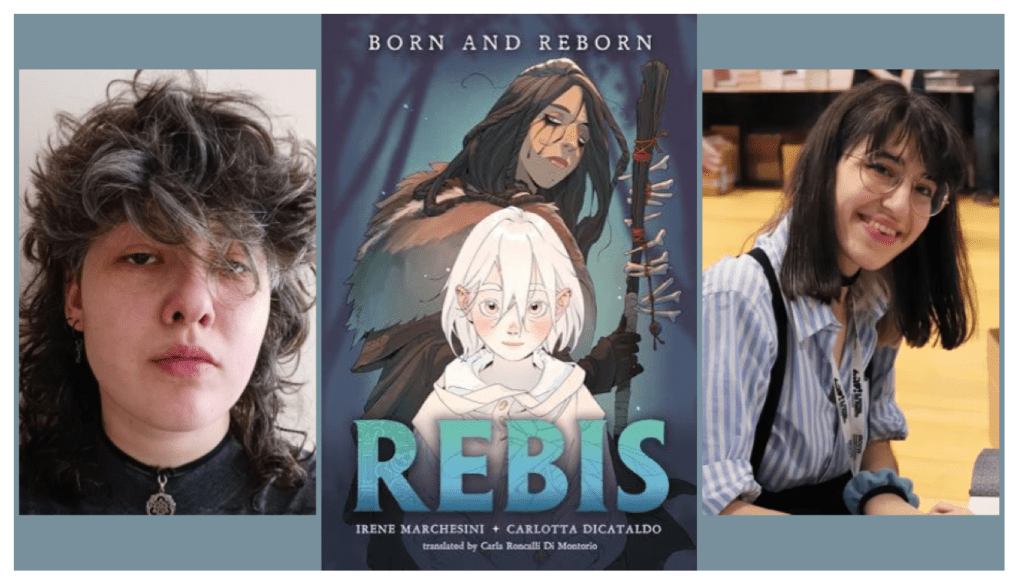
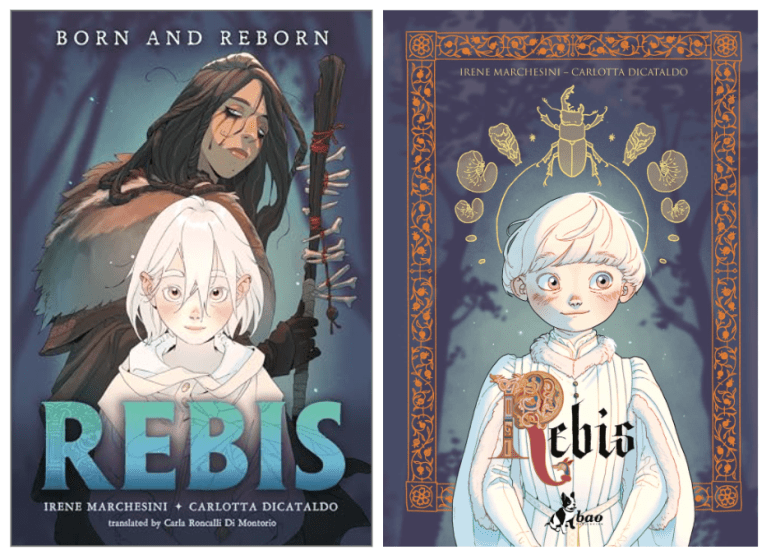
Rebis: Born and Reborn — written by Irene Marchesini & illustrated by Carlotta Dicataldo (2023), translated from Italian by Carla Roncalli Di Montorio (2025)
In a medieval Italian village, men and their parish priest are patting themselves on their backs, proud of a victory they have won for their village and the church. Included in this comradery is a man named Girolamo whose wife Annetta is about to give birth. He cannot stay long, he just wants to see justice done. A recent ruling has brought them intense satisfaction. Turning the page, the cause of their gloating is revealed with the fire and choking smoke of a public spectacle. A stunning image blazes: two young women, Viviana and Beldie who are accused of being lovers and witches, are being burned alive at the stake. A young girl looks on in horror in concert with the reader. Viviana glares at the crowd in concentrated rage, Beldie sobs in terror. You can almost smell the smoke and feel the heat of the flames of the pyre.
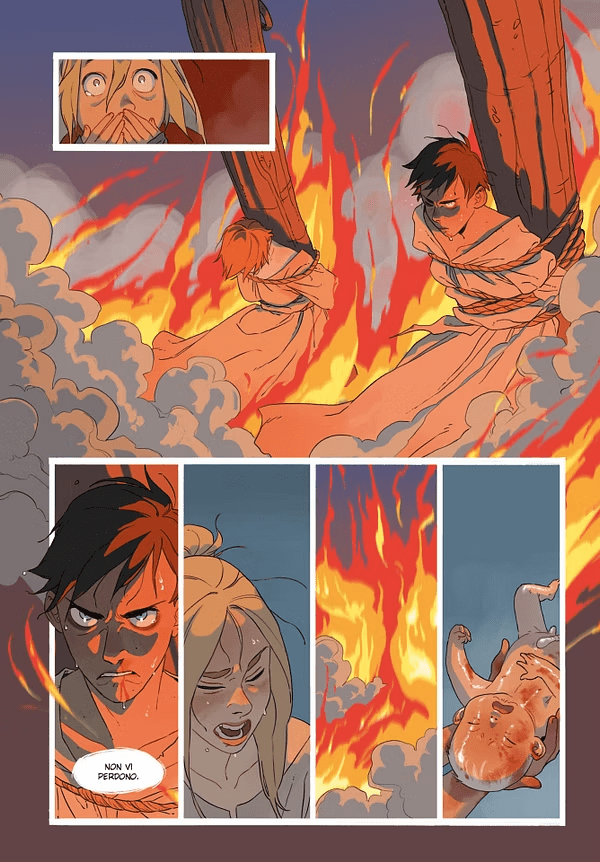
In a house close to the church where the public execution is taking place, Annetta is in labor. The burning women and the sweat-soaked mother are joined in pages and panels. Death and birth are intertwined in a cycle of pain and survival. A male child is born and there is immediate horror in his father’s eyes. The baby, named Martino, is strangely pale, from the tips of his eyelashes to his tiny feet. The father sees his difference and is repulsed, immediately demanding that his exhausted wife agree to rid themselves of the baby. But all Annetta says is, ”He stays.” You can almost smell the blood and the sweat of childbirth in the linens of the bed.
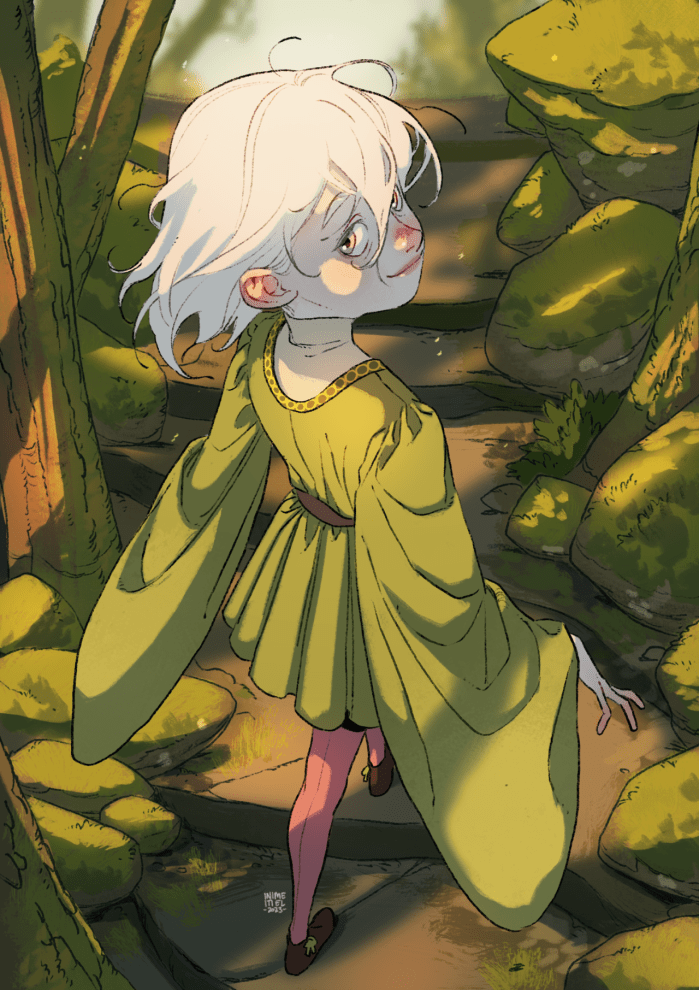
What follows is the path of a conflicted and confused childhood. Martino is raised with love by his mother and his sisters in their bustling household while being barely tolerated by his father and brother. He grows up knowing that he is different and is ashamed of his skin and hair that causes so much anger. His grief is hidden and unrelenting.
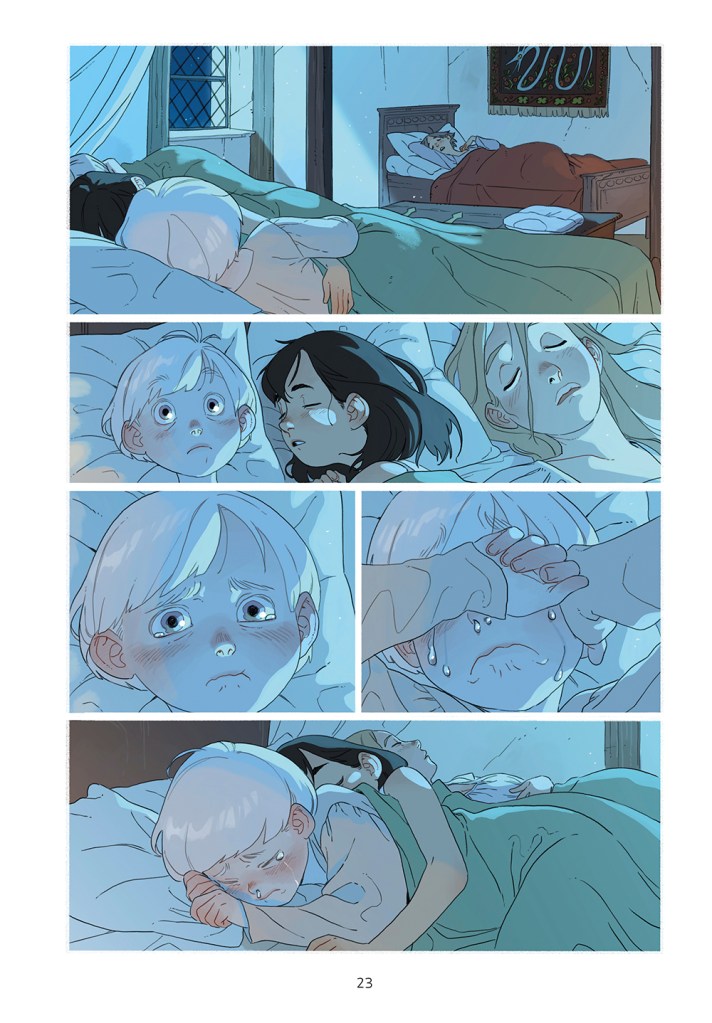
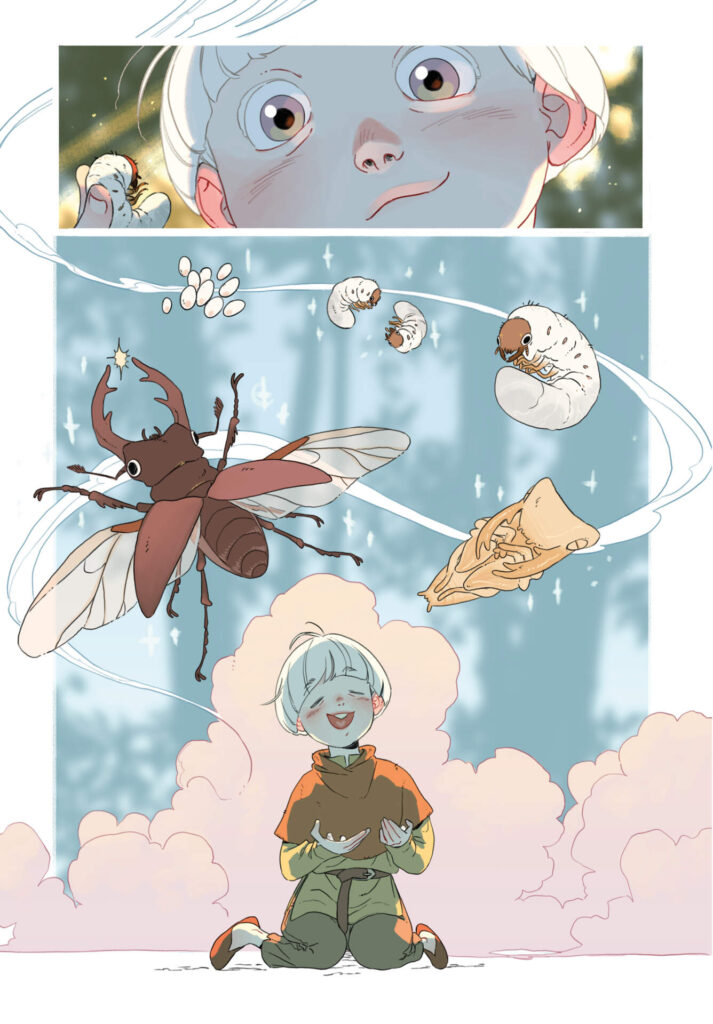
He escapes the hostile stares of neighbors and the cruelty of his father by exploring the woods and finding comfort in the white skin of grubs that is so much like his own. Martino inhabits a confusing world where he both belongs and yet is ostracized. Nature is the only place where he finds a center for his being, a place of comfort and solace from the villagers’ judgement. He considers insects his friends, and is inspired by and longs for transformation like the life cycle of his grubs.
But the village ends up finding him. Attacked by his brother’s friends who crush the grubs Martino was caring for, Martino races deeper and deeper into the undergrowth and abruptly finds himself staring at a small cottage hidden deep within the forest. There he discovers a solitary woman who exists on the very edge of the world he knows best and fears most. At first he is terrified by her wild appearance.
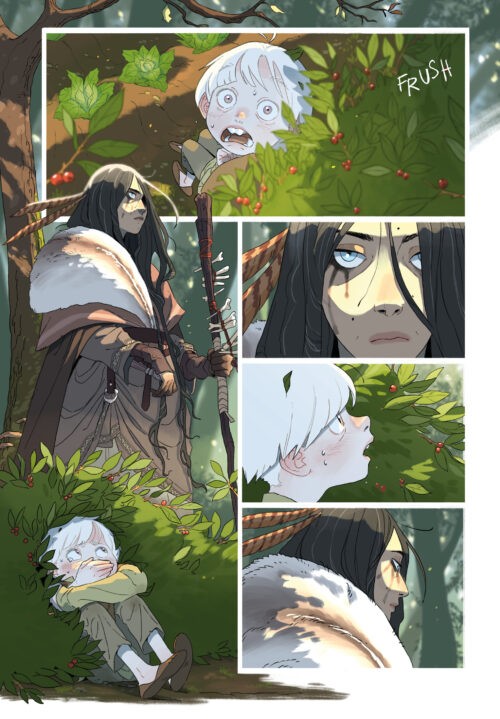
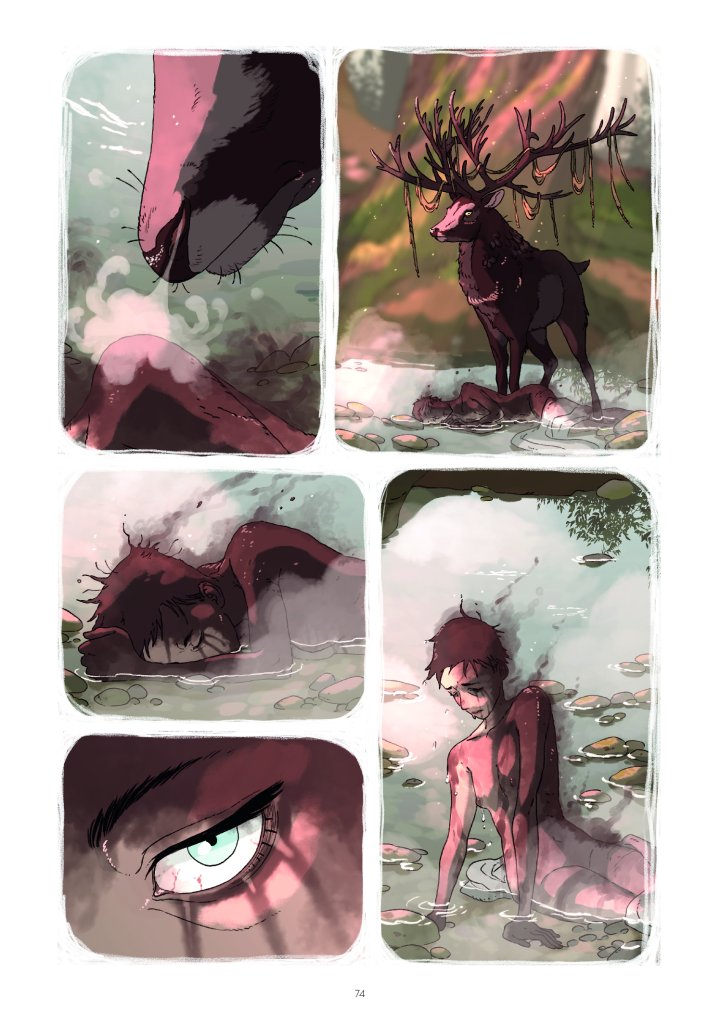
But after seeing her care for one of his grubs, he begins visiting her despite her attempts to send him away. She begrudgingly begins to teach the gentle child the ways of plants and animals. He tends his grubs and the woman accepts him as he is. To Martino, she is a stranger, but to the reader, she is a miracle. He sees a woman of scars and quiet strength, unaware that she is the same Viviana who was cast into the flames on the day of his birth. While Martino sees only a kindred soul who does not flinch at his difference, we see the impossible: a woman who suffered death on the pyre and emerged not as ash, but as something forged and permanent. She carries the transformative power of the forest, the breath of the stag, the scent of ancient herbs, and a resilience that suggests her survival wasn’t a stroke of luck, but an alchemical rebirth.
One night at home Martino overhears a conversation where his father has arranged for Martino to be sent far away. Accused of bringing a cursed child into the village, the reason that someone’s cow no longer produces milk and why a fox kills all their chickens, Martino’s father is convinced that getting rid of the child once and for all will bring order back to the village and his reputation. Terrified, Martino runs away to the only place and adult who has truly accepted him for who he is. With Viviana, Martino finds shelter and self-awareness on the fringes of society, a refuge with those who live in the shadows of the church and people that have always rejected them. In Viviana’s care, he must learn to embrace his own light, even if the world would prefer to see him in ashes, too.
“Lush, evocative illustrations draw readers effortlessly into this world of pain, retribution, magic, kinship, and love. This complex story invites and rewards repeated readings, with new treasures to discover each time within both dramatic text and cinematic artwork” (Kirkus Starred Review)
The visual world of Rebis immediately pulls you into a medieval Italian landscape with both beauty and terror at its core. Being different is deadly no matter how picturesque the setting. The almost Disneyfied homes for both Martino and Viviana are deceptively cosy, with the violent energy of the Grimm brothers’ fairy tales never more than a few pages away. Carlotta Dicataldo’s rich, saturated palette and careful characterizations, from the wide-eyed innocence of Martino to the tear-stained otherworldly marks on Viviana’s face, establish the story’s emotional stakes. As the story unfolds, the art mirrors Martino’s internal shift from a boy shunned for being different, to a young person beginning to understand the life or death choices they need to make in order to exist. Here, Martino is confronted with the choice of reintegration into his family or himself, with a cold magical realm in blues and grays revealing Martino’s new name, Rebis, and setting him on a heroic, transgender journey to his new life with Viviana.
The alchemical concept of the Rebis, a combination of male and female into one perfect being, reveals Martino’s transition in both literal and spiritual terms; he chooses the name Rebis and finds joy in wearing gowns, a process of self-actualization that Marchesini frames not as a tragedy, but as a sacred rebirth. This alchemical lens transforms Rebis’ life into a fully expressed, emboldened, reborn identity on the fringes of society, finding community with others in Viviana’s sisterhood who are too complex for the rigid, binary world of the village.
The emotional weight of the story is further elevated by Carla Roncalli Di Montorio’s translation from the original Italian, and she maintains a lyrical, almost folkloric quality throughout. This tone balances the harsh realities of medieval prejudice, vividly captured when Rebis risks attending his sister Maria’s wedding only to be threatened with the stake, deftly balancing dangerous threats with a persistent sense of warmth and kinship. Here Viviana and Rebis’ stories come full circle with the stake in the public square looming, but Rebis will not be sacrificed as Viviana was. She will make sure of that.
As a “complex story that invites and rewards repeated readings,” Rebis stands as a powerful testament to the courage required to define oneself and your family. It is a haunting yet hopeful exploration of what happens when the outcasts of society refuse to be extinguished, proving that while the world may prefer them in ashes, they are ultimately forged into something far more permanent and beautiful.
BOOK DETAILS
Title: Rebis: Born and Reborn
Author: Irene Marchesini (Instagram)
Illustrator: Carlotta Dicataldo (Instagram)
Translator: Carla Roncalli Di Montorio
Publisher: Macmillan First Second, 2025. Originally published in 2023 by Bao Publishing, Italy. Read a sample of the original text here.
ISBN: 9781250359070
Interest level: Ages 13 – Adult
Reviews
Kirkus Reviews, Starred review, Apr. 1, 2025
No Flying, No Tights review – Dec. 18, 2024
Quotes from a German review in Taggespiegel, Oct. 13, 2024
“In delicate drawings that subtly blend European comic influences with elements of American and Japanese animation, artist Carlotta Dicataldo creates a fantastical world full of magic and humanity, where the lavish depictions of nature are particularly impressive. She is also a masterful portrait artist; the faces of her characters convey a wide range of emotions.”
“Irene Marchesini’s entertainingly constructed scenario reads, on the one hand, like a classic coming-of-age novel, tracing the development of the young protagonist against all odds. However, since it also deals with the struggle against traditional gender roles and fluid identities, this book is simultaneously a very contemporary contribution to the current gender debate and a plea for openness and tolerance. (lvt)”
New York Public Library list of Best Books for Teens, 2025
Interviews
8 1/2 minute interview with the author & illustrator:
Book trailer
40-second book trailer in French:
You can buy a copy of Rebis here or search for it in your local library. (Book purchases made via our affiliate link may earn GLLI a small commission.)

Kim Tyo-Dickerson is the Head of Libraries at the International School of Amsterdam and has 25 years of experience across North America, Europe, and Africa. An advocate for global literature and social justice, her work is centered on the freedom to read and fostering belonging. Kim believes stories are essential tools for making sense of our world. She holds an MLIS from Syracuse University and an MA in English from Miami University in Oxford, Ohio.
Disclaimer: The opinions and views expressed are the author’s and do not necessarily reflect those of GLLI.
 Global Literature in Libraries Initiative
Such an evocative and powerful review! You’ve captured the story’s intensity so well that I feel like I’ve already started the journey. I can’t wait to read it!
LikeLiked by 1 person