Giovanni (Gianni) Rodari’s importance to Italian children’s literature is hard to overstate, though English translations of his books have been scarce until the last few years. Born in 1920, he was a young adult in Mussolini’s Italy, and in response, became a lifelong Marxist and anti-fascist. His politics are often visible under the surface of his stories (Joan Acocella argues that some of his stories are “frank agitprop”) but he was a masterful craftsman with an extraordinary imagination. His work should be enjoyed and understood as more than mere political allegory. Author of more than 30 books in Italian (and winner of the Hans Christian Andersen Writing Award in 1970), seven of his books are now available in recent English translations.
Since 2020, Enchanted Lion has published six new translations of Rodari’s work, as well as one updated edition: Telephone Tales (2020, illustrated by Valerio Vidali and translated by Antony Shugaar); Telling Stories Wrong (2022, illustrated by Beatrice Alemagna and translated by Antony Shugaar); A Daydreamy Child Takes a Walk (2023, illustrated by Beatrice Alemagna and translated by Antony Shugaar); The Book of Whys (2023, illustrated by JooHee Yoon and translated by Antony Shugaar); Lamberto, Lamberto, Lamberto (2025, illustrated by Roman Muradov and translated by Antony Shugaar); The Grammar of Fantasy (new edition in 2025, illustrated by Matthew Forsythe and with a revised translation by Jack Zipes); and The Adventures of Cipollino (2025, illustrated by Dasha Tolstikova and translated by Antony Shugaar).
In 2007, Jack Zipes (known for his superb translation of The Original Folk and Fairy Tales of the Brothers Grimm) delivered a speech to the Children’s Literature Association about his discovery of and enduring interest in Rodari – it was excerpted here on the GLLI blog last year.
With all of these new editions and translations, there have been a number of excellent recent profiles of Rodari. This 2021 Jacobin piece by Giorgio Chiappa provides a thorough overview of just how his politics influenced his work. Joan Acocella wrote about Rodari for The New Yorker in 2020 (paywalled), where she explores his lifelong interest in children’s education. (He started his career as a teacher, and often said his storytelling initially grew out of a need to keep his students calm and interested.) Mac Barnett wrote about Rodari’s Grammar of Fantasy for The New York Times in 2025, describing it “less a manual on how to write for kids than a treatise on why we must respect them as readers.” This Publisher’s Weekly article from 2022 is also worth a read, for a closer look at the illustrators and translators who have brought these new editions to life!
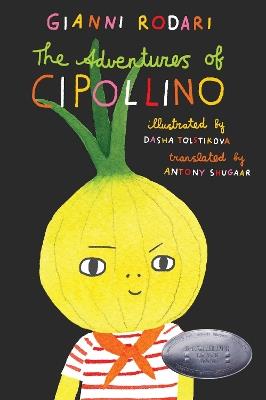
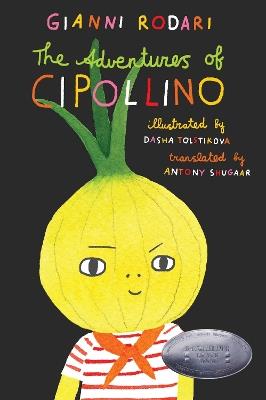
And now for the book at hand! Published at the very end of 2025, The Adventures of Cipollino is perhaps a slightly funny choice for the first post of YA month on GLLI. It is a wonderful book – one that would make an excellent addition to any school library – but it is a bit difficult to categorize. Dasha Tolstikova’s splendid illustrations may make it seem like a book for younger readers, but the themes – and our young, vegetal hero – are complex and sometimes quite mature, and could be dissected and enjoyed by readers up through high school and beyond.
Cipollino (“Little Onion”) is young and alone in the world. His father (Cipollone or “Big Onion”) was wrongfully arrested, and Cipollino sets out to “study” scoundrels and avenge his father. His adventures lead him to encounters with the good (the cobbler, Master Raisin), the slippery (the lawyer, Squire Peapod), the unfortunate (Squire Zucchini, whose humble house is seized), the greedy (the ruler, Prince Lemon), and the outright bad (Cavalier Tomato, who loves nothing more than imprisoning the poor and protecting the rich).
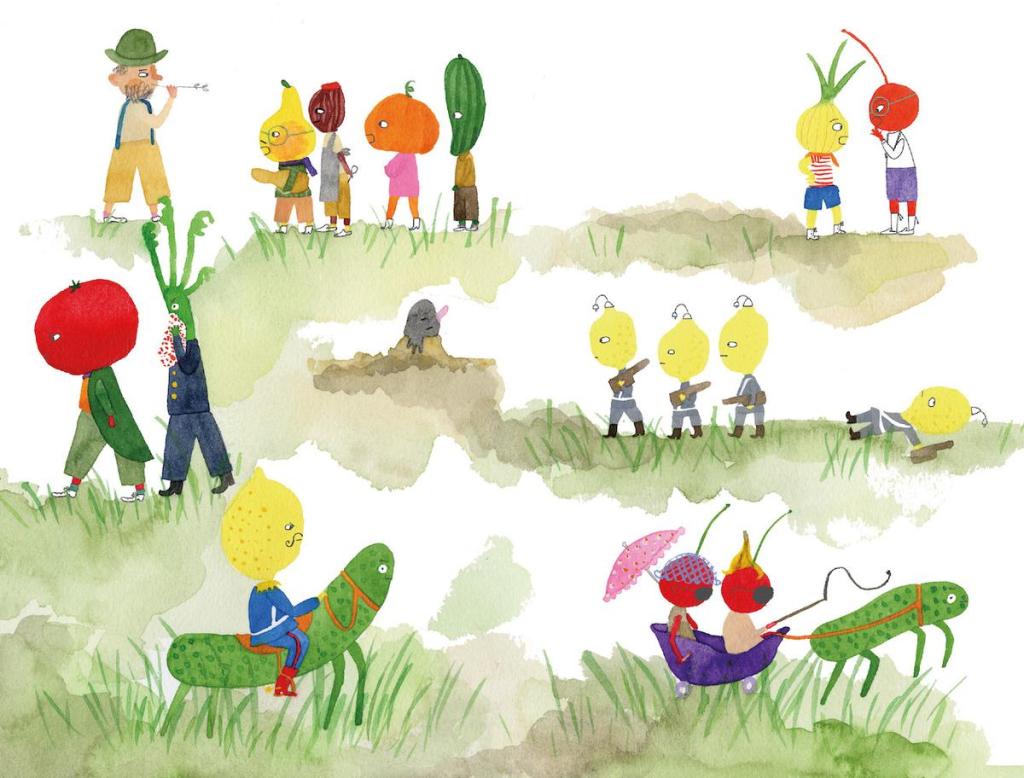
Rodari’s sympathies are clear – as Cipollone explains early on, under the imperious Prince Lemon, “people who rob and kill have been invited to join his court, and only good citizens are sent to prison.” But The Adventures of Cipollino is not Animal Farm, and Rodari put his characters in a variety of absurd and ambiguous situations that allow the story to transcend its political message. There is Squire Blueberry, who deals with roving thieves by making a sign inviting them in to see that he has nothing worth stealing (and often befriending them in the process) , and young Viscount Maraschino, who removes his glasses so that he cannot see (and therefore follow) the strict rules put in place by his tutor.
In the end, the rich and powerful are vanquished or reformed, their castle is converted to a playhouse to be enjoyed by all, and Cipollone is freed. But it is Rodari’s whimsy and playfulness that make the book such a joy.
You can buy a copy of The Adventures of Cipollino here or find it in a library here. (Book purchases made via our affiliate link may earn GLLI a small commission.)

Kim Beeman is currently a teacher at Marymount International School in Rome. Before moving to Rome, Kim spent over a decade in Asia, working as a librarian at Shrewsbury International School in Bangkok and Tanglin Trust School in Singapore. She also co-founded the International School Librarians in Europe conference, and is a member of the advisory board for the Librarians Knowledge Sharing Workshop. Before working in school libraries, Kim worked as a cookbook librarian at The French Culinary Institute in New York City for many years, where she completed the professional culinary program and was certified as a sommelier through the Court of Master Sommeliers. [LinkedIn]
Disclaimer: The opinions and views expressed are the author’s and do not necessarily reflect those of GLLI.


What a lovely post. I love Gianni Rodari’s stories and also talked about them on my blog, though my favourite remains La Freccia Azzurra and not Cipollino. I am not from Italy, but every child in the Soviet Union knew the stories like the back of their hand.
LikeLike