Today’s post comes to you from Laura Simeon:
This marks the 21st year that the United States Board on Books for Young People (USBBY), a division of the International Board on Books for Young People, has selected some of the very best titles from around the world for children and teens. Our dedicated committee of nine received hundreds of submissions from publishers large and small, all of which were released in the U.S. in 2025 and previously or simultaneously published in another country.
From these, we chose 41 books representing 24 countries and originally published in 13 languages: Chinese, Dutch, English, French, German, Italian, Japanese, Korean, Lithuanian, Norwegian, Russian, Spanish, and Swedish.
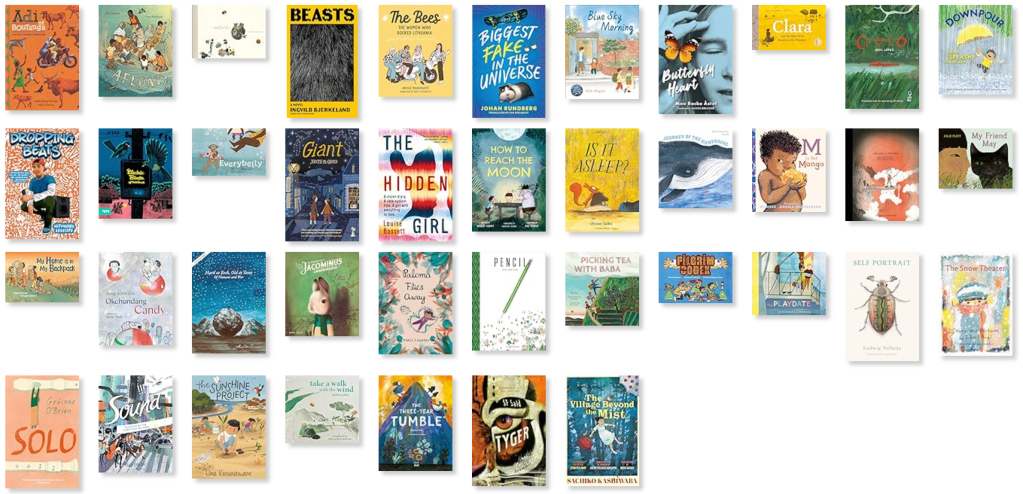
In a world filled with an abundance of book awards, many very specific in nature, what makes USBBY’s Outstanding International Books list stand apart is its sheer scope. The collection is broadly inclusive in terms of age of audience, cultures of origin, and genres, formats, and themes.
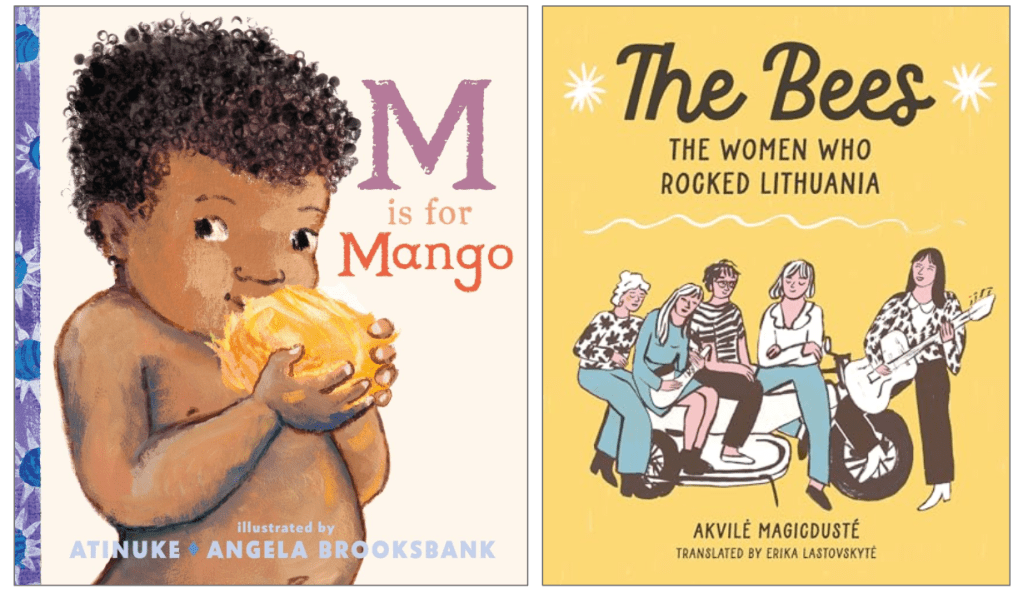
You’ll find M Is for Mango, written by Atinuke and illustrated by Angela Brooksbank, a sweet picture book about a Nigerian baby for the very smallest of readers, alongside The Bees: The Women Who Rocked Lithuania, energetic adult/YA crossover graphic nonfiction about a boundary-breaking late-20th-century rock band, written and illustrated by Akvilė Magicdusté and translated from Lithuanian by Erika Lastovskytė.
Our list is for the curious: readers who are open to going on exciting journeys through the pages of a book, educators and librarians who want to introduce young people to the world’s riches, and parents who are consciously striving to make sure their children grow up with the benefits of a global perspective.
The list also serves as a wake-up call to the publishing industry by highlighting gaps. We strove as a committee to include as wide an age and geographical range of titles as possible, while also considering literary and artistic merit—but we were of course constrained by what was available. YA was scarce compared to picture books. Certain areas of the world—Northern and Western Europe and East Asia—dominated the submissions.
We received relatively few books about marginalized communities. Even though such stories may require a degree of culturally specific contextual awareness that might make them seem harder to export, they address questions—and pose possible solutions—to issues of belonging that are universal to the human condition, making them uniquely valuable.
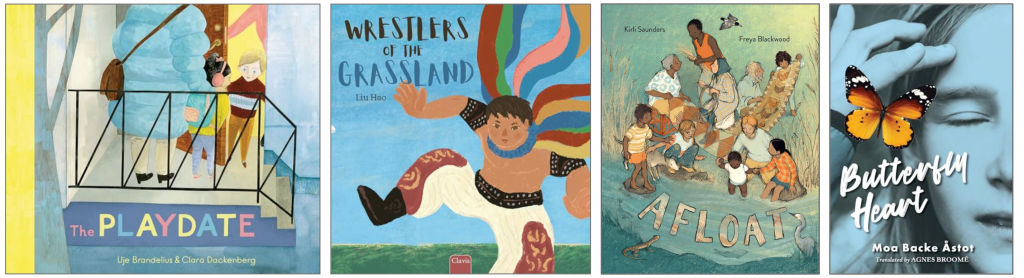
We did receive some spectacular works in this vein, however, including picture books like The Playdate by Uje Brandelius, translated from Swedish by Nichola Smalley and illustrated by Clara Dackenberg (which explores socioeconomic differences); Wrestlers of the Grassland, written and illustrated by Liu Hao and translated from Chinese by Clavis Publishing (about a boy from Inner Mongolia), and Afloat by Kirli Saunders (Gunai) and illustrated by Freya Blackwood (a love letter to Indigenous Australians). We also got novels such as Butterfly Heart by Moa Backe Åstot (Sámi), translated from Swedish by Agnes Broomé, which centers on a young teen who’s exploring her Sámi heritage.
While there are many benefits to highly focused book awards and lists, an all-encompassing one like Outstanding International Books offers another advantage: Taken together, the books are in conversation with one another, allowing readers to notice commonalities that transcend cultures as well as characteristics, such as in tone or artistic style, that distinguish works from particular regions and elements and contrast with what they’re more familiar with from domestic titles.
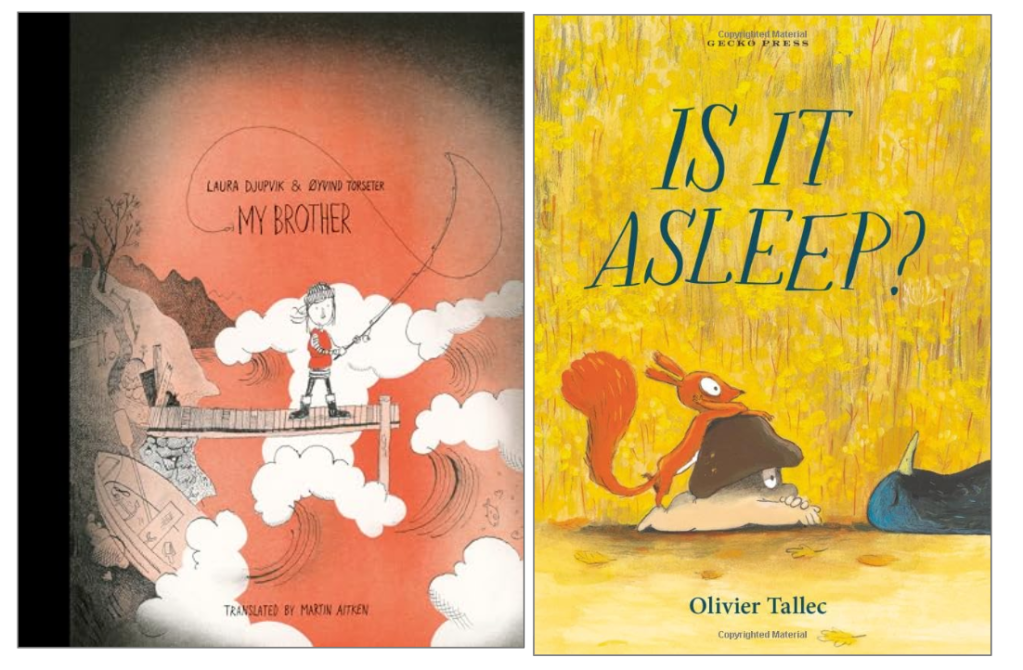
Two European picture books—Laura Djupvik’s My Brother, translated from Norwegian by Martin Aitken and illustrated by Øyvind Torseter, and Olivier Tallec’s Is It Asleep?, translated from French by Antony Shugaar—approach the universal topic of death in ways that feel qualitatively different from typical U.S. titles on the subject. Markedly, both avoid offering direct advice or platitudes, instead presenting readers with slightly surreal scenarios and concise yet nuanced journeys of emotional growth.
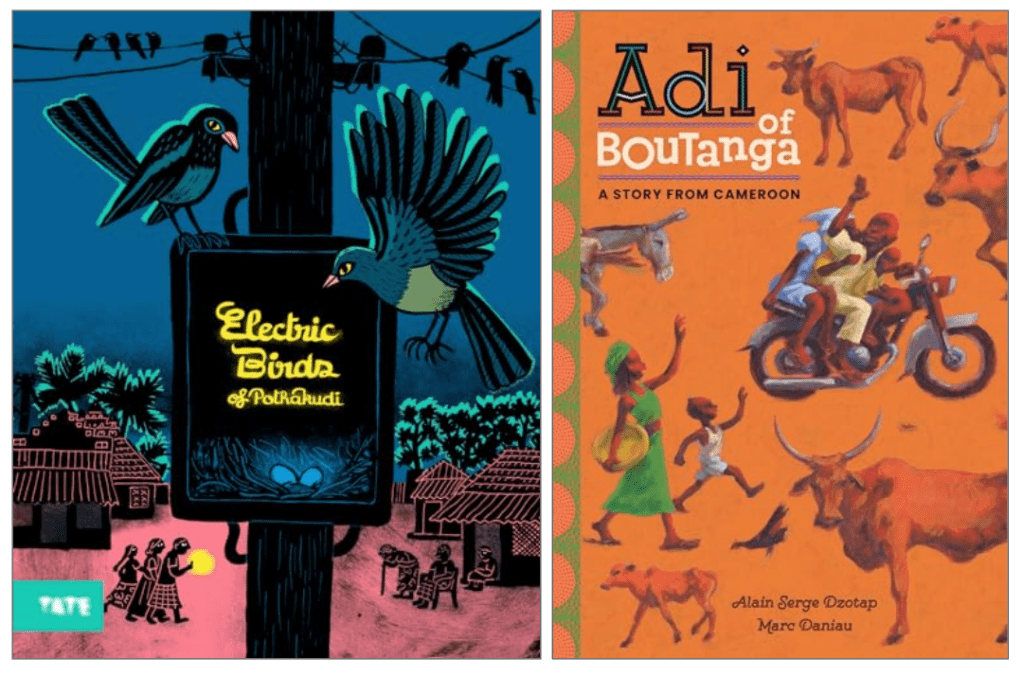
A couple of books from France present narratives that eschew both white savior narratives and perspectives that flatten the complexities of people’s lives in the Global South. Electric Birds of Pothakudi is a picture book for older elementary readers by Karthika Naïr, set in her native India, with vibrant illustrations by Joëlle Jolivet. Telling a story within a story and inspired by real events in Tamil Nadu, Naïr spins an inspiring tale of human and animal coexistence. Adi of Boutanga: A Story from Cameroon, written and translated by Alain Serge Dzotap and illustrated by Marc Daniau, offers middle schoolers a fascinating, nuanced exploration—based on the life of a real young woman—of parents who break with tradition and support their daughter in her desire to attend school.
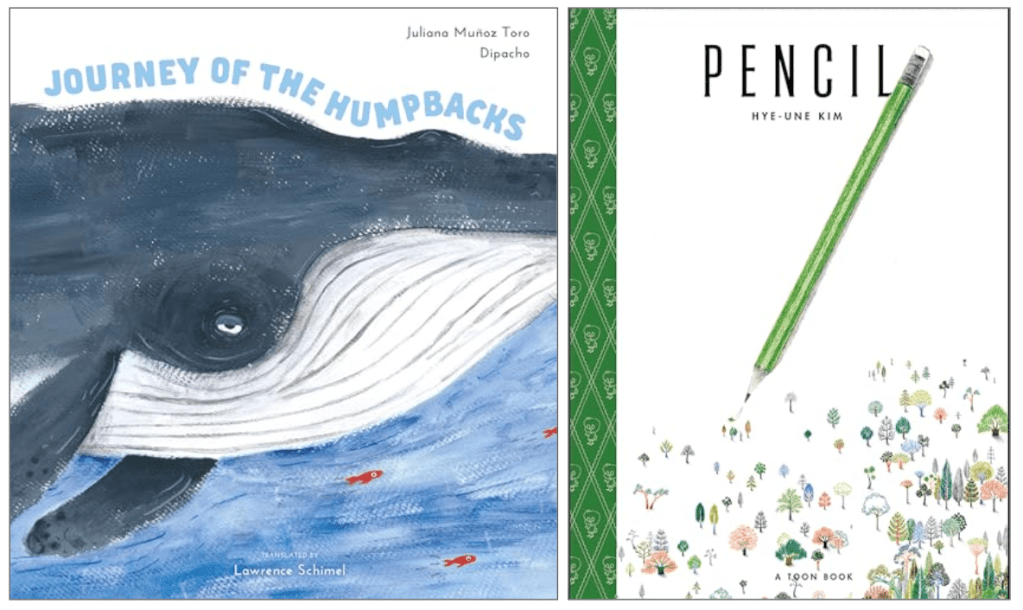
We create new readers and feed the souls of bookworms by presenting them with appealing, engaging stories they don’t want to put down—and that’s precisely what the Outstanding International Books list offers in spades. Readers won’t be able to resist Juliana Muñoz Toro’s Journey of the Humpbacks, a nonfiction picture book translated from Spanish by Lawrence Schimel, which features whimsical illustrations by Dipacho; it’s an absorbing, eye-opening account of these magnificent whales. Or Hye-Eun Kim’s Pencil, an elegant wordless picture book from South Korea that traces the evolution from tree to pencil wielded by a young artist—showing young readers that they can create similar wonders through their own imaginations.
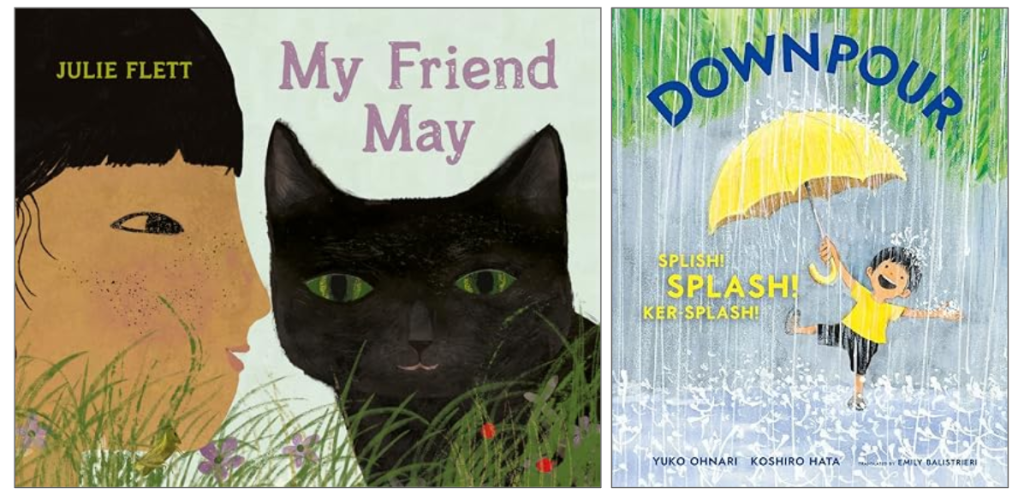
In the delightful and charming Canadian picture book My Friend May by Julie Flett (Cree-Métis), which seamlessly incorporates Plains Cree words and has rich and informative backmatter, a little girl finds her missing cat with help from her beloved nitôsis, or aunt. Downpour: Splish! Splash! Ker-Splash! by Yuko Ohnari, translated from Japanese by Emily Balistrieri, and illustrated by Koshiro Hata, is a visual and sensory delight that celebrates the joys of playing in the rain—and introduces readers to the rich onomatopoeia used in Japanese.
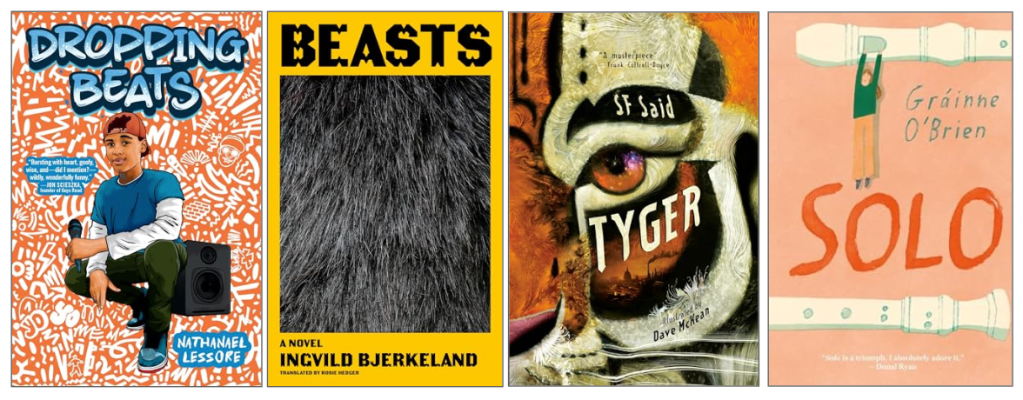
Middle schoolers will revel in novels that make them cackle with laughter (like Dropping Beats by Nathanael Lessore, from the UK), shiver in terror (like Beasts by Ingvild Bjerkeland, translated from Norwegian by Rosie Hedger), or lose themselves in fantasy worlds (like Tyger by SF Said, illustrated by Dave McKean, from the UK). Older teens will resonate with the deeply felt emotions of the protagonist of Gráinne O’Brien’s Solo, a jewel of a verse novel from Ireland centering on a girl who’s navigating a breakup, her father’s illness, and her struggles with her first love: music.
Go browse the full list—and the previous 20! Great books transcend borders.

Laura Reiko Simeon is a Young Readers’ Editor at Kirkus Reviews, and a former librarian and diversity coordinator at a K-8 school. She has served on book list and award committees including the Coretta Scott King–Virginia Hamilton Award for Lifetime Achievement, the Global Literature in Libraries Initiative Translated YA Book Prize, Rise: A Feminist Book Project for 0-18, and USBBY’s Outstanding International Books. Thanks to a grant from the Swedish Institute, Laura was able to do research in Stockholm on diversity in contemporary Swedish picture books. She’s a former co-chair of the U.S. National Committee of the UWCs, a secondary school program that seeks to make “education a force to unite people, nations and cultures for peace and a sustainable future.”
 Global Literature in Libraries Initiative
Laura, thank you for this wonderful personal tour of the latest Outstanding International Books list!!
LikeLike