
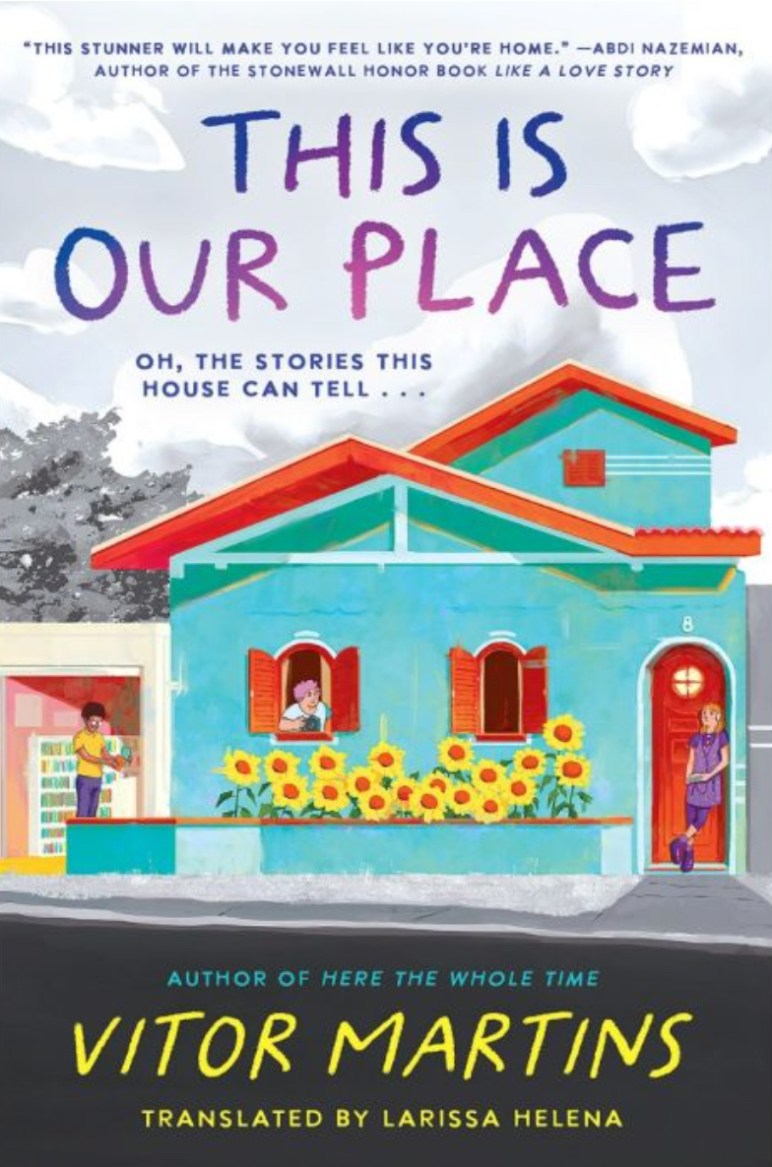
Vitor Martins‘ tender, funny, and honest YA novels are no stranger to Global Literatures in Libraries Initiative, nor to its Translated YA Book Prize. He returns to us with his newest novel and the 2023 Translated YA Book Prize winner, This Is Our Place. Translated by Larissa Helena (who translated Martins’ previous prize winning book), this coming-of-age novel is comfort and affirmation in book form. At the risk of being too informal, let me tell you that I LOVED THIS BOOK. I’ve already recommended it to various friends, and I hope you read it as well.
This Is Our Place uses a particular conceit to tell the stories of three queer teens living in a small town in Brazil: their stories are narrated by the house in which they all live, at one time or another. Set alternately in the years 2000, 2010, and 2020, the house at 8 Sunflower Street in the small of town of Lagao Pequena cares deeply for all its occupants, and is unequivocally in their corner as they navigate first loves, family shifts, and global changes.
Ana is seventeen years old and rings in the new millennium at home with her father Celso, a doting if somewhat scatterbrained computer repairman. Ana loves vampire novels, listening to music, and her girlfriend Letícia. She is excited for what the year 2000 may hold for them as a couple, but is dismayed (to say the least) to learn that Celso has secured a prestigious job and will soon be moving the both of them to Rio de Janeiro, hundreds and hundreds of miles away from her childhood home and her first love.
In January 2010, Greg is unceremoniously packed off to Lagao Pequena to spend a few weeks with his aunt Catarina, whom he barely knows. His affluent parents are going through a divorce, which they do not discuss with their teenage son—even though it is obvious to everyone. Catarina is perfectly content living alone with her beloved dog, Keanu Reeves (Catarina loves Keanu Reeves the actor, hence the canine homage) and is not enthused about having a teenage boy underfoot. At least he can help out at her video store, which she runs out of the garage of the house on 8 Sunflower Street. Yes, in the year 2010, Catarina runs a video store, and in age of ever increasing streaming, business is lagging.
In the Spring of 2020, as the COVID-19 pandemic arrives in Brazil, budding photographer Beto finds that his dreams to leave Lagao Pequena forever are put on hold. His older sister Lara arrives from São Paulo to join him and their mother Helena at 8 Sunflower Street, “just until this whole thing is over.” While Beto enjoys reconnecting with his sister, he cannot help but feel frustrated that life is seemingly passing him by.
The three accounts are actually interconnected, but I will refrain from spoilers. The connections come to light in small, intimate revelations that make this book that much sweeter. It is at turns both moving and laugh out loud funny. In a time of ever-increasing efforts in the United States to censor books with LGBTQIA+ content, the power of This Is Our Place lies in how it depicts queer teens’ lives as perfectly ordinary. Ana, Greg, and Beto are also supported by the adults in their lives; Celso accepts Ana when she comes out to him, for example, even if it happens in a rather unexpected way (you have to read the book to find out!).
Because of the above mentioned censorship, I feel it incumbent upon me to mention that there is nothing gratuitous nor pornographic in this book featuring LGBTQIA+ teens. Yes, there is kissing between queer teens, but it is perfectly tame and sweet. Queer people merely kissing is not pornographic. There is no cursing, no violence, no drug use, and the only alcohol use is the one glass of wine that Ana’s father Celso drinks. In fact, every teen protagonist in this book is what many would consider “a good kid.” Ana, Greg, and Beto are respectful toward their adult caregivers, pitch in around the house (or video store), and in the cases of the two young men, are even budding entrepreneurs.
There is a sleepover between Ana and her girlfriend, which some folks may object to. However, teenage girls of all backgrounds have sleepovers. It is perfectly ordinary. After Ana comes out to her father, he does not recriminate her for having had Letícia—who he thought was merely a friend—over for the night. To take a conservative tack on this, I would say that this book is appropriate for teens beginning at age 14. Queer teens of all ages deserve books in which they see themselves. Readers of all backgrounds will find something to enjoy in This Is Our Place, even if it is a three-legged dog (!) named Keanu Reeves.
Title: This Is Our Place
Written by Vitor Martins
Translated from Portuguese by Larissa Helena
PUSH, an imprint of Scholastic, Inc., 2022
Originally published as Se a Casa 8 Falasse 2021, Globo Alt
Awards: Global Literature in Libraries Initiative Translated Young Adult Book Prize Winner, 2023
ISBN: 978-1-338-81864-2
You can purchase this book here.*
Reviews: Kirkus, Publishers Weekly, Bulletin of the Center for Children’s Books
*Book purchases made via our affiliate link may earn GLLI a small commission at no cost to you.
Klem-Marí Cajigas has been with Nashville Public Library since 2012, after more than a decade of academic training in Religious Studies and Ministry. As the Family Literacy Coordinator for Bringing Books to Life!, Nashville Public Library’s award-winning early literacy outreach program, she delivers family literacy workshops to a diverse range of local communities. In recognition of her work, she was named a 2021 Library Journal “Mover and Shaker.” Born in Puerto Rico, Klem-Marí is bilingual, bicultural, and proudly Boricua.
 Global Literature in Libraries Initiative