Today’s post comes to you from Sabrina Rossi
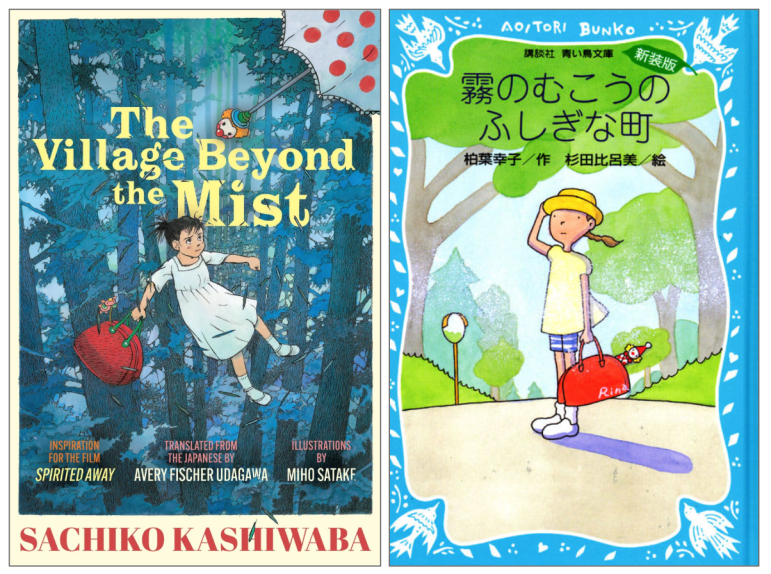
The Village Beyond the Mist – written by Sachiko Kashiwaba (1975) and translated from Japanese by Avery Fischer Udagawa (2025) – GLLI review by Nanette McGuinness on Mar 19, 2025 – Shortlisted 2026 GLLI Translated Young Adult Book Prize
The Village Beyond the Mist, (霧のむこうのふしぎな町 – Kirino mukōno fushigina machi) first published in Japanese in 1975, is Sachiko Kashiwaba’s debut novel and the source of inspiration for Hayao Miyazaki‘s renowned anime Spirited Away (2001).
This delightful chapter book centres on the adventures of young Lina, a sixth grader who lives in Shizuoka. Following her father’s decision, she travels by train on her own to Sendai, about 550 km away, to spend her summer holidays in a remote village with someone she has never met before.
As soon as Lina steps off the train, her school break becomes a journey into the mysterious and magical. Carrying a red bag and a white umbrella with red polka dots and a handle shaped as a clown’s face, she starts climbing a mountain, and crossing a forest that becomes thicker and thicker, in a mist that slowly hides the path. When her umbrella is blown away by a sudden gust of wind, Lina chases it until she finds herself in a clearing where the mist lifts showing a cobblestone street with three cottages on each side.
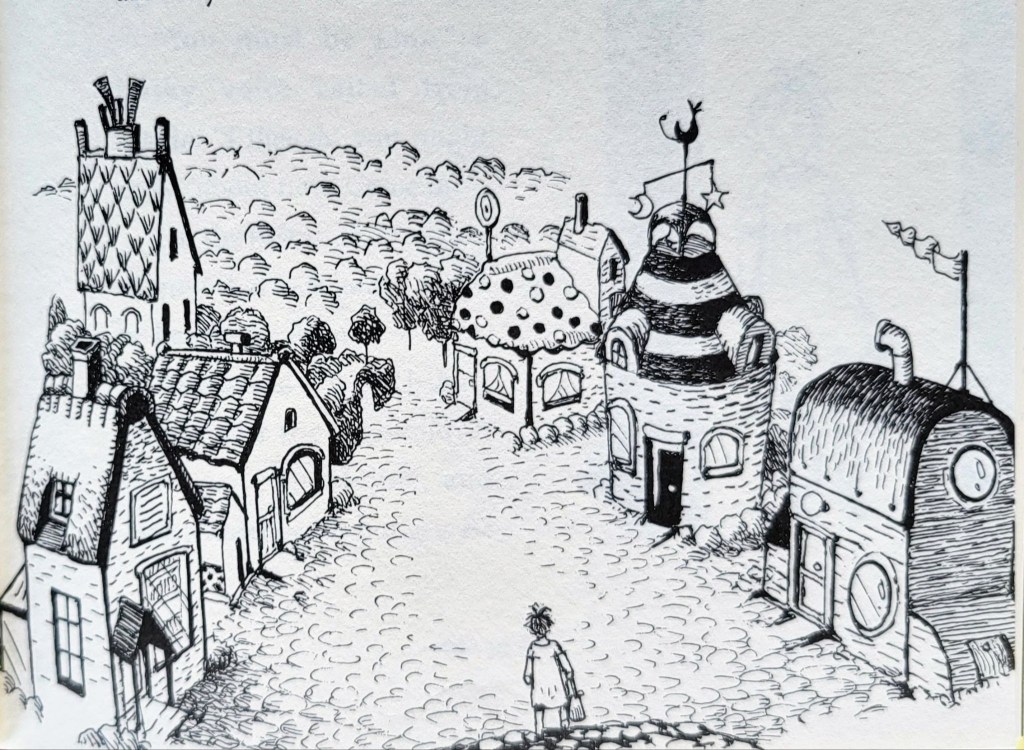
Misty Valley – illustration by Miho Satake
Lina has finally reached Misty Valley, and although nobody is around, she believes this is the village her father told her about and walks to the last cottage, Picotto Hall, a boarding house run by Ms. Pippity Picotto.
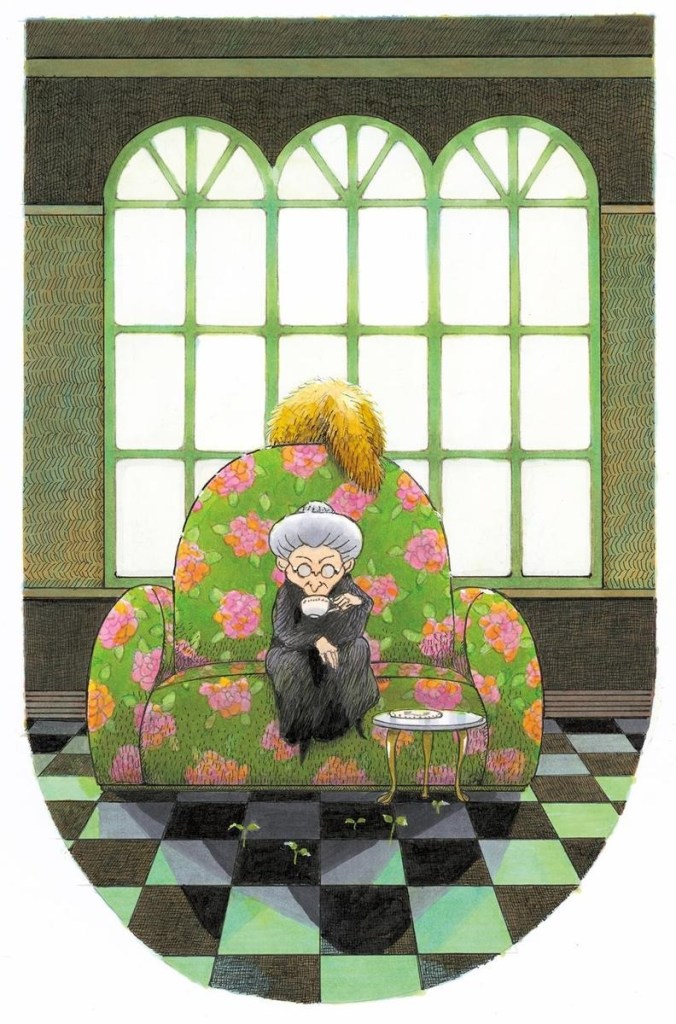
“a small elderly woman dressed all in black” – illustration by Miho Satake
Ms. Picotto informs Lina that she is expected to earn her stay because, “He who does not work shall not eat.” Lina worries that she has no useful skills but during the following three weeks she works in a bookshop, in a ceramics shop, and in a toy shop as well as in the boarding house, helping with chores in the kitchen, in the vegetable garden, and in the invention lab. Her days are filled with new encounters, from bubbly Nata and shy Shikka to a spoiled prince and a masked child. Lina also becomes friends with the other guests at Picotto Hall, in particular with Icchan, the inventor. She discovers that everyone in Misty Valley descends from sorcerers and she grows accustomed to the magical events that fill its daily life: centaurs, imps, and gnomes walking down the street, pottery turning into people, flowers of all seasons blooming at the same time, and cats teaching maths. No wonder Misty Valley has been affectionately renamed by its villagers as Absurd Avenue!
Lina works hard at her chores, and she goes above and beyond what is required of her so she can help others. All the way, she is guided by the kind advice of Misty Valley’s inhabitants and their deeds; she learns to give and receive, she learns not to make assumptions or jump to conclusions (she hates it when Ms. Picotto asks, “What exactly did I say?”), that what matters is not avoiding mistakes but doing your best, and that sometimes you have to set boundaries to build a healthy and respectful relationship.
At the end of the book, when Lina finally leaves the enchanted village to return home, she has not acquired magical skills but she has received much more than food and bed in exchange for her work: she has been empowered with the accountability for her actions, emotions, and relationships.
Her journey, which happens in a setting with both Japanese and Western features, is familiar to readers from around the world.
Similarly to Little Red Riding Hood and Hansel and Gretel, Lina enters the woods: the quintessential unknown.
Then she chases her umbrella until she finds herself in Misty Valley, just like Alice chased the White Rabbit discovering Wonderland.
Ms. Picotto, her boarding house with four stoves, and the tasks she assigns to Lina recall Baba Yaga and her house with chicken legs.
Lina walks the universal path that fairytale children travel in order to overcome their fears and vulnerabilities, and emerge mature and self-confident.
That Kashiwaba is very knowledgeable about global children’s literature, especially the fantasy genre, comes as no surprise. In her Note to Readers in 1975 she writes:
“When I was in elementary school, I read a Mary Poppins book. I thought I could meet Mary Poppins if only I went to England. When I was in middle school, I read The Chronicles of Narnia, and I wanted to go to Narnia too; I thought up all sorts of ways.
Every time I read a book, I would wish that I could somehow enter its world.”
The first Japanese translations of books from other languages started to appear in Japan at the end of the nineteenth century and have been popular ever since. Throughout her book The Village Beyond the Mist, Kashiwaba explicitly names some of those books: Anne of Green Gables, Jane Eyre, Mother Goose Nursery Rhymes, Robinson Crusoe, The Adventures of Dunno and His Friends, and The Arabian Nights.
The Village Beyond the Mist is not filled with epic battles between Good and Evil, nor are there almighty and threatening fantastical creatures or impossible tasks for Lina to accomplish. It is a more gentle introduction to the fantasy genre. During the time spent in Misty Valley, Lina’s life is never in danger. Instead, she witnesses how a sparkle lights up in the eyes of her new friends every time they do something good for others.
The story ends with Lina on her way back home reflecting on her new favorite color. While in Misty Valley, Lina, who previously loved pink, discovers many colors like November Sea and Hearth Flames, and comes to love the color of the Sun Setting in the West which, in geographical terms, is the exact opposite of the Land of the Rising Sun, aka Japan.
What Kashiwaba seems to tell the readers is that the magical land of Misty Valley/Absurd Avenue, just like Neverland of Peter Pan, is somewhere out there waiting for them to reach it:
“No matter where you are, all you need to do is take one step and you’ll be at Absurd Avenue.”
No matter where you are, all you need to do is gather the courage to step out of your everyday routine and your life will be filled with wonders.
Additional Notes:
In 50 years since its first edition, the book The Village Beyond the Mist has seen a previous English translation by Christopher Holmes (The Marvelous Village Veiled in Mist, Kodansha, 1987) as well as several Japanese editions illustrated by Kozaburo Takekawa, Hiromi Sugita, and Kyotaro Aoki.
You can learn more about the challenges of working with classics in these two World Kid Lit posts by Avery Fischer Udagawa on retranslating and illustrating a new The Village Beyond the Mist.
The Village Beyond the Mist is considered part of a trilogy together with A Strange Journey from the Basement (地下室からのふしぎな旅 – Chikashitsu kara no fushigina tabi) published in 1981 and Mysterious Friends Behind the Ceiling (天井うらのふしぎな友 – Tenjō ura no fushigina tomo) published in 1985.
The three books focus on different characters but they share the mysterious nature of the fantasy world. So far, only The Village Beyond the Mist has been translated into English while in 2019 A Strange Journey from the Basement has been made into an anime movie, The Wonderland – you can watch the trailer here.
More books by Sachiko Kashiwaba that have previously been translated in English by Avery Fischer Udagawa are:
- Temple Alley Summer published by Restless Books/Yonder in 2021 (from the original Japanese 帰命寺横丁の夏 – Kimyōji yokochō no natsu, Kodansha, 2011) – GLLI review and GLLI interview with Avery Fischer Udagawa;
- The House of the Lost on the Cape published by Restless Books/Yonder in 2023 (from the original Japanese 岬のマヨイガ – Misaki no mayoiga, Kodansha, 2015) which was also made into an anime movie in 2021 – here you can watch the EN trailer and the JP trailer.
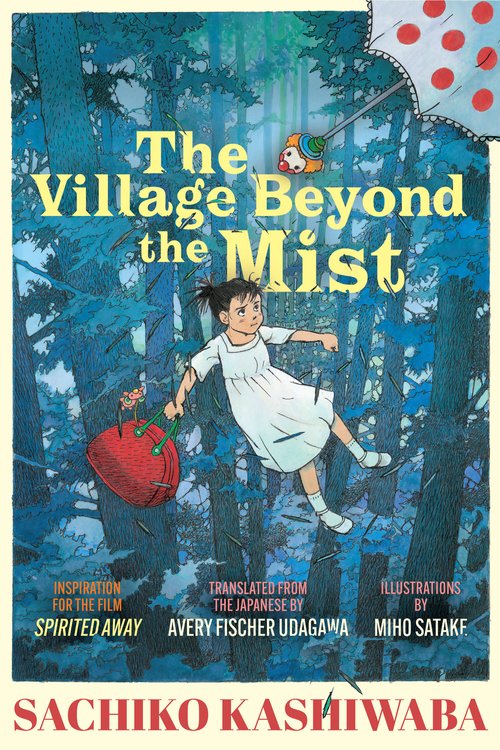
TITLE: The Village Beyond the Mist, May 2025

AUTHOR: SACHIKO KASHIWABA is a prolific writer of children’s and young adult fantasy whose career spans five decades. In Japan, her works have garnered the prestigious Sankei, Shogakukan, and Noma children’s literature awards. Her books have also been animated as the films The Wonderland and The House of the Lost on the Cape, among others, and her 1975 novel The Village Beyond the Mist-published in English in 2025-inspired Hayao Miyazaki’s film Spirited Away. Her novel Temple Alley Summer, illustrated by Miho Satake and translated by Avery Fischer Udagawa, won the American Library Association’s 2022 Mildred L. Batchelder Award, and her novel The House of the Lost on the Cape, translated by Fischer Udagawa and illustrated by Yukiko Saito, was named a 2024 Batchelder Honor Book. She lives in Morioka, Iwate. (from the publisher)

TRANSLATOR: AVERY FISCHER UDAGAWA grew up in Kansas and studied English and Asian Studies at St. Olaf College in Minnesota. She holds an MA in Advanced Japanese Studies from the University of Sheffield. She has studied at Nanzan University, Nagoya, on a Fulbright Fellowship, and at the Inter-University Center for Japanese Language Studies, Yokohama. She writes, translates, and works in international education near Bangkok, where she lives with her bicultural family. Her translations include Sachiko Kashiwaba’s middle grade novels Temple Alley Summer and The House of the Lost on the Cape, which garnered the 2022 Mildred L. Batchelder Award and a 2024 Batchelder Honor, respectively. She serves as Global Translator Coordinator in the Society of Children’s Book Writers and Illustrators. In 2024, she was named the SCBWI Stephen Mooser Member of the Year. (from the publisher)
Find out more at Avery Fischer Udagawa‘s website, her Facebook page, and her Bluesky account.
ILLUSTRATOR: MIHO SATAKE is an artist and illustrator based in Tokyo. She is best known for illustrating the Japanese editions of many classic children’s and young adult books, including Howl’s Moving Castle by Diana Wynne Jones, Rowan of Rinn by Emily Rodda, Dragon Sword and Wind Child by Noriko Ogiwara, the Moribito series by Nahoko Uehashi, and several books in the Kiki’s Delivery Service series by Eiko Kadono. In addition to illustrating classic children’s literature, her work spans a wide range of genres, including fantasy and realism. (from the publisher)
PUBLISHER: Restless Books/Yonder 2025. Originally published in 1975 by Kodansha, Japan.
ISBN: 9781632063922
Interest Level: Age 8-13
REVIEWS:
- GLLI review by Nanette McGuinness – March 19, 2025.
- Kirkus starred review – May 27, 2025 – Captivating and magical, with a dash of goodness baked in
- New York Times review – May 9, 2025 – Pick Up This Book and Be Spirited Away
INTERVIEWS:
- Exploring Fantasy with Sachiko Kashiwaba & Avery Fischer Udagawa – Dec 1, 2025.
- Avery Fischer Udagawa and “The Village Beyond the Mist and the State of Kidlit Translation” at SCWBI in Japan, July 17, 2025.
AWARDS:
- Shortlisted, 2026 Global Literature in Libraries Initiative Translated Young Adult Book Prize
- A 2026 CCBC Choices Title
- A 2026 USBBY Outstanding International Book
- One of NPR’s Books We Love 2025
- One of Kirkus Reviews’ Best Middle Grade Books of 2025 and a Passport to New Worlds
- One of Forbes‘ 11 Brilliant Art and Culture Books to Curl Up With This Winter
- The November/December 2025 Libby & Sora Reads Title

Sabrina Rossi works as Upper School Library Assistant at the International School of Amsterdam, where she previously was Lower School Library Assistant. Sabrina holds a BA in Japanese Language and Literature from the University “La Sapienza” and a MA in Children and YA Literature from the University “Roma Tre” of Rome, Italy, where she is originally from. After living in London, Sabrina moved to Amsterdam in 2003 where she fell in love with the colorful fashion, the bikes, and the immense variety of languages that can be heard on its streets and has been living there ever since. Sabrina speaks five languages and enjoys reading books in their original versions as much as possible. Sabrina is a big fan of picture books!
Disclaimer: The opinions and views expressed are the author’s and do not necessarily reflect those of GLLI.


One thought on “#IntYALitMonth: GLLI 2026 Shortlist: The Village Beyond the Mist”