
by Emma Mandley
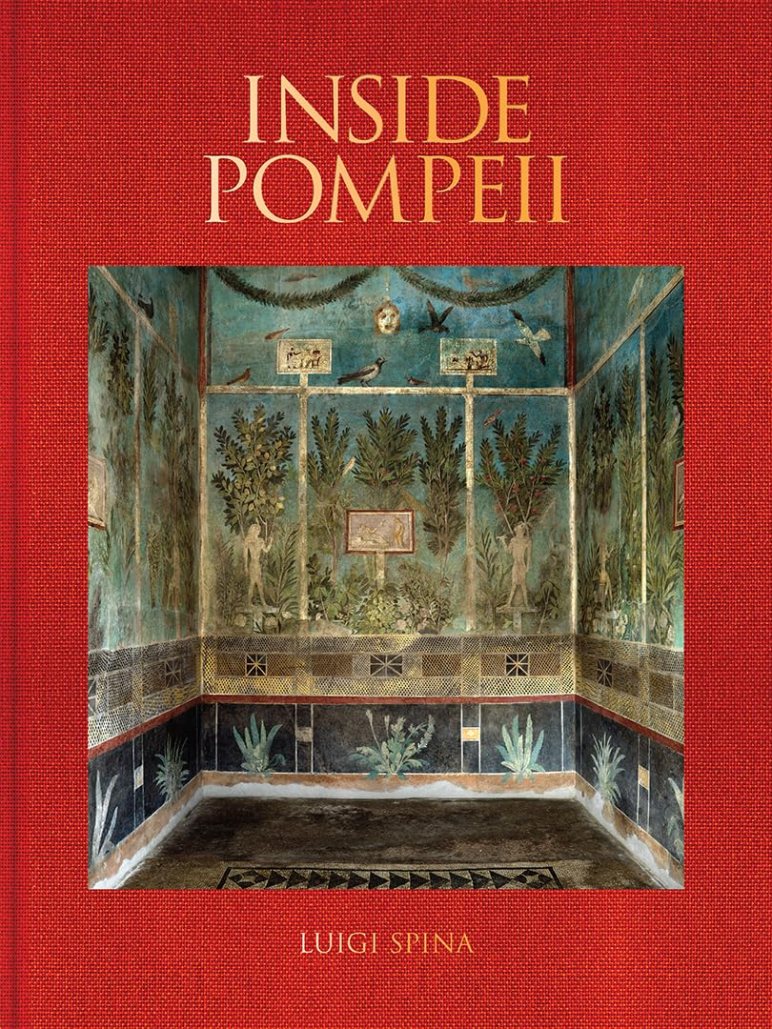
As a translator who specializes in texts about art history and antiquities, I’m lucky enough to spend my time poring over fascinating works of art, from classical antiquity to modernist architecture. New topics always mean new and often demanding research: in recent times I’ve had to familiarize myself with terminology for subjects as arcane as manuscript binding techniques, medieval tapestry stitches and the decoration of early Scandinavian horse trappings. But the book I’m going to write about here, Inside Pompeii by the distinguished art photographer Luigi Spina, actually presented very few tricky challenges in its translation. The text was there to support the book’s real purpose: its breathtaking photographs, presented in a publication with the highest production values, which do the images justice and make it a real sensual pleasure to turn the book’s pages.
While some of us were doing jigsaw puzzles and trudging around our local parks, and others were engaged with responding more actively to the shock of the pandemic, Luigi Spina was using this strange time to take photographs of a deserted and silent Pompeii – in natural light, at different times of day and in different seasons, seeking out surprising vistas and inaccessible corners, celebrating the astonishing wall paintings and mosaics but giving equal prominence to the rougher cracks and blemishes that different periods have left upon the city’s layers. Spina himself has said that his photographic research “follows the path of light and the passing of time”. His objective was to capture Pompeii’s soul, to give us a feeling for the places where people once lived and worked, bringing a new and intimate perspective to this vast expanse of excavations.

Pompeii is one of the most extraordinary and well-preserved archaeological sites in the world. Destroyed by the eruption of Vesuvius in 79 CE, the city’s mystery has fascinated artists since excavations began in the eighteenth century (and there’s still plenty more that remains to be discovered). There is no shortage of photographs of Pompeii – an album was produced by the architect responsible for the excavations as early as 1847. But while Luigi Spina’s images, shot with his Hasselblad camera, do indeed document Pompeii at a particular moment in time, they are also very much more than just photographic records. With their haunting atmospheric quality, their remarkable understanding of colour, light and texture, their unexpected viewpoints, their simplicity and charm, they are truly works of art in their own right.
Spina has captured the rhythm of a city that no longer exists, but where the traces left by the inhabitants still conjure up their presence – “a glimpse of other people’s lives through a fissure in time”, as Spina puts it. The photographer explores the colourful, theatrical interiors that contrast with the plain exteriors and austere streets, sometimes with views of the landscape beyond – including the silhouette of Vesuvius looming in the distance. The vistas lead the eye from one space to another, in a succession of mosaic floors, painted rooms and gardens with pillared porches. The juxtaposition of brightly coloured walls, rough stone, crumbling plaster and crisp mosaics often produces images that could be abstract paintings. My own favourites include a stack of amphorae leaning against a wall; a mysterious interior with a window opening onto a sunlit tree; and a winding, empty street leading out of the city towards a golden sky.
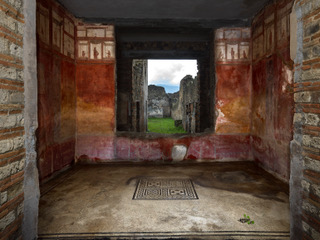
The photographs speak for themselves and have no need for a translator, but they are accompanied by useful short essays (by the Director General of the Archaeological Park of Pompeii and other senior academics) describing the history of the city and its excavations, as well as by Luigi Spina’s own meditation on Pompeii’s soul. There are also clear maps of the ‘regions’ into which the archaeological site is divided, pinpointing the exact location of all the homes and shops that appear in the photographs, as well as brief texts giving concise information about each one: its history and purpose, an explanation of the layout, a discussion of the wall paintings and mosaics – and wherever possible, some thoughts about the original owners. Reading these texts alongside the photographs is like taking a gentle stroll through Pompeii in your own time, wandering along its streets and lingering in its courtyards, without the distraction of tourists but with a discreet and discerning guide at your elbow.
‘Here there are no carbonised bodies, crouched and curled in fear and pain. Instead there are empty rooms, gorgeously decorated, with polychrome marble details, geometric black and white floor mosaics, elaborate mythical wall paintings, as well as wall paintings of gardens lush with birds and fruits, botanical motifs, garlands.’ – Gavanndra Hodge, The Times (full review here)
‘Spina’s seductive photographs chronicle the lush interiors, the rich mosaics and frescoes and a vivid urban streetscape. A visual feast.’ – Edwin Heathcote, The Financial Times (full review here)
Inside Pompeii
- by Luigi Spina
- Translated from the Italian by Emma Mandley
- Original title: Interno Pompeiano (2023)
- 480 pages
- Publisher: Thames and Hudson (2023)
- ISBN: 9780500027301
- Treat your bookshelf to a taste of Italy! Order the book here.
A Financial Times Best Book of 2023
Interno Pompeiano won first prize in the ‘Art, Design and Photography’ category and first prize overall as ‘Best Book of the Best Books’ at the prestigious MGIP – Motovun Group of International Publishers Award 2024.
Emma Mandley translates from Italian and French. She specializes in art historical and academic texts and has translated books on subjects as varied as eighteenth century silverware, Anselm Kiefer’s photography and the art of ancient South Arabia. Her translation Byzantine and Sasanian Silver, Enamels and Works of Art by Marco Aimone (Thames & Hudson, 2020) won the 2021 ITI Award for best performance on a translation assignment. She also enjoys translating children’s books and adult fiction.
Emma has a degree in Italian and History of Art and a master’s degree in Translation (distinction), both from the University of Bristol. Her earlier education was at the Lycée Français de Londres. Before discovering that translation was her passion, Emma had a long career in broadcasting. She lives in London.
More here.

“Italy’s extraordinary cultural history is reflected in a long tradition of producing beautiful art books whose appeal transcends frontiers: everyone needs wonderful things to look at and read about.” — Emma Mandley

Italian Lit Month’s guest curator, Leah Janeczko, has been an Italian-to-English literary translator for over 25 years. From Chicago, she has lived in Milan since 1991. Follow her on social media @fromtheitalian and read more about her at leahjaneczko.com.
 Global Literature in Libraries Initiative
Thanks for your brilliant review.
I’ll ask my agent to get me that book
Klausbernd 🙂
LikeLike
So glad you enjoyed reading it, and I’m sure you’ll love the book. The Italian original has just won the MGIP award for ‘Best book of the best books’ at the Frankfurt book fair!
LikeLiked by 1 person