by Oonagh Stransky
Domenico Starnone, born in Naples in 1943, is one of Italy’s greatest living authors. His name is often mentioned in connection to the mysterious figure of Elena Ferrante because of their shared interest in certain themes and the city of Naples. But we won’t be talking about that here.
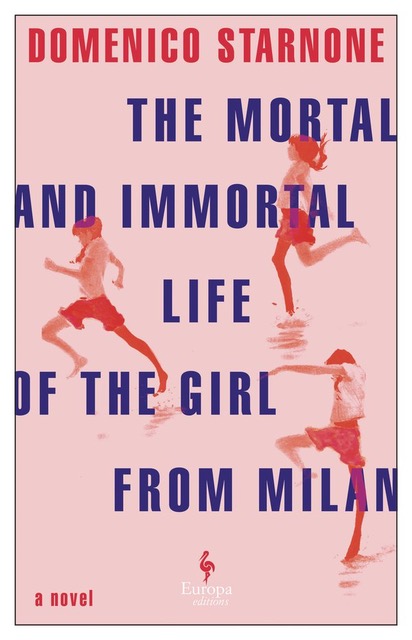
The Mortal and Immortal Life of the Girl from Milan is a work of auto-fiction in which the narrator Mimí, a writer, dives into his childhood, recalls his first young love, and traces the impact she had on his life through his university years and into adulthood. Drawing inspiration from the myth of Orpheus and Eurydice (where Orpheus tries to bring Eurydice back from the underworld but fails) and from Dante’s devotion to Beatrice (who acts as his guide in two books of the Divine Comedy), Starnone weaves a story that is tender, amusing and brilliant yet devastating.
Mimí grows up in working class Naples, loves graphic novels, and listens attentively to the peculiar stories his elderly grandmother tells him about heaven, hell, and her deceased husband. He and his best friend invent games to test each other’s courage and win the attention of the “Girl from Milan,” who lives across the street, and represents everything he is not. Her sudden disappearance leaves an emptiness in his life which he will forever try to heal. Mimí works hard at school but thinks he has to erase his natural dialect to get ahead in life; he wishes he could speak in perfect standard Italian. But eventually, at university, he realizes that this form of language and even this way of being – so beautifully embodied by his grandmother – is a gift, and he ultimately makes skillful use of it to surge ahead in his professional life.
The Mortal and Immortal Life of the Girl from Milan is the second book by Starnone that I have been privileged to translate. To celebrate its release, I wrote a reader’s guide that explores some of the themes through the lens of translation. Below are a few of the questions. The full version will be available on the Europa Editions website.

EXCERPT FROM THE READER’S GUIDE
What is the “pit of the dead”? And what does it represent to the narrator?
The opening lines refer to a vague, dark space that will be repeatedly mentioned throughout the book. Finding just the right phrase for it in English was the first of many challenges I had to resolve. I kept telling myself that it would be simpler and easier to understand if I could just call it the “land of the dead” or “the underworld,” but the original is actually fossa dei morti, with the word fossa meaning grave, trench, or sewer. I couldn’t use “underworld” or other terms referring to the myth of Orpheus and Eurydice, because they come up a few lines later, so that was a non-starter. I needed to find a way of describing a space that could stand up to the grandmother’s long and detailed description of it, which comes a few pages later:
…you raise the cover…then go down some steps…into a stormy cloud of dirt with thunderbolts and lightning and rain that comes down in buckets and stinks like rotting flesh…there’s the constant sound of hammering and chiseling from all the dead people in their tattered shrouds…
The relevance of the pit to the story can’t be overemphasized: the narrator’s mind is deeply imprinted with his grandmother’s words, with his perception of the place going on to shape his later choices, his relationships, and his very existence.
What does “the girl” represent?
The girl, who lives across the street from Mimí, stands for everything that the narrator does not have in his life, and which he desperately yearns for: a happy home, grace, genteel manners, words carefully spoken in standard Italian, not shouted in dialect. “The sun never shone in our house, it always seemed to shine at the girl’s. Her balcony was filled with colorful flowers, my windowsill was bare, at the very most a grey rag hung from a metal wire after my grandmother used it to mop the floor.” The girl, and her brilliant light, will lead us into the darkest depths of this enchanting story.
The girl also represents desire and inspiration. She fans the flames of masculinity and sets the boys to dueling. She is mystery incarnate: Mimí does not know who her parents are. She might live in the neighborhood, but she is not quite part of it. Her grandmother “dressed entirely in navy blue with pearls around her neck, she had silvery-blue hair, rosy skin, perfect posture, and played calmly with the girl until the sun went down,” while Mimí’s had a “nose like a bell pepper and a permanently absent gaze.”
The girl’s sudden absence represents a rupture, one that leads to change, a sudden painful growth spurt, adolescence, and maturity, but something of the girl will always remain in him. Her absence-presence develops into an unresolved issue that will become his identifying trait: a longing to return to the boy he once was, complete with all his vivid dreams and natural talents, a boy who teeters on the cusp of success and degradation.
How does the author use humor?
Starnone manages to balance out heavy themes (growing up, maturity, death, first love, betrayal, ambition) with lightness—with light—through skillful use of irony. We are amused and then gobsmacked. I think of how Mimí and Lello play at hurting each other with bikes and swords when they’re young, only to go on and wound each other gravely later in life. Or, how the narrator “uses” his grandmother’s words for a university project, only for her to then lose her ability to speak. Starnone is like a spider spinning a web: he uses humor to trap us, and then chews us up and spits us out.
Italian, Neapolitan, and… phonetic language
To some degree, the key struggle at the heart of this novel is linguistic. How will the main character—who grows up speaking Neapolitan, wishing he spoke standard Italian, and dreaming of becoming a writer—manage to shelve his home language and learn to use the “proper” one, which he needs to possess to move forward in life? How can he “elevate” himself without erasing or denigrating his origins and the people who cared for him with love? Enter: phonetic writing and etymology. Breaking apart words into their sounds and studying the historical/geographical origins of place names are two inspiring activities that also allow the protagonist to move the story forward.
From a translating perspective, I found the original Italian of The Girl from Milan almost more complex and experimental than Via Gemito. The original version of this book contains five kinds of language: standard Italian, Neapolitan, hybrid conversations with a little of both, academic writing, and phonetic language. My translation has three, possibly four, linguistic layers:
- I translated the narrator’s “standard” Italian into “normal” English;
- I translated the majority of the conversations that take place in Neapolitan into standard English, without using any cultural parallels so as not to stereotype or weaken the discourse;
- as with The House on Via Gemito, I chose to leave some words in Neapolitan intact for texture, history, culture, or simply because they don’t need translating;
- with regards to the phrases in the original that rely on a combination of standard Italian and Neapolitan, I have tried to retain a hint of this hybridization, which may or may not be noticeable to the general reader;
- finally, because the phonetic alphabet is used in the original for both single words and longer phrases, I thought it was important to leave the phonetic signs and so I merely translated them. Including the joke.
For the complete version of the reader’s guide, visit the Europa Editions website.
© 2024 Oonagh Stransky
The Mortal and Immortal Life of the Girl from Milan
- by Domenico Starnone
- Translated from the Italian by Oonagh Stransky
- Original title: Vita mortale e immortale della bambina di Milano (2021)
- 144 pages
- Publisher: Europa Editions
- ISBN: 979888966047
- E-book: 9798889660484
- Publication date: USA October 15, 2024/ Canada October 25, 2024/ UK October 10, 2024
- Cover design by: Ginevra Rapisardi
- Treat your bookshelf to a taste of Italy! Pre-order the book here.
This book has been translated thanks to a contribution awarded by the Italian Ministry of Foreign Affairs and International Cooperation.
Advance Reviews
For a closer exploration into all things Starnone, readers would do well to visit the Reading in Translation website, which offers a range of articles about the writer.
Other works by Domenico Starnone also available in English and published by Europa
- The House on Via Gemito (2023), translated by Oonagh Stransky (Long-listed for International Booker Prize, short-listed for the Oxford Weidenfeld Translation Prize and the ALTA Italian Prose in Translation Award)
- Trust (2021), translated by Jhumpa Lahiri
- Trick (2018), translated by Jhumpa Lahiri (Finalist for National Book Award and PEN Translation Prize)
- Ties (2017), translated by Jhumpa Lahiri
Oonagh Stransky has been translating Italian writers for more than two decades. Her first translation was a noir set in Bologna, Almost Blue by Carlo Lucarelli (City Lights 2001). Since then she has translated fiction and non-fiction by writers as diverse as Pontiggia, Saviano, Pasolini, and Pope Francis. Recent translations include Butterfly of Dinard by Eugenio Montale (with Marla Moffa, NYRB 2024), Abandonment by Erminia Dell’Oro (Héloïse Press 2024), and The Throne by Franco Bernini (Europa 2024). Her translation of Starnone’s The House on Via Gemito was long-listed for the International Booker Prize and short-listed for the Oxford Weidenfeld Prize and the ALTA Italian Prose in Translation Award. Stransky has also translated Starnone’s The Old Man by the Sea, forthcoming in 2025 from Europa. Born in Paris, Oonagh grew up in Beirut, Jeddah, London, New Jersey, and Boston. She studied Book Arts and Comparative Literature at Mills College, and Italian at Middlebury College, UC Berkeley, the Università di Firenze, and Columbia University. She currently lives in Italy.

More at: www.oonaghstransky.com.
Oonagh does not regularly use social media but you can follow her on Instagram, Facebook or LinkedIn.
“I consider myself a re-creator of Italian literature, and by that I mean that I derive creative gratification from working to make the experience of reading the English version parallel to the Italian one.” —Oonagh Stransky

Italian Lit Month’s guest curator, Leah Janeczko, has been an Italian-to-English literary translator for over 25 years. From Chicago, she has lived in Milan since 1991. Follow her on social media @fromtheitalian and read more about her at leahjaneczko.com.
 Global Literature in Libraries Initiative
One thought on “#ItalianLitMonth n.6: Who’s That Girl? A Reader’s Guide to The Mortal and Immortal Life of the Girl from Milan”