Review by Susanne Abou Ghaida
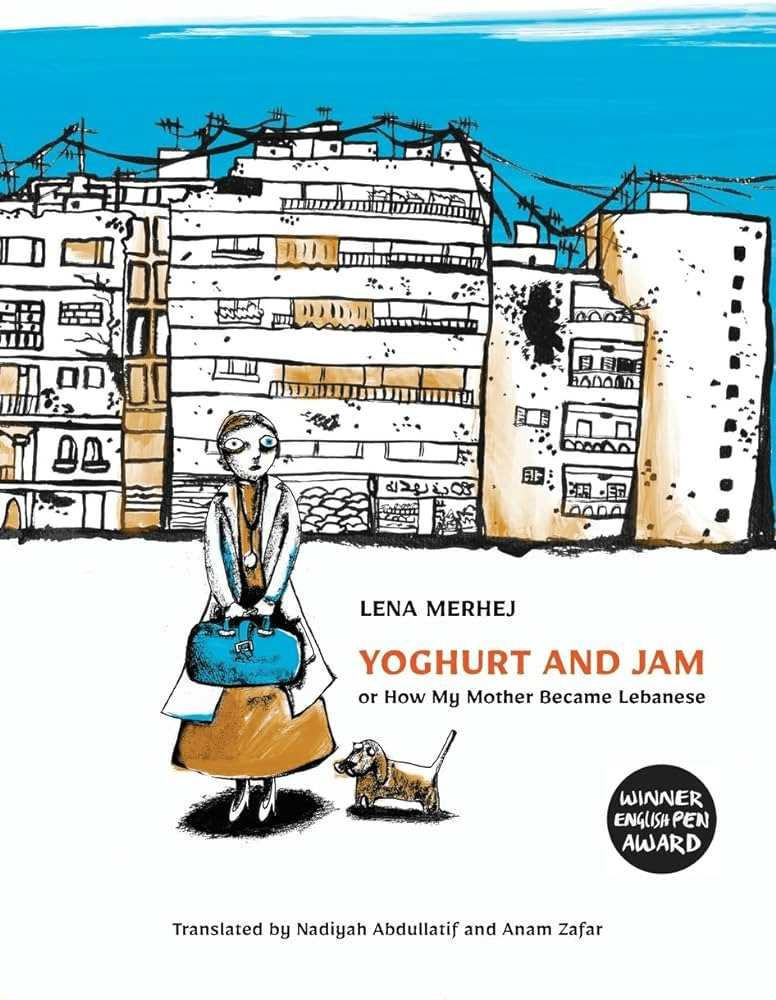
Note: This review is based on the French translation of this graphic memoir; all translations from French are mine. An English version, translated from Arabic by Nadiyah Abdullatif and Anam Zafar, was published by Balestier Press in 2023 under the title Yoghurt and Jam (or How My Mother Became Lebanese).
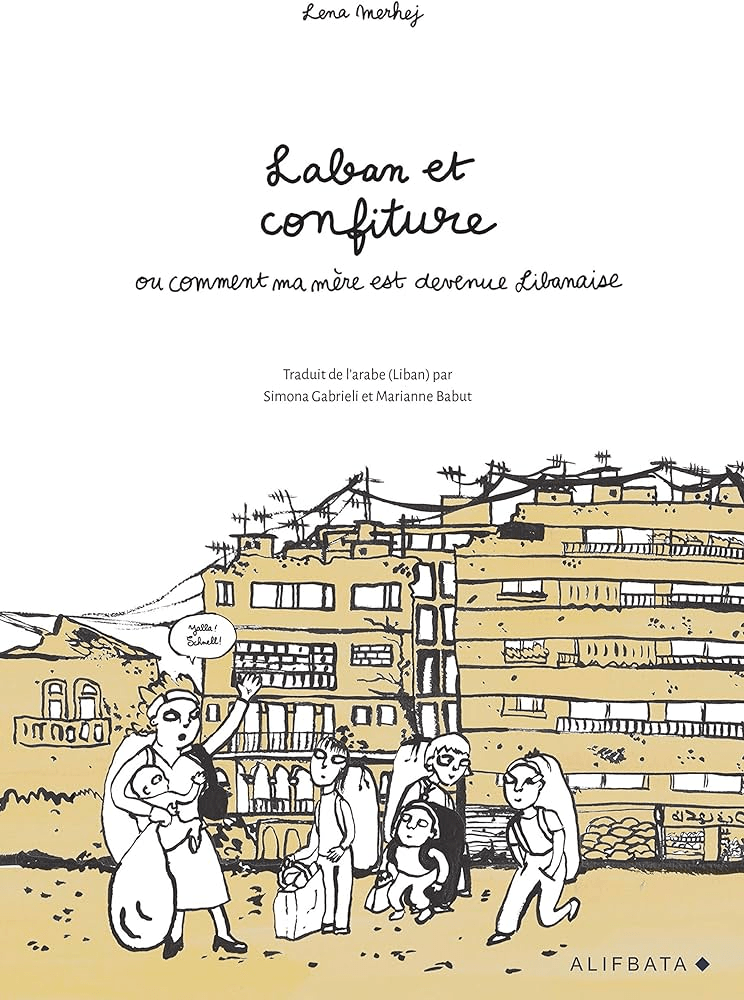
Laban et Confiture: ou comment ma mère est devenue Libanaise [Yoghurt and jam: Or how my mother became Lebanese], written by Lena Merhej and translated from Arabic to French by Simona Gabrieli and Marianne Babut, is a biography of sorts. It traces or rather dips into the life of the author Lena Merhej’s mother from her childhood, youth and young adulthood in Austria and Germany to her arrival and life in Lebanon. We see her fall in love, learn Arabic, meet her two husbands, raise her five children during the Lebanese Civil War while working as a doctor and an educator, age and lose her vision. Along the way, she experiences a staggering amount of loss, including the deaths of her best friend, her mother, her first husband, her born and unborn children. To deal with her sorrow, she “transform[ed] [it] into an anger that pushed her to work” (p.24), read history books “which offered a broader vision of existence” (p.36) and compared her plight to those who are worse off (p.36).
While this summary may suggest a linear progression, that is far from being the case as the narrative continuously jumps backwards and forwards in time and requires the reader to fill in the gaps, or at least learn to live with them. As Merhej writes, “this work is a mix of memories that return to me, sometimes triggered by an event or a thought, and at other times, they arrive from I don’t know where” (p.53) while, in an interview, she compares this novel to a memory box. This approach of assembling an assortment of memories, works effectively; it is informative, and thought-provoking while also knowing when to step back.
As a graphic memoir, Laban et Confiture is equally the story of the author’s often complicated relationship with her mother, her journey as an artist and a recounting of her attempts to write this book and learn about her mother’s past, a process sometimes resisted by her mother. One of the major themes it tackles are childhood, parenthood, and work during Lebanon’s fifteen-year civil war. Reading this work in the context of the current Israeli assault on Gaza, including the destruction of its hospitals, it is poignant to witness her mother rage against another earlier war on Gaza (p.53) and learn that she had worked at Gaza hospital in Beirut, where they received victims of the Sabra and Chatila massacre in 1982 (p.36) and the difficult conditions they worked under (p.53). Another major theme is that of managing a bicultural identity, a challenge that both Merhej and her mother face. The title of the book refers to one of her mother’s many culinary concoctions that Lena and her siblings found completely bizarre, and that, on another level, represented their mother’s ‘foreignness’. While the title suggests a successful transition towards a Lebanese identity, the narrative interrogates what it means to be ‘an Oriental woman’: “Was it to have black eyes? Polished nails? [to drink] coffee and [smoke] cigarettes? [Give] excessive compliments? Dancing? Obedience?” (p.27); in the end, however, the book embraces cultural hybridity and rejects simplistic binaries. The heaviness of some of the themes it tackles does not prevent Laban et Confiture from often being humorous.
At the level of the visuals, the illustrations are in black and white. The frames of the comics panel appear to be hand drawn as well while the text and dialogue are presented in a font that resembles handwriting. Some panels are frameless while others are wordless, letting the reader piece things together. Those who are familiar with Merhej’s children’s book illustrations will recognize one of the signatures of her style, the large, sometimes elongated eyes, of her characters.
In recounting the extraordinary life of the woman at its center and her family, Laban and Confiture combines a sophisticated structure and insight into a range of lived experiences with a deftness of touch that should please and challenge both adolescent and adult readers.
Laban et Confiture: ou comment ma mère est devenue Libanaise
Written by Lena Merhej and translated by Simona Gabrieli and Marianne Babut
2018, Alifbata
ISBN: 978-2-9553928-5-0
Yoghurt and Jam (or How My Mother Became Lebanese)
Written by Lena Merhej and translated by Nadiyah Abdullatif and Anam Zafar
2023, Balestier Press
ISBN: 978-1-913891-51-0
Susanne Abou Ghaida is a researcher specialising in Arabic children’s and adolescent literature. She has a PhD in Education from the University of Glasgow, and her doctoral research was on the Arabic adolescent novel and constructions of adolescence. She is currently a Civis-3i postdoctoral fellow at Aix-Marseille University in France and co-hostedby the University of Glasgow where she is carrying out research on Al-Shayaateen Al-13 [The 13 Devils], an Arab espionage series for adolescents published between 1974 and 2008. She has researched and written about a number of subjects, including oral history and memory; Arabic picture books; multicultural children’s literature; critical hope; disability; and sexuality in Arabic adolescent literature. She is the Vice President of the Young Adult Studies Association and an associate editor of the International Journal of Young Adult Literature (IJYAL).
—

GLLI’s 2024 International YA Literature Month has been curated by Dr Emily Corbett. She is a lecturer in children’s and young adult literature at Goldsmiths, University of London, where she leads the MA Children’s Literature: Theoretical Approaches to Children’s and Young Adult Literature programme. Her research focuses on the growth and development of YA from literary, publishing, and cultural perspectives. She is also General Editor of The International Journal of Young Adult Literature and was founding Vice President of the YA Studies Association. Her monograph, In Transition: Young Adult Literature and Transgender Representation (2024), is forthcoming with the University Press of Mississippi in June. You can find her contact details on her institutional website and connect with her on Twitter and Instagram via @DrEmilyCorbett.
Opinions expressed in posts on this site are the individual author’s and are not indicative of the views of Global Literature in Libraries Initiative.
 Global Literature in Libraries Initiative
One thought on “#IntlYALitMonth Review: Yoghurt and Jam: Or how my mother became Lebanese”