I will be finishing this month off at GLLI with a few of my favorite reads that I have been blogging. One of the things that has kept me blogging is the support of various publishers and writers over the years, and here is both a writer and publisher that have been helpful over the years to my blog.
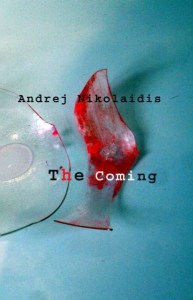
The first chapter of this book was featured in this year’s Best European Fiction. Andrej Nikolaidis is a rising star of central European fiction born to a half Greek family. He spent his youth in between his current homeland and Bosnia, and you can see the effect in his book; he won the Montenegrin section of the European literature prize last year and has so far published three novels. He is well-known for speaking his mind in his native country on a number of subjects, mostly to do with Serbia, and has worked closely at times with the new government in Montenegro. He is also married to a famous poet from the region. They also now have children I have met Andrej a couple of times and he wrote a piece about his love of Thomas Bernhard for the blog.
So, The Coming is Andrej’s first book to reach us in English. What is it about? Like all good Central European fiction, it is about a lot more than it seems on the surface. On the surface, it could be viewed as a crime novel but also cynical and comic with a touch of historical fiction and some epistolary touches as he likes to use emails. The story starts when someone dies, the local library burns, and a father, the town’s sheriff of Ulnjc, begins to investigate. As he investigates, his son appears to have been in Austria. Then we have a second story line of Fra Dolcino, a heretic born in the late 1200s, that announces the return of the Messiah. Hence the title of this book and the manuscript by Fra Dolcino called the” the book of the coming”. Add in a third strand of strange things happening in the local environment, and you have just scratched the surface of this book. This book even has it own soundtrack at the back of the book to listen to as you read. I knew most of the tracks but enjoyed listening to the non-English artists on the list that I didn’t know. I liked Andrej’s taste in music, as a huge fan of Nick Cave, the Smiths and Stone Roses. He says music helps his writing process, and he falls asleep to music every night.
The other theme of the book is the end of the world coming, but also about what happened in the region Andrej comes from. He grew up between Bosnia and Montenegro; he was caught up in Bosnia civil war in 1992.I heard an interview via Andrej’s publishers Istros books with Andrej and Will Firth the translator. I worked alongside a Bosnia Croat in the mid-nineties as he and I lived in Germany so the sense of how the war could happen and the end of something is something I felt from the book also, In the first chapter, when the detective describes what he has seen in the village can be expanded to the canvas of the Bosnian war. I found this book a real hidden gem. I must admit that Will Firth, looking for a new voice from this region and the new country of Montenegro, has turned up a real gem and a robust new voice. That reminds you of why you read books in translation it is to see worlds through different eyes and concepts. This book has a lot of imagery, and the Fra Dolcino section could be seen as what happens when people’s views get out of hand. If you like a book that makes you think for weeks after but isn’t as long as a Umberto Eco, this is the one for you. This book is the first of many of his I have read. His latest has just come out.
The writer

Andrej Nikolaidis was born in 1974 in Sarajevo, to a mixed Montenegrin-Greek family. Until the age of six, he lived in the city of Ulcinj, where he returned in 1992 after the war in Bosnia erupted. Since 1994, he has written for regional independent and liberal media and cultural magazines. He is considered by many to be one of the most influential intellectuals of the younger generation in the region, known for his anti-war activism and for his promotion of the rights of minorities.
Nikolaidis also publicly defended the victims of police torture, which resulted in his receiving many threats, including a death threat during a live radio appearance. He has often stated that he considers freedom of speech to be the basis of freedom.
He has worked as a columnist in the weekly magazine Monitor and for publications including Vijesti (Montenegro), Dnevnik (Slovenia), Slobodna Bosna (Bosnia-Herzegovina), E-novine (Serbia), and Koha Ditore (Kosovo). Since 2010, he has been employed as an advisor for culture and free society in the parliament of Montenegro.
The translator

Will Firth is a literary translator from Newcastle, Australia. He graduated in German and Russian (with Serbo-Croatian as a minor) from the Australian National University in Canberra. He won a scholarship to read South Slavic studies at the University of Zagreb in the 1988-89 academic year and spent a further postgraduate year at the Pushkin Institute in Moscow in 1989-90. Since 1990 Will has been living in Germany, where he works as a freelance translator of literature and the humanities.
Writer of this post
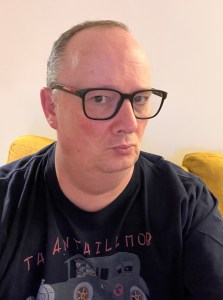
This post is by guest curator Stuart Allen, the blogger behind the blog, Winstonsdad. Stuart is a lover of translated literature and world cinema. He started the #translationthurs hashtag on Twitter and his blog is rated the #1 translated literature blog in the world by Feedspot.
 Global Literature in Libraries Initiative
It’s great to see my fellow Aussie Will Firth featured here as the translator, what I like about him is that he has brought us books from the less dominant European languages which don’t often come our way.
Many thanks to Stu for a wonderful month of posts here at GLLI, it’s been great:)
LikeLiked by 1 person
I’ve loved revisiting and updating old reviews and books from my time blogging
LikeLiked by 1 person