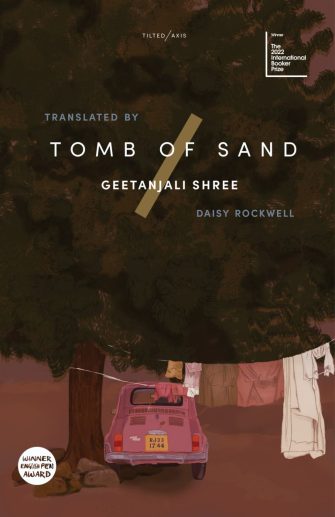
I moved on to Booker International in 2022; this is a book I struggle to review, as it is just so rich in its language and poetic voice. I finally tackled it after we, with the Booker shadow panel, just chatted with Daisy Rockwell, the translator of Tomb of Sand. She brought her process in translating the book alive and the wordplay and writing style Shree uses in her works. It made you think this must be the tip of the iceberg for Indian fiction in translation.
Well, I have finally finished reviewing this book as I just struggled to understand how remarkable Tomb of Sand is. I have read it twice and am still struggling with how to put it across. It is the fifth novel from Geetanjali Shree. Her earlier books have also been translated into English, but by other translators. Geetanjali was brought up in Uttar Pradesh, and she said the lack of available children’s books in English made her write in Hindi using her rich connection in Hindi ( I was lucky with my shadow Jurors to have a Zoom chat with Daisy where she said Geetanjali loved wordplay and sometimes just put pieces in the book for the wordplay). This is the first novel translated from Hindi into English to be longlisted, also shortlisted, and going on one step further: winning the International Booker Prize.
I agree with Daisy when she said there is a real blind spot in the UK for translated works from India and South Asia. I now know there is a new Prize in India, The JCB prize, which I will now be watching for books to read from India.
The book’s first title is Samadhi which is a Hindi word with a multitude of meanings. The English title was suggest by Daisy as it has part of what the word means but also makes you think about it (for me I felt it was in a way about the sand of time running out but that was my view when first reading the title). The book features an 80-year-old woman who has lost her husband at the start of the book and has gone into a slump. In the first hundred-odd pages, she is with her daughters just in her bed with grief, or I do wonder, if the grief is the loss of her husband or the loss of time in her life? Maybe that is just me. What is captured well: in her household, the coming and goings around Ma as she gets her life together, there is also a lot about how her being on with her daughter which I didn’t know isn’t very common. And she comes out of her room and starts to live again. This involves reconnecting with Rosie a Hirja ( a trans woman). On the cover, it says they meet after the husbands, but at times in the book, there is a reference to them spending time as kids as Ma visits Lahore. This is the later part of the book and is about the loss of identity when partition happened and how it had a knock-on effect on Ma, as She and her daughter Beti visit. That is just part of the book. Add a lot of sidetracks about the locals, birds and Hindi religion and myth, and you see how hard this book was to forget. I loved how this was put over in English. When it dropped through the letterbox, I went, oh no, a 700-page novel, but it is actually maybe a 500-page novel. What they did between the Hindi version of the book and the English is add chapter breaks. In Hindi, the the pages fill the book with 300 pages of tightly packed text. This story was hard to get into English as it had the ‘untranslatable’ tag. Daisy said the wordplay at times is hard to convey, but she found that if she had to cut something, another wordplay would appear in the same passage.
The book has a number of controversial stories. The first is Rosie. There are very few books written in India with Hijra are portrayed or even mentioned. I did feel that Rosie was a real person that the writer may have met. The mannerisms and speech just jump off the page. This is one of those books that is hard to put across. It is Ma’s world we see, the world through her eyes. I felt that after the first reading earlier in the year and even more after this reading, this is a book I will read again and again over time, which for me is something I never think of doing. Have you read this book, or any books translated from other Indian languages into English?
The writer:
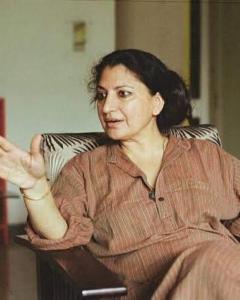
Geetanjali Shree गीताजंली क्ष्री (She was known as Geentanjali Pandey, and she took her mother’s first name Shree as her last name) (born 1957) is a Hindi novelist and short story writer based in New Delhi, India. She is the author of several short stories and three novels. Mai was short listed for the Crossword Book Award in 2001. She has also written a critical work on Premchand.
The translator:
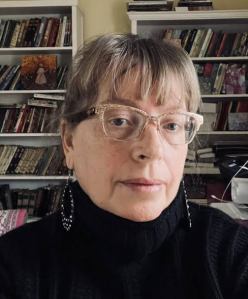
Daisy Rockwell was born in 1969 in Massachusetts. She has translated a number of classic works of Hindi and Urdu literature, including Upendranath Ashk’s Falling Walls, Bhisham Sahni’s Tamas, and Khadija Mastur’s The Women’s Courtyard. Her 2019 translation of Krishna Sobti’s A Gujarat Here, a Gujarat There was awarded the Modern Language Association’s Aldo and Jeanne Scaglione Translation Prize.
Post written by Stuart Allen.

This post is by guest curator Stuart Allen, the blogger behind the blog, Winstonsdad. Stuart is a lover of translated literature and world cinema. He started the #translationthurs hashtag on Twitter and his blog is rated the #1 translated literature blog in the world by Feedspot
 Global Literature in Libraries Initiative
A new prize: the JCB! Excellent!!
(Mind you, so there should be, all those Indian tech billionaires should be doing something patriotic with their money!)
I read Tomb of Sand a while ago, and I liked it enough, but I know a lot of it went over my head.
LikeLiked by 1 person
Very much so just find if a shame sometimes a lot of Indian fiction never makes it out of India
LikeLike
Yes, that is true. And maybe even more true here in Australia.
We used to be able to get a lot of books from around the globe through the Book Depository, postage free, but since it was taken over by Amazon, not only do we have to pay postage, but also the choice is more limited. We have to buy from AmazonAU, and they don’t have the same books as the parent company. So when it comes to books from India, they might be available in the UK, or the US, but not here.
It’s infuriating.
LikeLiked by 1 person