Now I have reached 2021, and I had to pick this book as I haven’t had a book from Africa in my choices. This writer is always a name that is on the list of writers who could win the Booker and is near the top of that list. He originally wrote his first book in English but has written most of his works in Gikuyu. He translated this book himself into English.
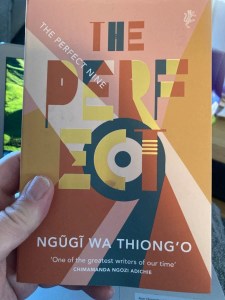
Ngũgĩ wa Thiong’o’ is one of the best-known and most respected African writers of his generation. He is often mentioned as a future Nobel winner, and in the last few years, he has been high in the betting each year. He was one of the first writers to break through and also one of the first writers to question colonial times and what happened. I reviewed his 1967 novel, A Grain of Wheat, some years ago, which was his best-known book. He wrote in English initially. In later years, he wrote initially in his native tongue, Gikuyu, and then translated his own writing into English. I feel that this was a great idea as he kept what must have been the rhythm the book had in its original language. This is a novel in verse that nods towards Greek classics.
The story is the story of his own tribe: a writing down of the oral history of the story of the Perfect Nine. Gikuyu and Mumbi have had nine perfect and beautiful daughters and well, there is a tenth daughter. So, the news of these daughters has spread. so when 99 suitors appear for them. The suitors are sent on quests ad challenges of strength and skill along the road to find the best set of final suitors by the parents, The last challenge for those that are left is to find the cure to help Wariga, the tenth daughter, who has been injured and needs a cure that is held by an Ogre king. So the suitors team up with each daughter and then set out. This is the origins of the tribe as each daughter settles with a suitor these are all told in little verses in the book that tells of them settling. An example is Wantjiru, the matriarch of the Anjiru clan, Wanmbui.
This is a poetic book that nods toward the Greek epic verses that are also told in verse poems like The Aeneid. But there is also the oral tradition of the storyteller around the fire. This is the history of a tribe that has been passed down from generation to generation. It is an origin story that echoes other origin stories from around the world. Gikuyu and Mumbi could be Adam and Eve and their descendants. But it is also a nod to tribal histories.
I remember Michael Palin visited a tribe and being shown a similar history to this. It follows a classic quest story like The Lord of The Ring’s journey that sees the daughters show strength but also sees the suitors fall to one side in a survival of the fittest. Myth and reality blur as the epic tells of the start of the tribe. It is very different from his earlier work, but also an exciting work that embodies a tribal and vocal history that in these fast-changing times is disappearing. The world is shrinking, and individual tribes and histories are disappearing. A writer who should be read, he captures a tribal world and his country’s changing history over the last 50 years.
Writer/Translator
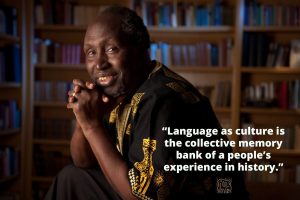
Ngugi wa Thiong’o is one of the leading writers and scholars at work in the world today. His books include the novels Petals of Blood, for which he was imprisoned by the Kenyan government in 1977, A Grain of Wheat and Wizard of the Crow; the memoirs Dreams in a Time of War, In the House of the Interpreter and Birth of a Dream Weaver; and the essays, Decolonizing the Mind, Something Torn and New and Globalectics. Recipient of many honors, among them ten honorary doctorates, he is currently a Distinguished Professor of English and Comparative Literature at the University of California, Irvine.
Post was written by Stuart Allen

 Global Literature in Libraries Initiative
This has inspired me to find a copy of one of his books and try it out.
LikeLike