Of all my adventures around the world of writing, the most startling and revealing happened closest to my home. Googling “Linguistics Program” took me to the University of Massachusetts (Amherst), which offers an amazing range of linguistics courses, including, but not limited to: Computational Linguistics Discourse Analysis Eye-tracking Field work First Language Acquisition Historical Socio-linguistics … Continue reading #EndangeredAlphabets: Final Post: An Adventure, A Doughnut Hole, A New Curriculum, An Appeal
#EndangeredAlphabets: How Do You Go About Reviving a Traditional Script? Case Study: Bali
"Suksma," or "Thank you," in the traditional Balinese language and script. Photo and carving by the author. Fairly often I get asked: what does it take to revive a traditional script that has been unused, or largely unused, for years? Decades? Centuries? Much less often, I actually have a clear, detailed answer. In this case, … Continue reading #EndangeredAlphabets: How Do You Go About Reviving a Traditional Script? Case Study: Bali
#EndangeredAlphabets: Roman Column
Endangered Alphabets Project poster, 2020. Design by Alec Julien, carving and photo by the author. The elegant maps that illustrate the spread of writing take at best a satellite’s-eye view of what really happens when one culture adopts writing from another. It may look as though writing spreads like a good idea (and there are … Continue reading #EndangeredAlphabets: Roman Column
International Mother (Written) Language Day
International Mother Language Day, February 21st, is a kind of well-intentioned bureaucratic expansion of the Bangladesh observance of National Martyrs Day, a remembrance of the day in 1952 when five people were killed for protesting their right to speak Bengali (Bangla) rather than Urdu, the official language of the new state of Pakistan. What came … Continue reading International Mother (Written) Language Day
#EndangeredAlphabets: God’s Handwriting
Rembrandt, Moses, stone, God's handwriting Our sense of the extraordinary qualities of writing has sunk so much in the past century that when we hear how many cultures have traditionally regarded writing as a divine creation, a gift to the human race by a deity, we shrug it off as superstition and ignorance. In a … Continue reading #EndangeredAlphabets: God’s Handwriting
#EndangeredAlphabets: Two Cheers for Rongorongo
Rongorongo. Source: Wikipedia. Even though my work is more about endangered scripts than those no longer in use, I love Rongorongo, a glyph system discovered over a century ago on Rapa Nui, a.k.a. Easter Island., which recently returned to the news through a rather breathless article in Smithsonian magazine. What makes Rongorongo, which has so … Continue reading #EndangeredAlphabets: Two Cheers for Rongorongo
#EndangeredAlphabets: The Songbook Scripts
Zhuang Musicians in Longzhou. Source: Wikipedia Those of us from Western Europe and the Americas use a script that is so widely used we barely recognize it as a script. In fact, we often refer to it as “the” alphabet, as though there were only one. For us, our script is writing itself; most of … Continue reading #EndangeredAlphabets: The Songbook Scripts
#EndangeredAlphabets: Whatever You Do, Don’t Call It Picture-Writing
Papyrus painting. Photo by the author. Today this column ventures through not only space but time—to ancient Egypt, or more accurately to a papyrus painting in the style of Egyptian hieroglyphics, kindly given to me by the parents of a student graduating from my writing program, a decade ago. Like most people, I know … Continue reading #EndangeredAlphabets: Whatever You Do, Don’t Call It Picture-Writing
#Endangered Alphabets: The Gnostic Script
Article One of the Universal Declaration of Human Rights in the Mandaic script. Carving and photo by the author. Many, many of the world's less-known scripts might change the way you think about writing, but none more so, I suspect, than the Mandaic. The Mandaeans have possibly the most exquisite awareness of the importance of … Continue reading #Endangered Alphabets: The Gnostic Script
#WorldKidLit Wednesday: !Qhoi n|a Tjhoi. Skilpad en Volstruis. Tortoise and Ostrich
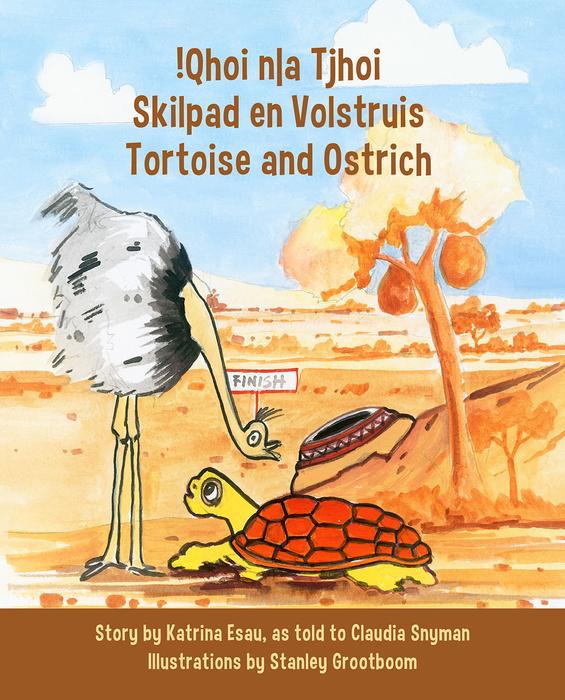
Long ago, animals and people from different clans lived together in the Kalahari. One of the clans was the San. The San men hunted with bows and arrows, while the women cooked food in clay pots that they made themselves. One day, a huge sandstorm came from the sky, and when it was over everything … Continue reading #WorldKidLit Wednesday: !Qhoi n|a Tjhoi. Skilpad en Volstruis. Tortoise and Ostrich
 Global Literature in Libraries Initiative