
Today’s post comes to you from Joyce Chua
See this sample list of #SingLit YA books…
Does YA Fiction Still Have a Place in the Attention Economy?
We live in an attention-deficit age.
With access to streaming services, news, podcasts, video and mobile games, a plethora of social media platforms and more, it is now the norm to be inundated with the onslaught of content aimed at monopolising our attention. An average morning routine involves checking our phone as soon as we wake up, listening to a podcast or news on the way to work or watching TikTok video after TikTok video on the way to school.
Content is increasingly bite-size, and videos are watched in 2X speed. Long-form blog posts are replaced by 15-second reels, and books are relegated to dusty cupboards in favour of smartphones. Many people stop reading books after graduation, citing the lack of time and headspace to focus on them.
But the third reason is often not mentioned: this very bombardment of content all around us that has reduced our ability to focus on a book.
This then begs the discussion: does fiction still have a place in our entertainment repertoire? Is there still value in reading, especially for teens who grew up in the age of social media?
The Value of Fiction in a Time-Starved Age
The information saturation can make us feel as though our brains are a browser with too many tabs open. Buddhists dub this the “monkey mind”— like how a monkey swings from branch to branch, our hyperstimulated brains swing from one thought to another, one source of entertainment to another.
Information overload can “feed the monkey”, making it jump from thought to thought, reducing our focus and attention span. Unsurprisingly, reading a book becomes a cognitively harder task and a less appealing pastime over time as compared to scrolling on our phone, which offers instant gratification and consecutive dopamine hits.
Paradoxically, reading might just be a panacea to our monkey brains.
Reading makes us slow down, immerse ourselves in the experience of a story, understand he world and setting, the systems and structures, and the psyche of the characters. It requires our brains to do mental gymnastics that develop our cognitive muscles. We learn to read between the lines, to pick up nuances in language, and place ourselves in others’ shoes to understand them better. Our ability to stay till the end of a full-length novel increases our attention span and teaches our brains to appreciate delayed gratification.In an age where brands, influencers, and content creators demand for our attention, pulling us in all directions and leaving us mentally scattered, books do the opposite of that, concentrating all our attention on one story—and somehow, we remember a well-told story that touched us more than a 30-second video we scrolled past on our feed.
Are the Youth Okay?
According to a recent survey conducted by the Institute of Policy Studies and CNA, Singapore teenagers aged 13 to 19 spend nearly 8.5 hours a day on screens on average. This includes almost three hours for schoolwork, followed by at least two hours for entertainment and social networking.
The growing adoption of smart devices in schools contributes to the normalisation of these devices in everyday life. Despite the logistical benefits that a digitalised pedagogy offers, institutions legitimising the need for smart devices might be one of the catalysts for the eventual reliance on them.
Compounded with the prevalence of social media apps that are designed to retain your attention with features like auto-play and infinite feed, it’s little wonder that teens are becoming inseparable from their smart phone or tablet. And research has also shown that prolonged screen time, especially on social media, is closely linked to increased feelings of isolation and disconnection.
Reading can help to dispel that. Despite being a solitary activity, it makes us feel less alone and isolated by introducing us to characters that we may relate to and empathise with. I remember my eight-year-old self regarding Jo March and Pippi Longstocking as my best friends and spirit animals, because they were what I aspired to be—brave, bold, confident, passionate, and inquisitive, always marching to the beat of their own drum and standing by their convictions.
As a teen in the 2000s, my consumption of young adult books I read have made me feel less isolated as I experienced the growing pains of teenhood. While blockbusters like Twilight, The Hunger Games, Divergent, Legend and more made the young adult (YA) category the market juggernaut it is now, quieter coming-of-age books like those from Sarah Dessen, Deb Caletti, and John Green brought me solace and made growing up less daunting. I wouldn’t be the writer I am now without those books that shaped my formative years.
Does Singapore Need Teen Fiction?
There is proof, time and again, of the appeal of YA fiction.
From the glut of teenage paranormal romance books in the 2000s to the proliferation of romantasy we see in the market now, YA fiction continues to prove its commercial value with timeless, universal themes that capture people of all ages.Some might say that with other sources of entertainment, pressing commitments and obligations vying for an average teenager’s time, reading seems to be an increasingly outdated hobby.
Especially in Singapore, a performance-driven society driven by the unending quest for efficiency, reading fiction could be seen as a frivolity, an activity that yields little to no tangible returns. Why should one spend hours and days immersed in a made-up story, some ask?
To that I reply, a hobby is not merely measured by the quantifiable return it yields. The soul of a society lies in the stories it inspires.
Fiction is a reflection of the world we live in. Terry Brooks described in his Ted talk in 2012 how his fantasy stories mimic the sociopolitical dynamics he sees in real life, and R.F. Kuang often writes about anti-colonialism in her books, which borrow from real-world events.
Fiction requires not just imagination, but also a willingness to examine the world we live in—to question the existing structures, to contemplate the what ifs, and to convey that in a three-act story that stirs curious, exploratory minds.
In young adult fiction, the characters usually sit on the cusp of adulthood. They experience various pivotal events, situations, milestones, rites of passage, growing pains — often for the first time — and through that lens the reader gets to examine, observe, and reflect on those experiences and their own.
Reading fiction is thus an expansion of the imagination. It helps us understand the world and all its different cultures, peoples, and ways of life. Beyond rote learning and graded assignments, books are a school on their own — one that teaches us not just the words on the page, but the meaning tucked between the lines, the emotions and desires and psyches among the sentences. They take us chapter by chapter through a character’s life and instills empathy, curiosity, understanding and acceptance of lives different from ours. And the humanity that a story imbues in readers—especially teenage ones—is just as vital, if not more so, as one’s ability to be a high-functioning cog in a well-oiled machine.
Particularly in a city-state like Singapore that prizes STEM industries over the arts, stories remind us of our humanity. Singaporean literature (also known as Singlit) that capture the zeitgeist of local culture while pushing the boundaries of collective consciousness—like Wen-yi Lee’s When They Burned the Butterfly (2025), June CL Tan’s Darker By Four (2024), and Jared Poon’s City of Others (2026), to name a few—can reengage a population and inspire it to think beyond the confines of our sheltered existence.

See also this GLLI blog post on Singapore YA literature from Oct. 28, 2019 — by Kim Beeman.
The Quiet Power of Fiction in a Noisy World
In a world where attention is currency, the endless bids for eyeballs can be fatiguing.
Yet, fiction remains a safe haven for the weary, the curious, the damaged, the lost, and the human. It makes us wonder, imagine, reflect, understand, and connect.In a content-saturated digital age, in a productivity-driven society engineered for efficiency and growth, fiction is a playground, a sandbox, where the goal is not to arrive at a destination, but to understand and appreciate the journey. And young adult fiction is the place where we can begin, once more, to see the world through the lens of someone on the cusp of taking their first step into the vast unknown.

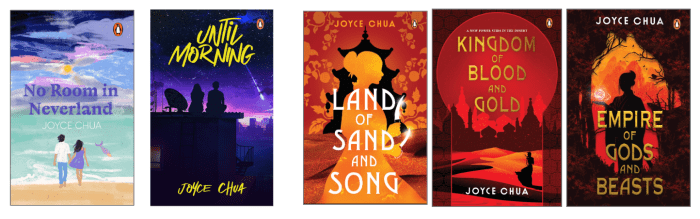
Joyce Chua is the author of the Children of the Desert trilogy, Until Morning, No Room in Neverland (all published by Penguin Random House SEA). She graduated from the National University of Singapore with a degree in English, and is now a content specialist by day and author by night. Her articles have appeared in The Straits Times, Harper’s Bazaar, Cosmopolitan, Yahoo, and more. She was a writer-in-residence at the National Centre for Writing in 2025, and can be found on Instagram, Threads, and TikTok at @joycechuawrites, as well as her website joycechua.com
Disclaimer: The opinions and views expressed are the author’s and do not necessarily reflect those of GLLI.


One thought on “#IntYALitMonth: A Singapore Perspective”