Today’s post comes to you from Nadine Bailey
The Colour of Tears
Alessandro D’Avenia is an Italian high school teacher with a PhD in Classical Literature. Both his love of classical literature and his real-world classroom experiences shine through in this wonderful glimpse into a year in the life of our sixteen-year-old protagonist, Leo.
Leo starts the school year as a typical teen boy interested only in soccer, gaming, riding his scooter, playing his guitar, and making dares and bets with his friend Niko. He describes his life strictly in terms of colors.
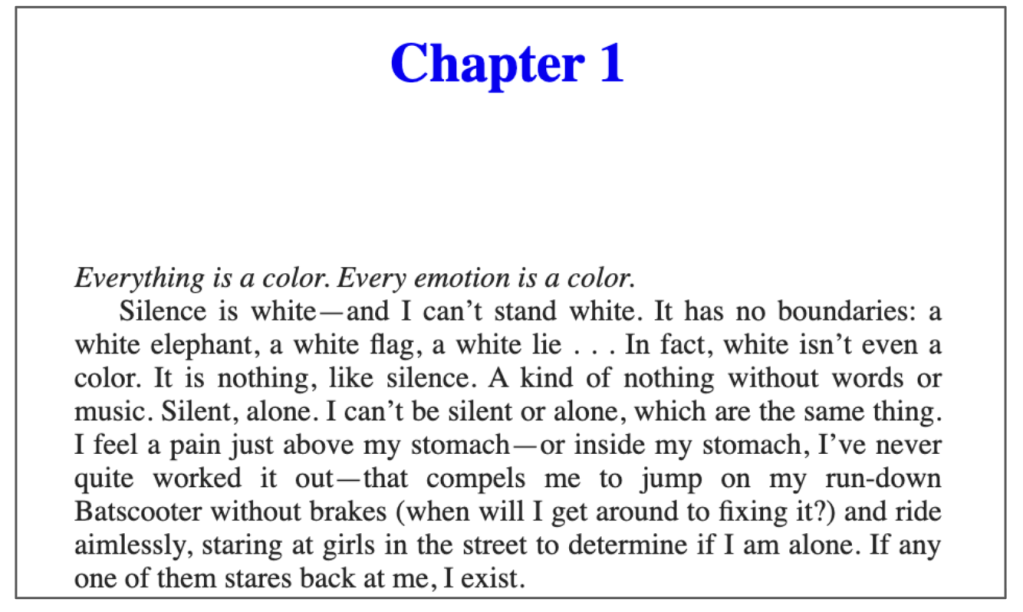
To Leo, white represents silence, emptiness, apathy, and fear. Blue belongs to his best friend Silvia, who “is blue, like all real friends… a blue angel,” and who, in turn, secretly harbors a crush on him. Then there is red. Red is Beatrice, a girl he glimpses before and after school but has never actually had a conversation with. Leo harbors an intense, unrequited infatuation with her, noting: “Beatrice is red. The easy love is red. A tempest. A hurricane that sweeps you away. An earthquake that crumbles your body to pieces. That’s how I feel every time I see her.”
Initially an apathetic and indifferent student who proclaims Bart Simpson as his “sole teacher and guide,” Leo is fully prepared to wreak havoc on the new history and philosophy substitute teacher. Leo preemptively describes him as “by definition a cosmic loser” and “the worst—someone who loves what he studies and believes in it.”
However, our nameless teacher rises to the challenge. By preempting the “loser” jibe with a captivating discussion of “A Thousand and One Nights” and insisting that having dreams is what truly matters, he earns the nickname “The Dreamer.” Provoking his students in a manner somewhat reminiscent of John Keating in Peter Weir’s classic 1989 film Dead Poets Society, The Dreamer pulls Leo and the rest of the class out of their indifference, challenging them to find their passions and a dream worth fighting for.
The seamless inclusion of classical literature, philosophy, and history—while staying true to teen culture and interests—is why this book is such a wonderful read. D’Avenia powerfully weaves in the concept of destroying a society’s spirit by destroying its dreams, historically illustrated through the pillaging and burning of books.
The Dreamer urges them to “never give up on your dreams … history is a cauldron of projects undertaken by people who became great for having the courage to turn their dreams into reality, and philosophy is the silence from which these dreams are born. Even if at times, unfortunately, the dreams these men had were nightmares, especially to those who paid the price.”
Both The Dreamer and Leo’s father recognize that the greatest threat to a teenager isn’t failing a class—it’s apathy. This leads to a wonderful scene between Leo and his father after Leo cuts class. His father tells him of a time he also skipped school, saying: “At that moment I realized that what was important when faced with the freedom of the sea was not having a ship to sail it, but a place to go to, a harbor, a dream for which it was worthwhile to cross all that water … If I had gone to school that day … I wouldn’t be the man I am today. I got the answers I needed on a day I didn’t go to school. A day in which, for the first time, I searched for what I wanted by myself, at the cost of being punished.”
Written in the era of early smartphones and nascent text prediction technology, the novel includes clever riffs on text faults—like “god” autocorrecting to “Fin.” Leo’s emotional journey mirrors this technology; he must transition from living life on “autocomplete” and letting things happen to him, to purposefully choosing his own profound words and actions when facing the harsh reality of grief.
That grief arrives when Leo discovers Beatrice has terminal leukemia. While the book is often compared to John Green’s The Fault in Our Stars, the narratives are quite distinct. Leo, as a healthy teen, has a one-sided infatuation with a sick girl, and witnessing her illness from the outside forces him to wake up and find meaning in his own life. As he concludes of his rapid maturation, “I was born on the first day of school, and I grew up and old in just two hundred days . . .”.
The book is divided into 113 short chapters, which gives it a very rapid feel despite dealing with the heavy themes of growing up, realizing the humanity of the adults around you, navigating the illness and death of a person you desire, maintaining friendships, and discovering that love is less about beauty and more about communication, presence, and understanding.
It’s a “must-read” for teens aged 13 and up.
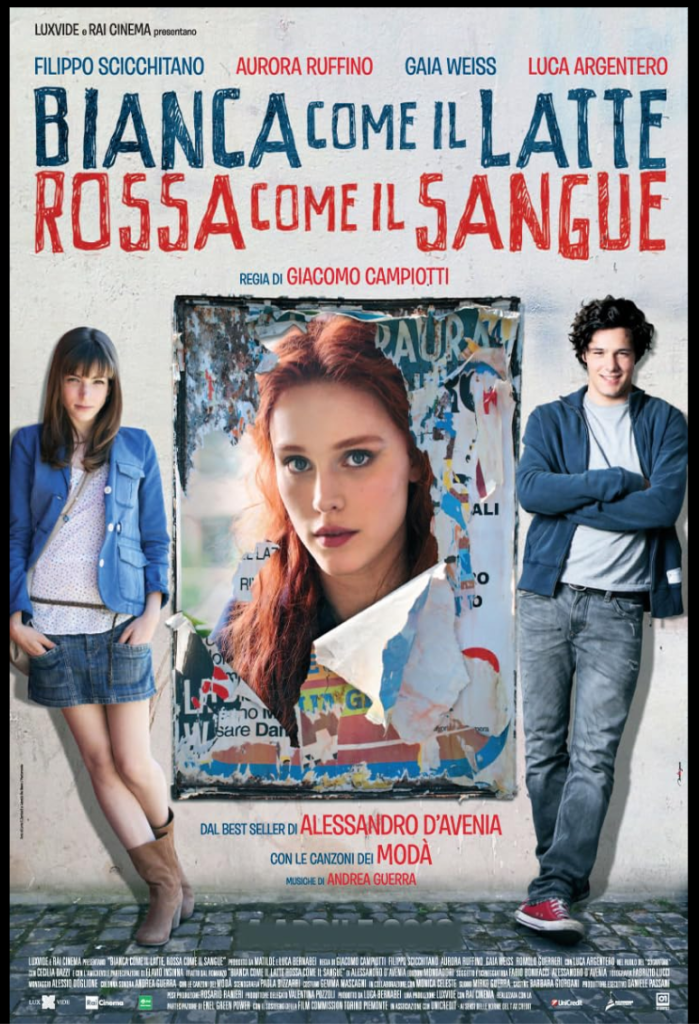
Italian film adaptation: 2013 (IMDb) — watch movie trailer (in Italian) here.
Another book by Alessandro D’Avenia was reviewed on GLLI a year ago — What Hell Is Not / Ciò che inferno non è (2014) (translated by Jeremy Parven, 2019).
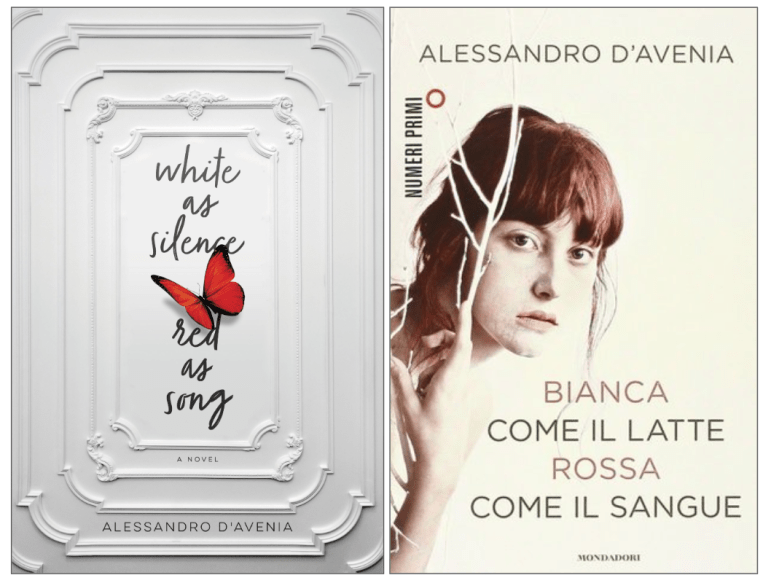
TITLE: White as Silence, Red as Song (2018) / Bianca come il latte, rossa come il sangue (2010) /

AUTHOR: Alessandro D’Avenia / Instagram: https://www.instagram.com/alexdavenia/. This book, his debut novel, was “translated into more than twenty languages and sold more than one million copies in Italy…. His book, L’arte di essere fragili (The Art of Being Fragile), published by Mondadori in 2016, was number one across all genres in Italy for more than five months and has since sold more than 700,000 copies. Ogni storia e’ una storia d’amore (Every Story Is A Love Story), published in October 2017, and his novel L ’Appello (The Register), were published by Mondadori and were also number one in the charts. The three books became bestselling theatre shows directed by Gabriele Vacis. His latest book Resisti, cuore (Hold on heart) was published by Mondadori in October 2023. His seven books combined have sold over 3.5 million copies in Italy alone.” (Via Andrew Nurberg Associates)
TRANSLATOR: Tabitha Sowden / Interview — Podcast, Feb. 9, 2023, with transcript: “Country-Hopping Gen X’er, Tabitha Sowden, on Straddling Cultures”
PUBLISHER: Thomas Nelson, 390 pages, 2018. Originally published by Mondadori in 2010.
AUDIO BOOK: Audiobook narrated by John Behrens – 5 hours and 8 minutes
ISBN: 9780785217060
REVIEWS: Kirkus review – Sep. 4, 2018

Nadine Bailey is middle school teacher librarian, currently living and working in Dubai, formerly in Beijing China, Singapore and a bunch of other cities around the world. Next year she will be working in Switzerland.
Passionate about our students seeing themselves and their worlds in literature and developing curiosity and a passion for reading and learning. You can read her previous GLLI posts here; see also her blog, “Informative Flights.”
Disclaimer: The opinions and views expressed are the author’s and do not necessarily reflect those of GLLI.


One thought on “#IntYALitMonth: White as Silence, Red as Song”