
Welcome back to #WorldKidLit month! Today’s post comes to us from Nadine Bailey.
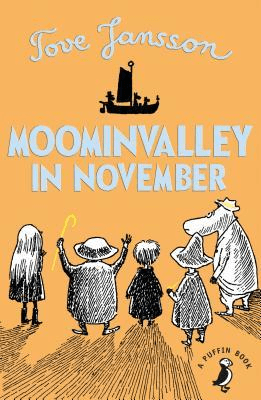
Moominvalley in November by Tove Jansson (1970) translated by Kingsley Hart (1971) is the final prose Moomin book, written twenty-five years after her first book. The first Moomin book (The Moomins and the Great Flood, translated by David McDuff, 1945) was written at a time of war, and the ideas of dangers are suppressed by showing a happy troll family in an idyllic valley. By 1970, Tove was increasingly feeling the weight of being the Moomin author and wanted to put writing for children behind her and become a serious adult writer, even as her publisher and public insisted on grasping back to the memories of what they thought the Moomins should be. Her biographer Boel Westin writes, “For Tove, Moominvalley was something she had to leave behind if she was herself to be seen”.
It is therefore fitting that Moominvalley in November has fewer of the characteristics of a children’s book and is imbued instead with the autumnal feelings of dreams, memory, loss and longing. In some senses the book is a remembrance of things to come. By the summer of 1970, the book had been written, her mother had died, and she had to complete the intensive work of the eighty-three illustrations for the book.
Reading this book as an adult, one can see the narrative on two levels. One that of an adolescent who has to individuate and let go of their role in, and idea of, the family, and the other of the adult child who has to let go of a parent in the face of aging and death.
Tove always wrote the people in her life into the Moomins, and in this book she becomes the Whomper Toft who expresses a longing for the family – the idea of a family, and ways of expressing feelings in the face of the loss of family. The glimpse of a return in the crystal ball at the end is a shadowy promise that may or may not have merely been imagination.
Each of the six characters – Fillyjonk, Toft, Grandpa-Grumble, the Hemulen, Snufkin and Mymble – are used to convey the autumn of the Moominvalley era.
On the one hand we have Fillyjonk writing about the family as a source of comfort and warmth
“It’s nice to gather together everything you possess as close to you as possible, to store up your warmth and your thoughts and burrow yourself into a deep hole inside, a core of safety where you can defend what is important and precious and your very own” (p4).
While Toft tells himself the story of the “Happy Family,” this is fiercely refuted by Mymble. “The family … They went to the back garden when they were fed up and angry and wanted a bit of peace and quiet. ” Toft: “It’s not true! They were never angry” … Mymble “and I can tell you that both Moominpappa and Moominmamma get terribly tired of one another from time to time” (p144).
The Hemulen speaks to the ideas of veering between attempting to please everyone and being true to oneself “He tried being the hemulen that everybody liked, he tried being the hemulen that no one liked. But however hard he tried he remained a hemulen doing his best without anything really coming off” (p27)… “But best of all he remembered what it felt like to wake up in the morning and feel happy” (p29).
Grandpa-Grumble alludes to the fantasy of the Moomins and Moominvalley, regretting the process of both aging and the uncovering of truth: “but you must stop telling me about the way things are and let me go on believing in nice things” (p.87).
While Snufkin reveals the art of the success of the Moomins: “Moomintroll was the only one who knew how to write to a snufkin. Brief and to the point. Nothing about promises and longings and sad things. And a joke to finish up with” (p. 93) and in doing so reveals precisely the objections Jansson’s public had to the departure from this formula in Moominvalley in November.
In the end all the longing of Toft for Moominmamma are revealed in the plea “I don’t want friends who are kind without really liking me and I don’t want anybody who is kind just so as not to be unpleasant. And I don’t want anybody who is scared. I want somebody who is never scared and who really likes me. I want a mamma!” (p. 142).
Moominvalley in November is the perfect book for the autumn – both the literal autumn and the autumn of young children’s lives and for the adults who are mourning the actual or eventual loss of their families.

By Nadine Bailey – middle school teacher librarian, currently living and working in Dubai, formerly in Beijing China, Singapore and a bunch of other cities around the world. Passionate about our students seeing themselves and their worlds in literature and developing curiosity and a passion for reading and learning. You can read her previous GLLI posts here; see also her blog, “Informative Flights.”
The views, opinions, and thoughts expressed in this blog post are solely my own and do not reflect the positions, policies, or opinions of any current or former employer. Any references or examples provided are intended for informational purposes only and should not be construed as endorsements or official statements from any organization I have been associated with.
 Global Literature in Libraries Initiative
One thought on “#WorldKidLit Month 2025: ‘Moominvalley in November’”