Welcome back to #WorldKidLit Month!
I will recommend some excellent, traditional translations of the Brothers Grimm at the end of this post, but first I want to suggest that your collection or library needs a copy of Grimms Märchen ohne Worte (Grimm’s Fairy Tales Without Words) no matter how many other editions of Grimm’s you may already have.
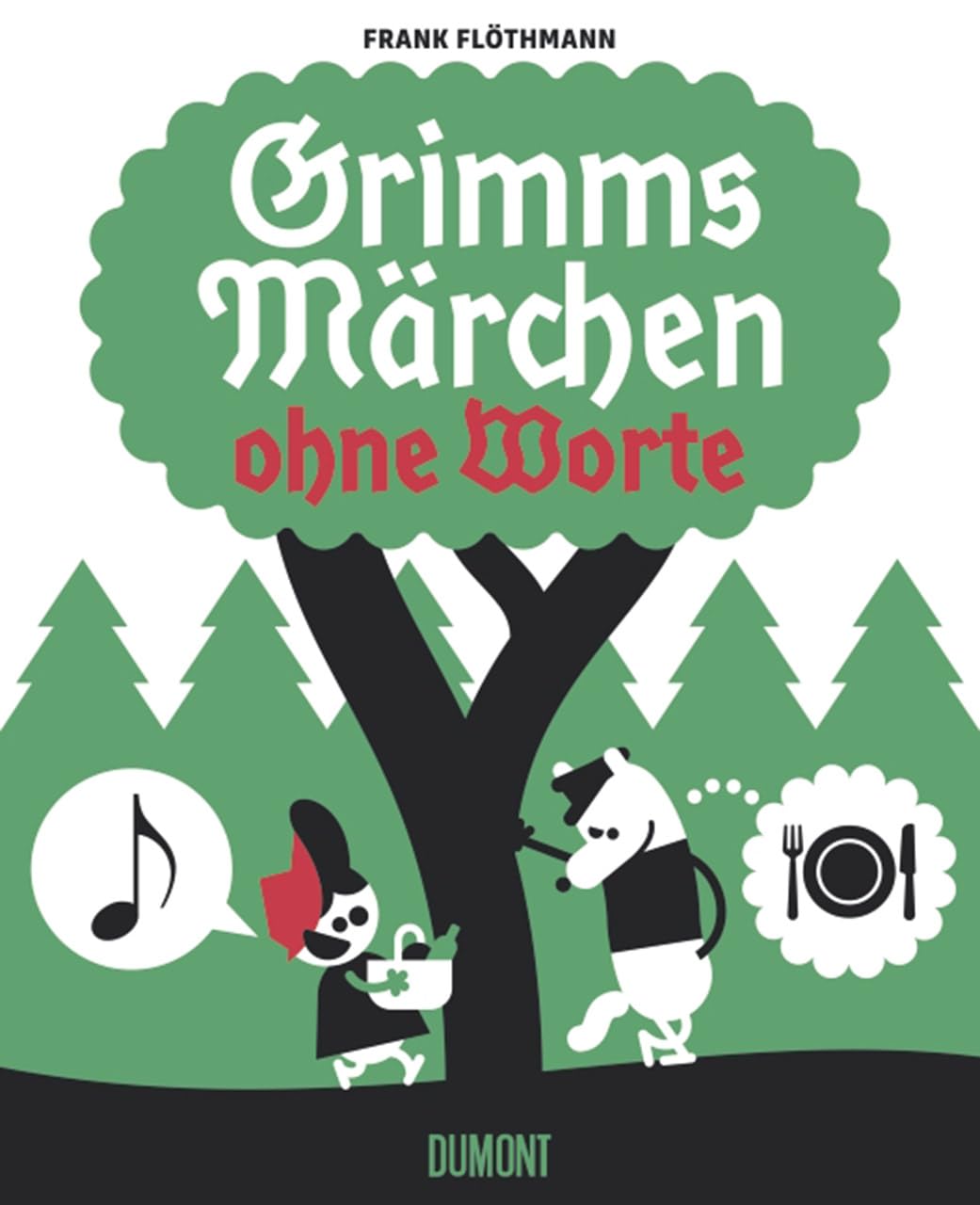
Published in Germany in 2013, Grimms Märchen ohne Worte was illustrated (and, I would argue, translated!) by Frank Flöthmann.
The premise is simple. Flöthmann takes several well known Grimm’s tales (Little Red Riding Hood, Hansel and Gretel, The Town Musicians of Bremen, Sleeping Beauty, and others) and turns them into wordless, comic-book-style stories. As he says, at the same time, he gave them “boiled-down plots, alternative endings, surprising twists.“
Flöthmann has a deep understanding and appreciation of both comics and pictograms, which come across clearly in his illustrations.
Here, for example, is his version of Little Red Riding Hood:
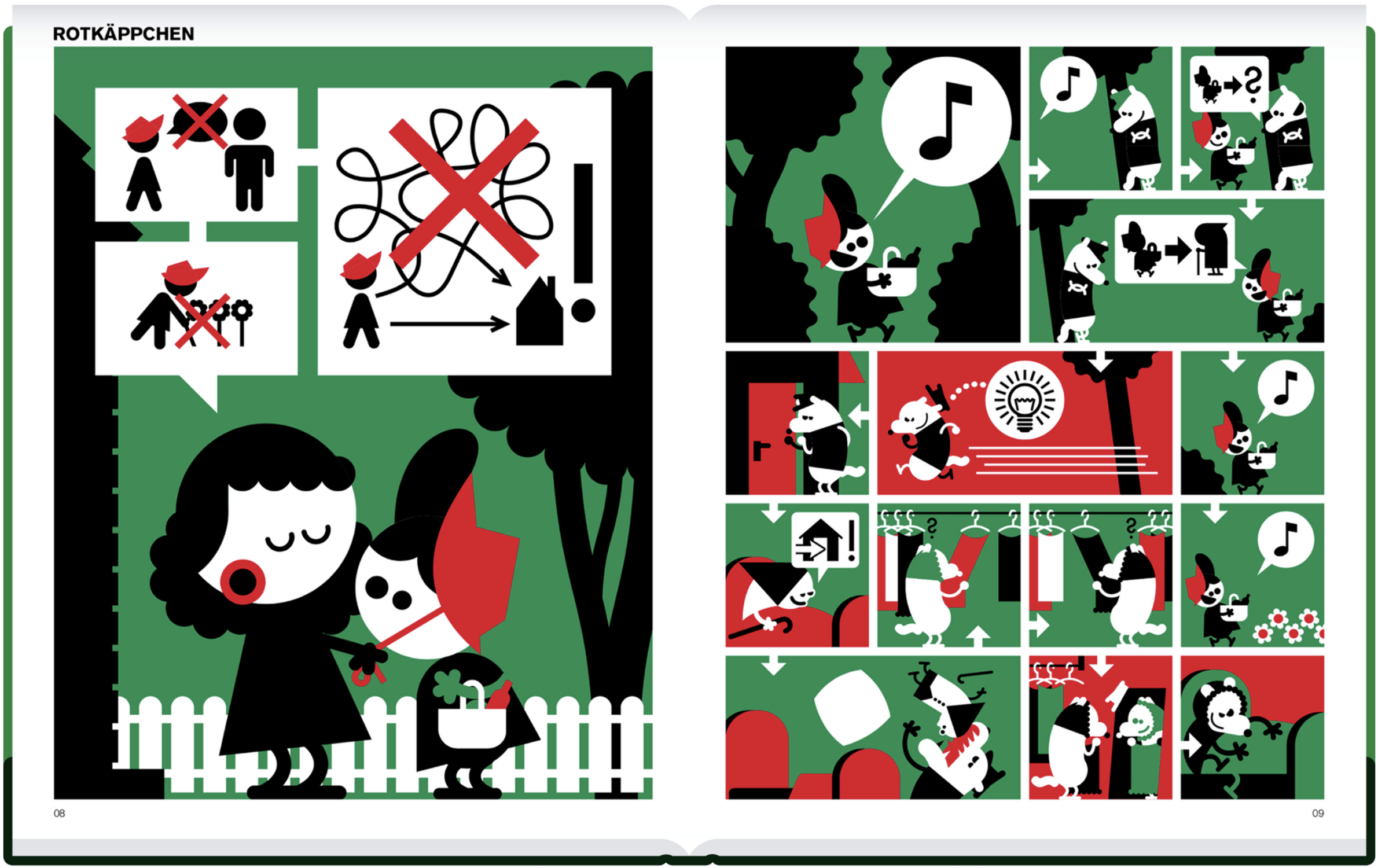
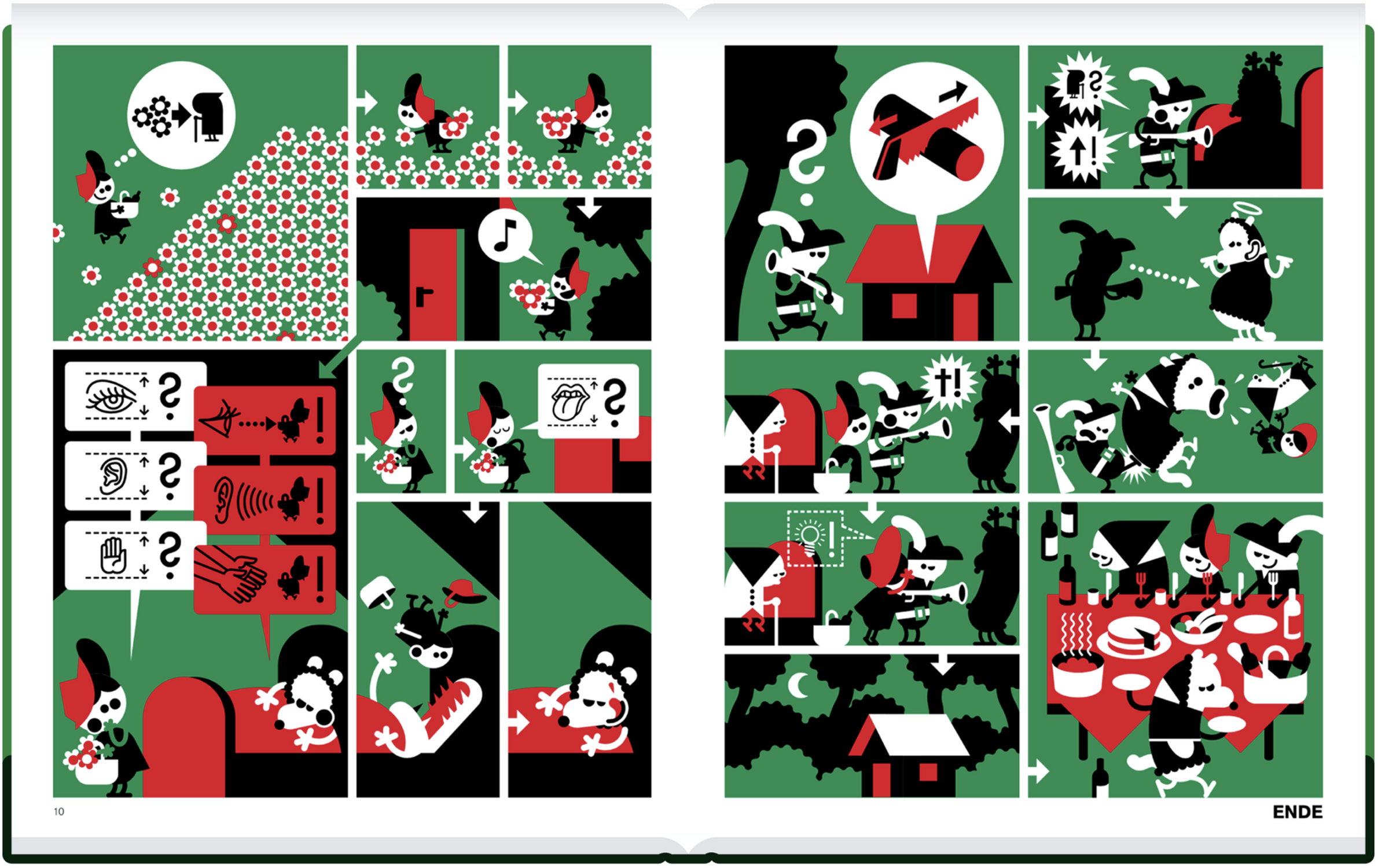
The essential elements are all there – the admonition not to wander from the path, the inevitable dilly-dallying, the swallowed grandmother, the “All the better to see you with, my dear!” I like the twist at the end, though – Little Red decides to bring the wolf back to serve them dinner, a fitting punishment since he tried to make her his dinner!
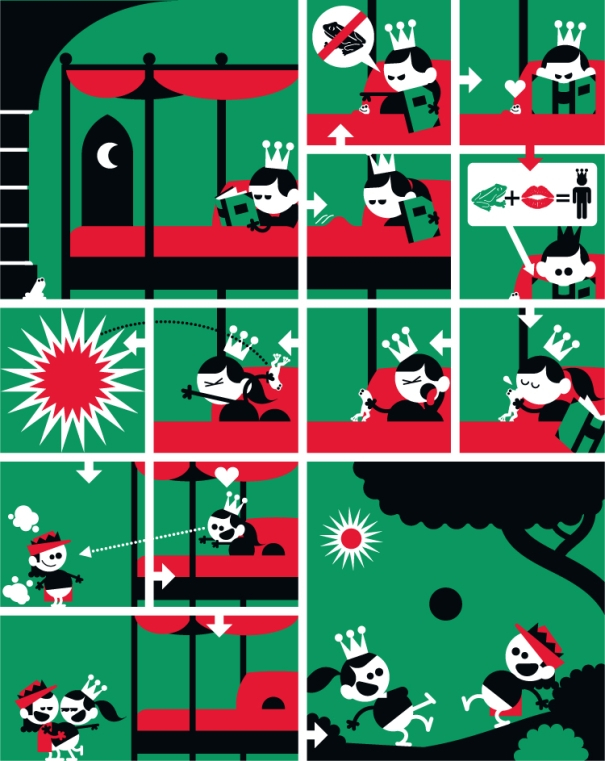
In another alternative ending, The Frog Prince becomes a football companion rather than a romantic partner:
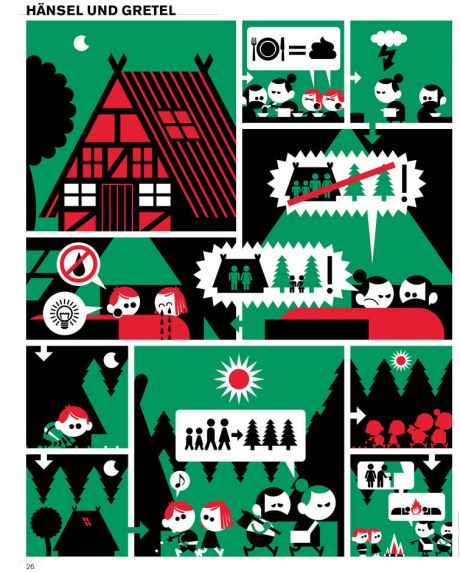
Were Hansel and Gretel really out of food at home, or did they just complain one time too many that dinner was a bit crap?
Flöthmann’s version stay close enough to the standard tales that they could easily be enjoyed alongside the originals. Though the simple color scheme and the use of panels may make the stories look quite simple, but I found that they were often deceptively complex. This book can definitely be enjoyed by younger readers, but older students, especially those already thoroughly familiar with the original tales, will probably get the most out of the book.
There are now several books in the “Ohne Worte” series: Shakespeare ohne Worte / Shakespeare without Words (2016), Männer ohne Worte / Men without Words (2014), and Helden ohne Worte / Heroes without Words (2022).

If you would like a more traditional translation of the Grimm’s Fairy Tales, I am partial to The Original Folk and Fairy Tales of the Brothers Grimm: The Complete First Edition (2014), written by Jacob and Wilhelm Grimm, and edited and translated by Jack Zipes. Published by Princeton University Press, this edition includes all 156 stories from the 1812 and 1815 editions, as well as an excellent scholarly introduction, which focuses on the lives of Jacob and Wilhelm Grimm. Jack Zipes is a scholar, translator, and author with a specialization in German literature and fairy tales. This edition is suitable for older readers, as the translation does not hold back. (There is blood and gore aplenty.)

For an even more thorough scholarly look at the Brothers Grimm, I would recommend The Annotated Brothers Grimm (2004), written by Jacob and Wilhelm Grimm, edited and translated by Maria Tatar. Tatar, a professor of Germanic literature and languages at Harvard, translated 37 of the stories. She added significant additional context through her annotations, drawing on the commentary and writings of the Grimms, as well as commentary about the ways the stories have been used by other authors and in popular culture. (Note: This particular edition is now out of print, but used copies can be found relatively easily.)

Kim Beeman is currently living in Rome. Before moving to Italy, Kim spent over a decade in Asia, working as a librarian at Shrewsbury International School in Bangkok and Tanglin Trust School in Singapore. She also co-founded the International School Librarians in Europe conference, and is a member of the advisory board for the Librarians Knowledge Sharing Workshop. Before working in school libraries, Kim worked as a cookbook librarian at The French Culinary Institute in New York City for many years, where she completed the professional culinary program and was certified as a sommelier through the Court of Master Sommeliers. [LinkedIn]
 Global Literature in Libraries Initiative
One thought on “#WorldKidLit Month 2025: Grimm’s Without Words”