Welcome back to #WorldKid Lit Month! Today’s post about a graphic novel written by an author from the Netherlands comes to us from Kim Tyo-Dickerson.
Ink Girls (2023), written by Marieke Nijkamp and illustrated by Sylvia Bi, is a vibrant, alternate history graphic novel starring three rebel girls fighting against censorship and corruption, a story that belongs in every upper elementary and middle school library!
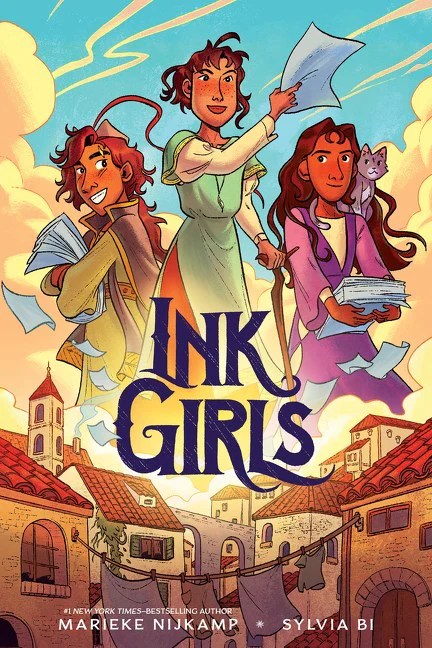

In Marieke Nijkamp‘s middle grade graphic novel, Ink Girls, the traditional, European Hero’s Journey gets a radical, girl power makeover when three brave girls take on political elites, censorship, and corruption in the fictional Renaissance-era Italian city-state of Siannerra.
Who are the Ink Girls?
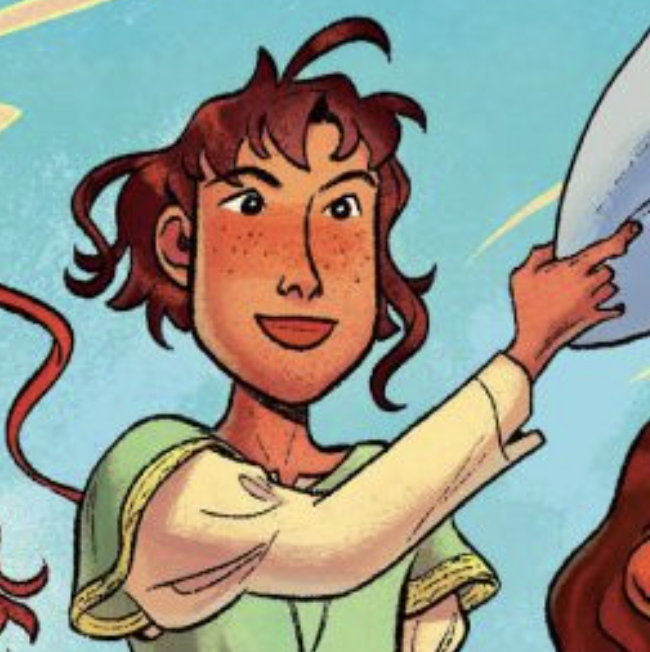
Cinzia: A feisty printer’s apprentice who uses a cane, adopted by the printer Mestra Aronne.
Cinzia’s life is turned upside down when her mestra is arrested as a traitor after publishing and distributing avvisi, news pamphlets, that reveal the city’s Lord Magistrate is extorting money and stealing from the people. With her trusty cane and quick wit, Cinzia expertly navigates the winding streets of Siannerra. When she escapes from the palazzo guards and stumbles into Elena’s royal garden, she sets in motion a chain of events that will change the fate of her city. She is fearless and resourceful, and her commitment to justice makes her a hero in her own right.
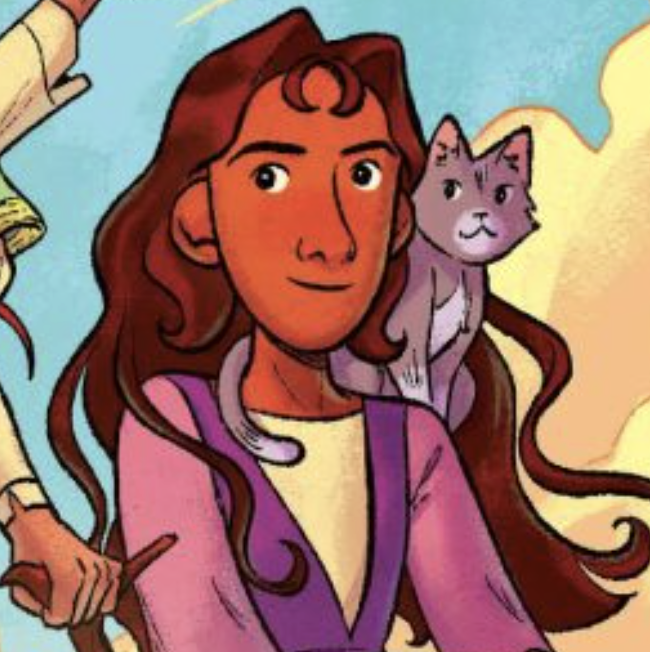
Elena: The shy and reclusive heir to the throne, daughter of the Principessa.
Elena is the heir to the throne of Siannerra. Unlike the princesses of classic fairytales, Elena’s life is not a whirlwind of balls and royal duties; instead, she is confined to her rooms and a secluded garden. Her family, especially her uncle the Lord Magistrate, considers her too naive and blunt to be part of the deceitful ruling elite, but it’s precisely these traits that make her a powerful and unique hero. When the spirited printer’s apprentice, Cinzia, lands in her garden, Elena’s world expands. Elena’s ability to see the world literally and logically allows her to cut through the political lies and schemes that blind her family, making her an invaluable ally in the fight to expose her uncle’s corruption and restore justice to her city.
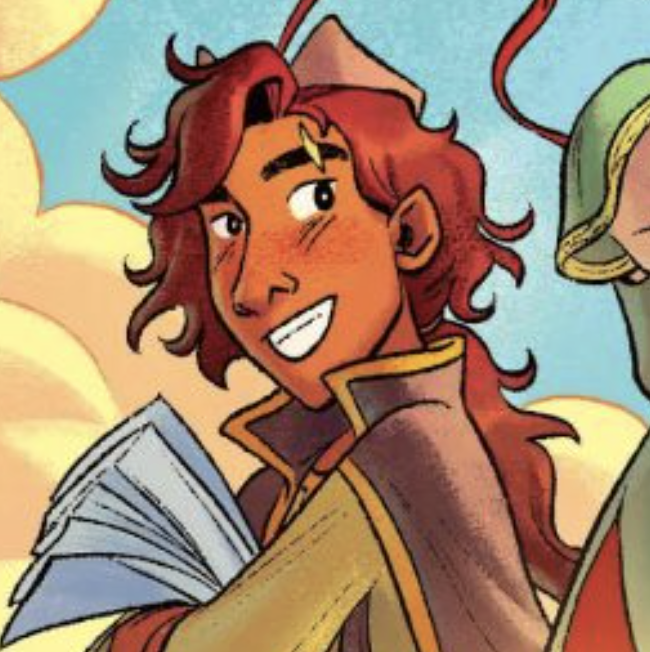
Carlotta: A pirate with a kind heart who helps the girls on their quest.
Carolotta is a spirited pirate who, unlike her elite family members who are trapped by the city’s rigid social structures, has chosen a life outside the palace walls. She’s not afraid to break rules or challenge authority, which makes her an invaluable ally to Cinzia and Elena. Carlota’s resourcefulness and intimate knowledge of the city’s hidden nooks and crannies provide the girls with a way to navigate their dangerous mission to free Mestra Avonne.
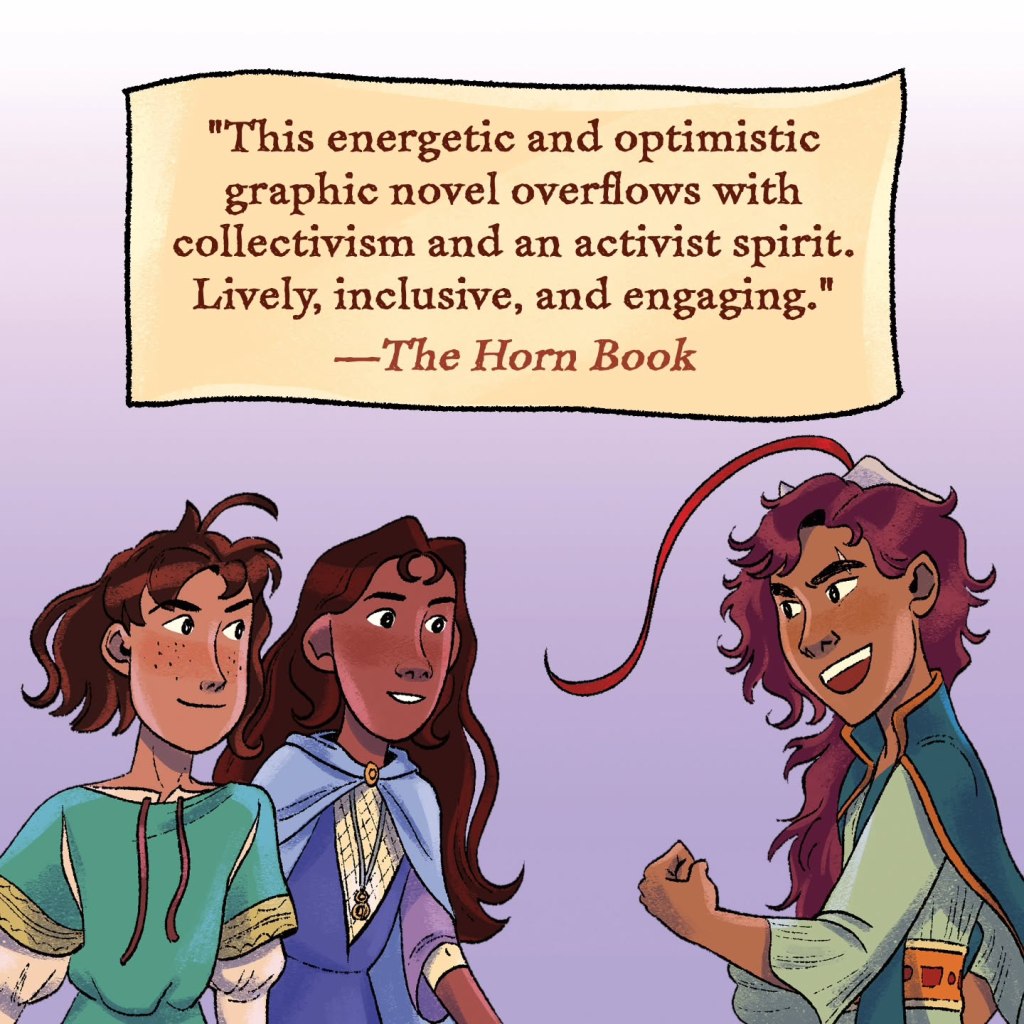
Combining Cinzia’s street smarts and printing skills and Elena’s logical mind and knowledge of the city’s powerful elite with Carlota’s resourcefulness and daring independence, the girls become a force for change. The courageous trio heads off on a forbidden, whirlwind adventure through the streets of Siannerra, harnessing the power of female friendships and the revolutionary power of the printing press to expose the magistrate’s crimes, enable marginalized voices like their own to stand up to injustice, and fight for the freedom of the printed word. And along the way, the girls explore the connections that create found family, showing that true allies are not those with whom you share blood, but those who share your commitment to justice and truth.
World-Building in the Details
Bi’s artwork utilizes a warm, saturated palette of rusts, golds, and deep blues that evokes the feel of a sun-drenched Renaissance city. The characters are rendered with expressive, dynamic lines, bringing to life their emotions and movements. Intricate details in the backgrounds, from the ornate patterns on the characters’ clothing to the specific architectural styles of the guilds, layer each panel of the book with rich background information, building a believable and immersive Renaissance-era world that makes Nijkamp’s story leap off the page.
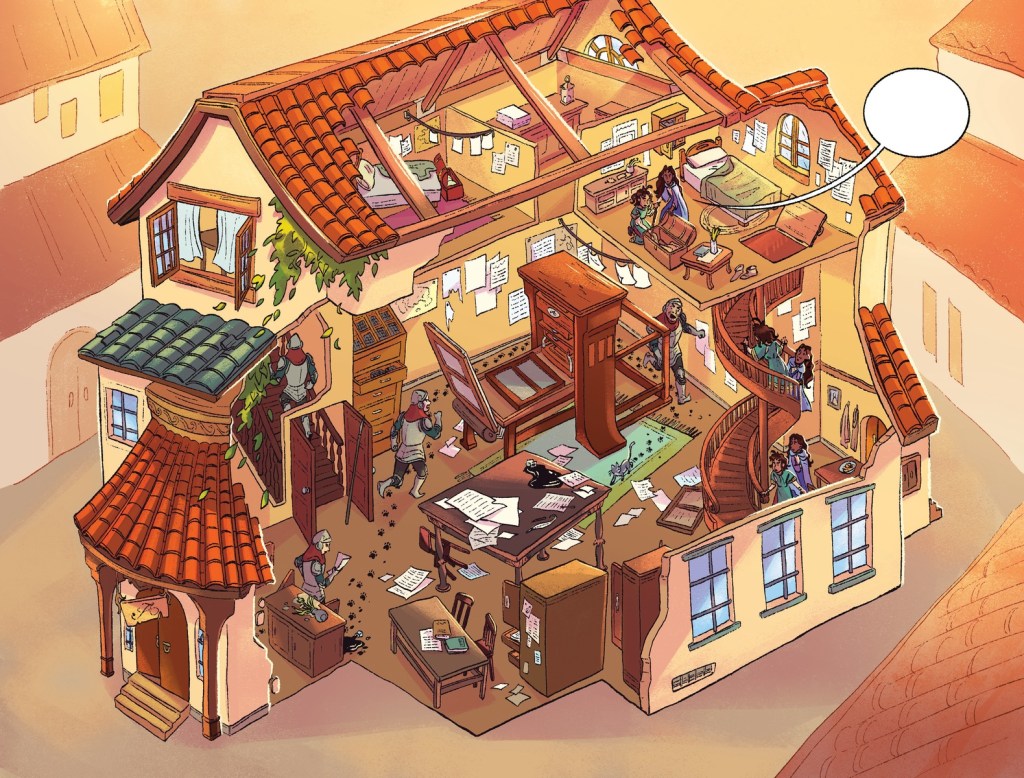
When Cinzia and Elena have to return to the printer’s shop to find Mestra Arone’s notes about the magistrate’s dirty dealings, Bi created a glorious double-page spread cross-section depicting the girls’ daring route through the building, each floor full of careful details from the Cinzia’s bedroom in the attic, to the pawprints Elena’s cat Dante makes as he tears through the printer’s shop area creating a much-needed distraction.
Multiple narrow escapes and dangerous choices confront the girls as they weave their way through the city streets and buildings. They make friends and build community at every turn as they pursue evidence of the magistrate’s corruption and find ways to support everyday citizens to tell the truth. Illustrator Sylvia Bi uses a dynamic visual language to draw readers into the high-velocity chases. Her large panels, combined with dashes and staggered depictions, create a visual path for the reader’s eye to follow, emphasizing the speed and urgency of the girls’ flight through the city. This isn’t just a stylistic choice; it’s a powerful storytelling tool that makes the action feel immediate and immersive.
Inclusive Storytelling through Physical Challenges, Neurodiversity, and Breaking with Tradition
In Ink Girls, Nijkamp addresses physical challenges through the character of Cinzia, the printer’s apprentice, who uses a cane. Cinzia’s cane is simply a part of her character; it’s a mobility aid, not a plot point to be overcome or a sign of weakness.
Nijkamp integrates the cane into the story in a way that feels natural and authentic. It is part of Cinzia’s physical presence, much like her printer’s apron or ink-stained hands. The narrative never treats the cane as a burden or a tragic element. Instead, Cinzia’s disability is normalized, allowing her to be a fully realized character whose intelligence, bravery, and determination drive the plot. This subtle yet powerful portrayal challenges common tropes about characters with disabilities.
Elena is portrayed as being neurodivergent. Her family and the rest of the ruling elite see her literal way of thinking, unconventional perspectives, and inability to make eye contact all as liabilities. They fear she cannot navigate the social subtleties and political maneuverings of court life. However, when she meets Cinzia, Elena’s neurodivergence becomes a crucial asset. Her unique perspective allows her to think outside the box and contribute to their fight for justice in ways that Cinzia, with all her street smarts, cannot.
However, these same traits are what make her a valuable ally to Cinzia. While others are swayed by charm and lies, Elena’s literal and logical mind sees the truth clearly. She can analyze problems and information from a unique, unbiased perspective, which is crucial in their quest to expose the magistrate’s corruption. And of course, as the Princess’s daughter, Elena can use her power and privilege at key moments to argue for truth, justice, and the safety of her friends. Nijkamp shows that what society deems a “weakness” is actually Elena’s greatest strength, allowing her to be a hero in her own right by leveraging both her mind and heritage to restore integrity to her mother’s rule.
As for Carlotta, she expresses gender nonconformity through her rejection of traditional female roles and her choice to live as a pirate, embracing a life of freedom and adventure rather than a life confined by societal expectations.
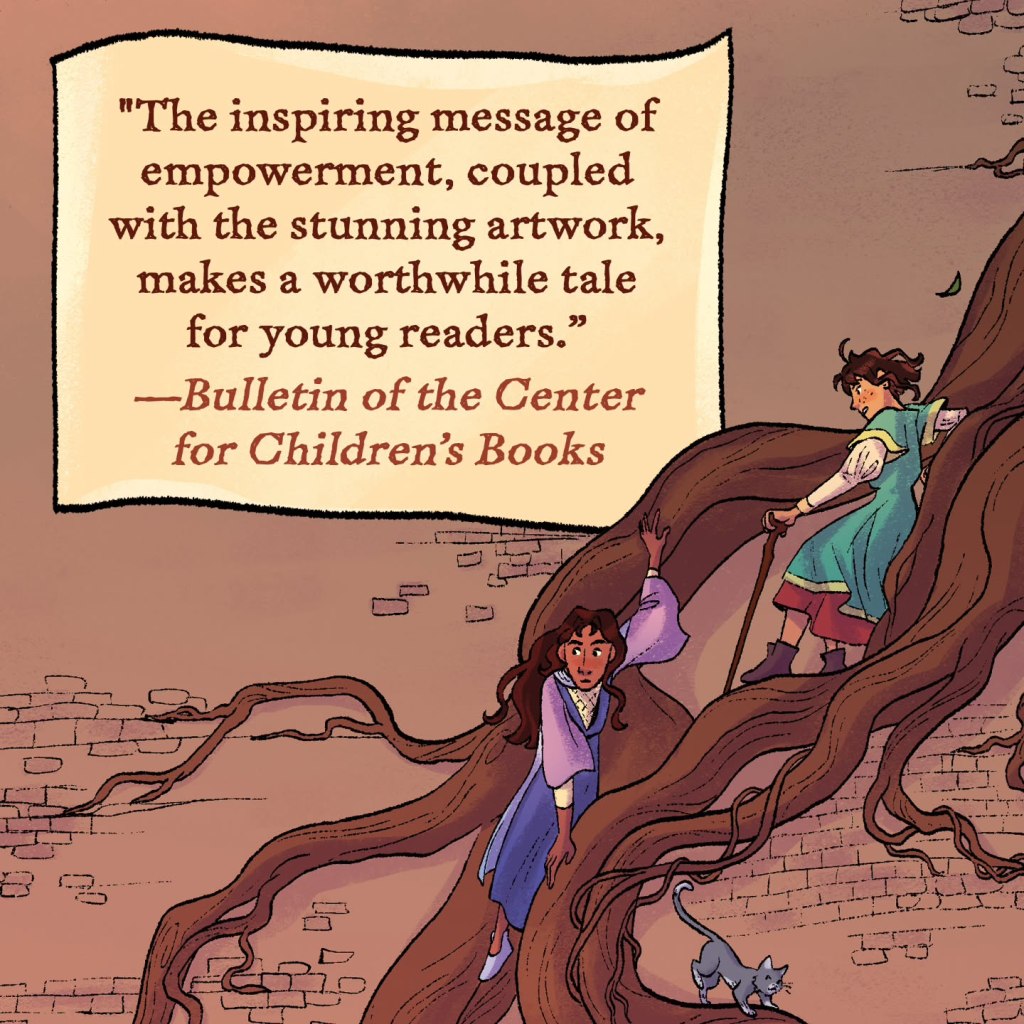
For more information about Marieke Nijkamp’s Ink Girls series, visit her official website here.
📣 🎉 And coming in April 2026, Clock Hands, a companion to Ink Girls!

Book information
Ink Girls by Marieke Nijkamp and illustrated by Sylvia Bi
ISBN-10: 0063027119 | ISBN-13: 978-0063027114
Release date: November 21, 2023
Publisher: Greenwillow Books
Details: 288 pages / Hardcover / Full Colour
Interest level: Ages 8 and up
Read
- Nijkamp, Marieke. “Ink Girls.” Marieke Nijkamp, Netherlands, 2023.
- Aggarwal, Cyra. “Author Interview: The Literary Spotlight with Author Marieke Nijkamp.”
Reviews
Watch
- Ink Girls | Graphic Novel | Sneak Peek
- 5 Easy Steps To Creating a Graphic Novel | With Author Marieke Nijkamp & Illustrator Sylvia Bi

Kim Tyo-Dickerson is the Head of Libraries and Upper School Librarian at the International School of Amsterdam. With over 25 years of experience in school libraries across North America, Europe, and Africa, Kim’s work is grounded in social justice and the freedom to read. Her practice is informed by her Ethiopian American family and focuses on diversity, equity, inclusion, and belonging. Kim holds a Master of Library and Information Science from Syracuse University and a Master of Arts in English from Miami University, with a specialization in 17th and 18th-century British Literature. She is a dedicated advocate for global literature, serving as the guest editor for the Global Literature in Libraries Initiative’s #WorldKidLitMonth #DutchKidLit and contributing to their UN #SDGLitMonth, where she wrote on Gender Equality. Kim’s languages are English, German, and Dutch, which inform her commitment to exploring the intersections of language, literature, and identity in her work.
 Global Literature in Libraries Initiative
2 thoughts on “#WorldKidLit Month 2025: Marieke Nijkamp’s Ink Girls, Rebels of the Printed Word”