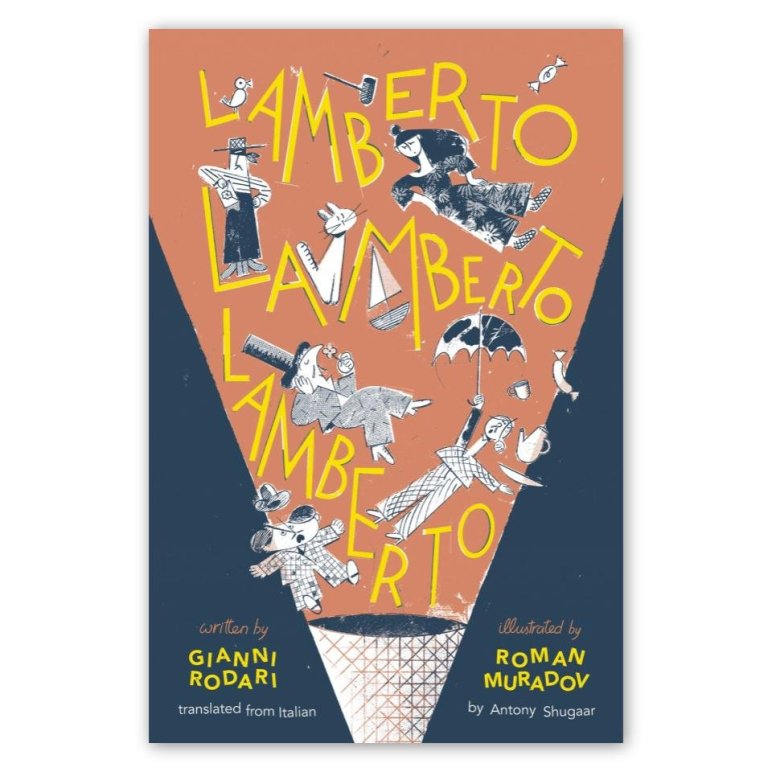
Baron Lamberto, 93 years old and in failing health, lives in a mansion on an island in the middle of Lake Orta, in northern Italy. Living from the proceeds of his 24 banks around the world, he is waited on by his butler, Anselmo, and an army of cooks, servants, and, strangely, six people in the attic who take turns chanting his name – “Lamberto, Lamberto, Lamberto.” While they are well paid and fed, they have no idea why they have this strange assignment. In fact, their chant is broadcast throughout the baron’s island because, on a trip to Egypt eighteen months earlier, Lamberto encountered a fakir who told him, “The man whose name is spoken remains alive.”
And that is what has come to pass in this fable first published in 1978 and reissued in a new translation from Italian, with appropriately fanciful new illustrations by Roman Muradov. It is the last work published by Gianni Rodari, a teacher, children’s book writer, resister of fascism during the Second World War, and socialist after the war. Rodari died in 1980 after a lifetime of poor health, and this story of a man who cheats death because others speak his name has a poignant personal connection.
Over-the-top action and peril will appeal to young readers of fantasy and humor. Besides his maladies, Lamberto faces two other perils. His last surviving relative, his ne’er-do-well nephew Ottavio, needs an inheritance to pay off major gambling debts. He shows up after a long absence, not expecting Uncle Lamberto to be in such fine health, looking decades younger. He had hoped that his uncle was at death’s door, and he would merely nudge him over that threshold. And a group of 24 bandits – 24 like the number of banks and homes that Lamberto owns – invade the island and demand the banks as ransom. After Lamberto is amusingly noncooperative, they cut off an ear, and then a finger, to show his bank managers that they mean business. When the severed ear grows back and the finger threatens to do the same, they realize they are foiled. And trapped.
But the story doesn’t end there, and the ambiguous resolution is designed to encourage young readers to imagine the next chapter in the story. Rodari knew his audience, and this novel has been a favorite in Italy for generations. The new translation, which captures the whimsy and humor of the original, includes an excellent introduction placing the novel in the context of Italy’s post-WWII history and explaining the connection of characters such as the six chanters and the 24 bandits to that history. Though written for middle grade readers, Lamberto, Lamberto, Lamberto is the kind of multilayered tale that will appeal to their elders as well.

Written by Gianni Rodari; illustrated by Roman Muradov
Translated from Italian by Antony Shugaar
Enchanted Lion, 2025
ISBN 978-1-59270-415-6
Reviews:
You can buy a copy of Lamberto, Lamberto, Lamberto here or borrow it from a library here. Book purchases made via our affiliate link may earn GLLI a small commission.
Lyn Miller-Lachmann is the author of the YA historical novel Torch (Carolrhoda Lab, 2022), winner of the 2023 Los Angeles Times Book Prize for Young Adult Literature and a 2022 Booklist Editors’ Choice, and the YA verse novel Eyes Open (Carolrhoda Lab 2024), chosen by Booklist as a Top 10 Historical Fiction for Youth, 2024. She wrote the picture book Ways to Play (Levine Querido, 2023), illustrated by Gabriel Alborozo, and co-authored with Zetta Elliott the middle grade verse novel Moonwalking (FSG, 2022). Her nonfiction includes a biography of Temple Grandin in the She Persisted chapter book series from Philomel and Film Makers: 15 Groundbreaking Women Directors (co-authored with Tanisia “Tee” Moore) from Chicago Review Press. She translates books for youth from Portuguese to English, including the 2023 YA graphic novel Pardalita by Joana Estrela, published by Levine Querido, which was named a Batchelder Honor Book in 2024 and the graphic novel Our Beautiful Darkness (Enchanted Lion), by the Angolan author Ondjaki, illustrated by António Jorge Gonçalves.
 Global Literature in Libraries Initiative