Written by Anthony Tilke
“Translated fiction is the hottest trend in books right now”, was a headline in a recent issue of a popular magazine (Gogarty, 2025). That’s great to know overall, but how can translated literature for the YA market contribute to reading for pleasure and support International Baccalaureate programmes?
The International Baccalaureate
The International Baccalaureate (IB) is a major player in international education, not only in the sense that the IB works in many countries world-wide, but also has values and philosophy that reflect and embody ideas of international-mindedness, which is defined as “an attitude of openness to, and curiosity about, the world and different cultures. Intercultural understanding involves recognizing and reflecting on one’s own perspective, as well as the perspectives of others”. (International Baccalaureate Organization, 2015, p. 6)
There are four educational programmes of the IB, ranging through primary, middle and upper secondary stages of education. In particular, for older students, two programmes (the Diploma and Careers programmes) offer demanding and traditionally content-rich courses and requirements and middle school students might say that is true of the Middle Years Programme (MYP) too. Given such expectations, perhaps a question might be “Do students have time to read for their own interest or pleasure?” Those students who want to read may do so for various reasons: perhaps to relax or ‘switch off’, being aware of their wellness needs or simply, as Daniel Pennac (author of the famous “readers’ bill of rights,” illustrated so well by Quentin Blake) argues, to enjoy themselves.
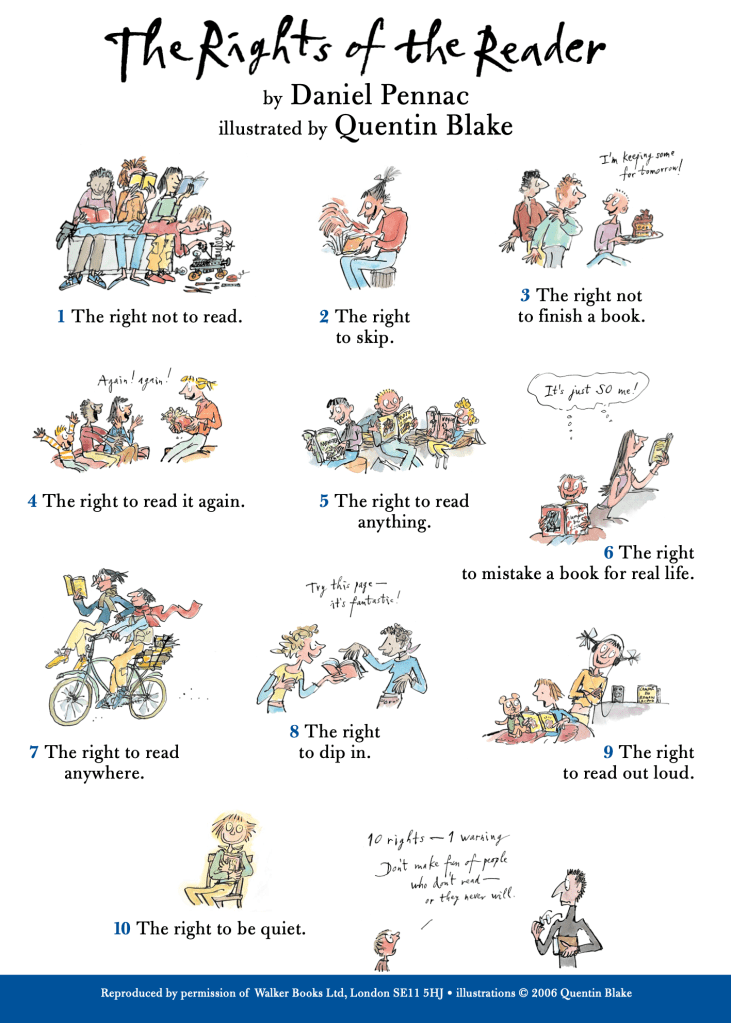
Daniel Pennac‘s book, Comme un roman (1992), has been translated from French many times into many languages (Goodreads lists 95 editions). The first British translation — Reads Like a Novel — was done by Daniel Gunn in 1994. A Canadian one also published in 1994 and translated by David Homel was titled Better Than Life.
The poster (image above) was publicly shared by Walker Books, based on their 2006 edition of Pennac’s book — The Rights of the Reader — translated by Sarah Ardizzone (formerly Sarah Hamp Adams) and illustrated by Quentin Blake. A PDF of the poster is still available via the Internet Archive here.
Indeed, the IB encourages voluntary, recreational reading and identifies both a role for librarians and student benefits – librarians can “play a key role in promoting reading for pleasure, which, as a by-product, will promote ATL [Approaches to Teaching and Learning] skills, language acquisition and intercultural understanding. Librarians should ensure that the books in the library reflect the inclusive nature of the school and the languages of the students.” (International Baccalaureate Organization, 2015, p. 42)
Given an age range, roughly defined as young adults, what students want to read will vary widely. In terms of book publishing, this will probably range through nonfiction, poetry, and fiction, both published on adult and YA lists.
Translation as a contribution to international-mindedness
Translation of literature in different languages feeds into the key concept of international-mindedness in IB education, as it opens up perspectives on other cultures, countries and experiences even if a person cannot read in a language associated with another culture. As Oloomi (2020) noted “We know much of the world through a strictly political prism; literature provides access to the lives of people in other cultures and countries”.
In spite of the attention-grabbing headline quoted at the beginning of this piece, translation of literature is not as easy or as plentiful as we might wish. In fact, it is challenging. This may be because “most English-language editors don’t read foreign languages, and so have difficulty evaluating texts. Literary fiction and poetry are financial risks even without the additional costs of translation. Add the handicap of an (often) unavailable or non-English-speaking author, which then limits promotional opportunities, and many publishers are simply unwilling to try”. When books are published in translation, “reviewers often don’t mention or acknowledge translators, which is particularly maddening when they praise a book’s language; this is often because they haven’t (or can’t) read the original, so have no way of judging how well it represents the author’s intentions, and also because some reviewers don’t understand what’s involved in translation.” (Oloomi, 2020)
However, the situation is not all ‘doom-and-gloom’ as there are new publishers who focus on translation (e.g. Pushkin Press).
In the adult publication market, translations exist that may interest a YA audience including writers such as Asako Yuzuki, Édouard Louis, Uketsu, Christina Morales and other writers suggested by the Center for the Art of Translation, and may be starting points for librarians interested in sourcing – and celebrating – translated fiction for older age groups.
Ease and convenience
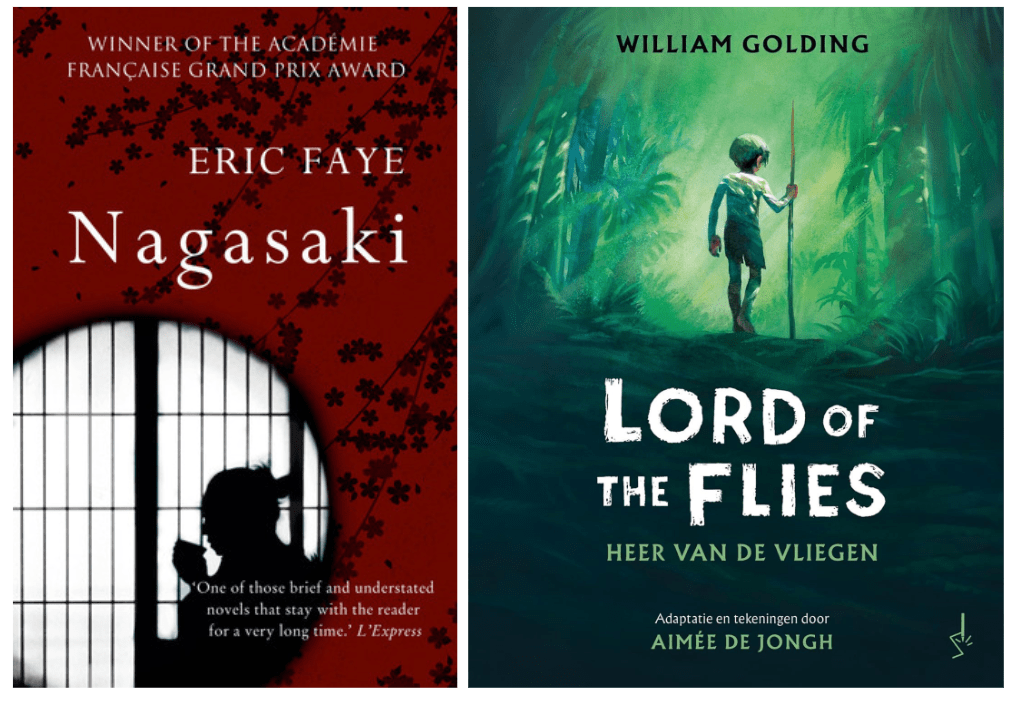
Given that IB students may overall be time-poor, selling points for encouraging reading may probably focus on the benefits and the pleasure students can derive. Equally, students will be interested in ease of reading, which they may equate with length of books – novellas published on adult lists can be helpful here, such as Nagasaki (2010) by Eric Faye – translated by Emily Boyce – or graphic books, such as those by Aimée de Jongh (see Nederlands Letterenfonds). Note: de Jongh has just published her adaptation of Golding’s classic: Lord of Flies: The Graphic Novel (2024). See Kim Tyo-Dickerson’s extended review of the book on GLLI here.
Given that students want high interest with ease of reading (or format) there are YA titles that could be of interest to IB students, including those shortlisted for the GLLI Translated YA Book Prize.
Let’s look at one example from last year’s and the current year’s shortlist.

- Smash the Patriarchy: A Graphic Novel – by Marta Breen & Jenny Jordahl / Translated from Norwegian by Siân Mackie (Helvetiq/2023)
The book operates on several levels or in different ways. As a nonfiction text, the book focuses on concepts of feminism and patriarchy, offering both chronological and celebratory approaches, but also focusing on topics or subjects, such as science, politics and psychology. The illustrations offer a second or independent way of reading, whilst also supporting the conventional text, and the endpapers play a vital role in providing an overview of influential women. In this publication, writer, illustrator and translator play equally pivotal roles.
(This book can’t be recommended too many times — as evidenced by repeated mentions in different contexts on this blog: June 17, 2024; May 9, 2025; May 12, 2025; plus the 2024 winner announcement for the GLLI Translated YA Book Prize.

A popular YA genre, dystopia, is used to look at a situation on Earth, but not as we know it. Here, in an environment of extreme (literally, frigid) weather, favored or chosen people live and are seen by the populace through a sort of reality TV show – what will individuals do to remain in or join a particular elite?
See also the 2025 GLLI Translated YA Book Prize announcement where this book is listed on the shortlist.
Whether translated text resources are considered to add a direct international dimension to school library collection development or help widen the selection of published material, translated literature can be helpful for collection development in IB school libraries.
References
Gogarty, J. (2025, April 08). Translated fiction is the hottest trend in books right now. GQ Magazine.
International Baccalaureate Organization. (2015). Diploma Programme: from principles into practice. IB. [Available to IB schools on the Programme Resource Centre through MyIB]
Kemp, R.A. (2020). Around the World in 18 Books: An introduction to literary translation in children’s and YA publishing. A webinar by Ruth Ahmedzai Kemp.
Nederlands Letterenfonds Dutch Foundation For Literature. Dutch Graphic Novels.
Oloomi, A. van der Vliet. (2020, March 12). Creating a bridge: A conversation with Susan Harris, Editorial Director of “Words Without Borders”. Azareen Van der Vliet Oloomi discusses the importance of translation with Susan Harris, editorial director of “Words Without Borders.” Los Angeles Review of Books.

Anthony Tilke spent 25 interesting years in international schools and 40 overall in libraries and information science. His doctoral thesis (Charles Sturt University, Australia) examined international school library impact on the IB Diploma Programme (DP), which was accepted without amendment. This inspired the writing of his book, The International Baccalaureate Diploma Program and the School Library: Inquiry-Based Education, and various academic articles. An accredited IB workshop leader, he has contributed ideas and content for IB documentation, including the IB Ideal Libraries project, and curriculum review for the Extended Essay. He has been school/youth library adviser for the then Library Association, in London, and a background as teacher, school and public librarian. Involved with various book awards, he especially treasures memories of being a judge for the UK Carnegie Medal and he is a current member of the GLLI Translated YA Book Prize committee. User perception of school libraries and library design are interests, plus the host culture concept, in which translated literature contribute to strategies for collection development. Twitter: @DPlibrarian
Katie Day is an international school teacher-librarian in Singapore and has been an American expatriate for almost 40 years (most of those in Asia). She is currently the chair of the 2025 GLLI Translated YA Book Prize and co-chair of the Neev Book Award in India, as well as heavily involved with the Singapore Red Dot Book Awards. Katie was the guest curator on the GLLI blog for the UN #SDGLitMonth in March 2021 and guest co-curator for #IndiaKidLitMonth in September 2022.
 Global Literature in Libraries Initiative
One thought on “#INTYALITMONTH: Translations of YA & the concept of reading for pleasure in IB programmes for young adults”