Written by Habel Amolo
Green Environment Through Reading Advocacy
I am excited to share with you today the story of Professor Wangarĩ Maathai, a Kenyan Nobel Laureate who was passionate about preserving our environment, leading to her starting an environmental movement called the “Greenbelt Movement”.
Wangarĩ authored several important books which showcase her big WHY of life: a passion for protecting natural environments and forests through the planting of trees.

Unbowed: A Memoir (2006) – by Wangarĩ Maathai
There is no young reader’s edition of this book, but her memoir is still very accessible to teenagers. She starts the account of her life with her birth in 1940, then describes coming of age during a time of great political, social, and economic change in Kenya, and ends with the surprise of her hearing that she has won the Nobel Peace Prize in 2004.
The publisher provides a Teaching Guide written by Stefanie Breitling, a high school teacher.
For young adults, perhaps some of her essays and speeches might be a good introduction. Three official websites provide links to many of these.
Her writing is also featured in several books reprinting speeches and essays by prominent women.
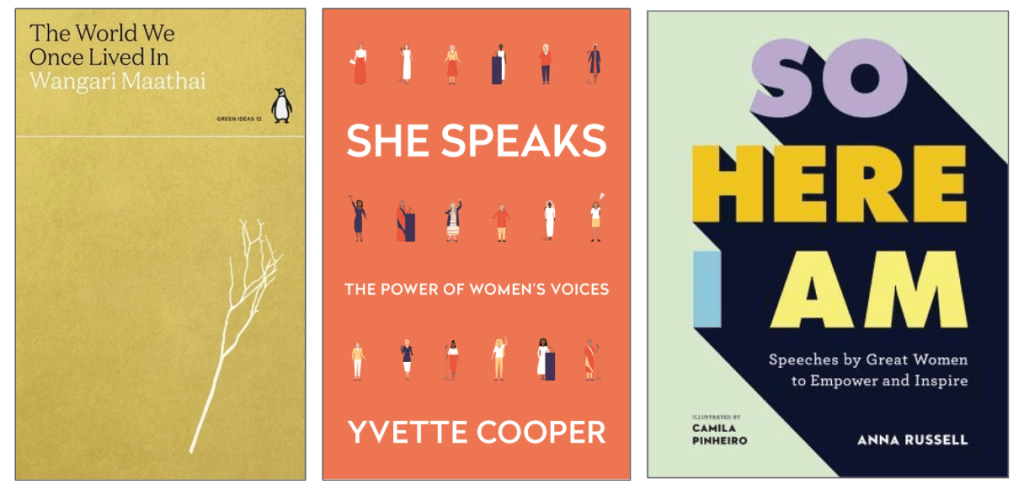
- The World We Once Lived In (2010) – by Wangarĩ Maathai – with three excerpts: “The Wounds,” “The Power of the Tree,” and “Sacred Groves, Sacred No More.” Part of the Penguin Classics series — Green Ideas — 20 short environmental classics printed in small volumes.
- She Speaks: The Power of Women’s Voices (2020) – edited by Yvette Cooper
- So Here I Am: Speeches by Great Women to Empower and Inspire (2019) – edited by Anna Russell and illustrated by Camila Penheiro
Wangarĩ Maathai‘s reading advocacy was a great spark that started from her passion of creating an environmental green movement, and eventually led to her authoring several books for adults.
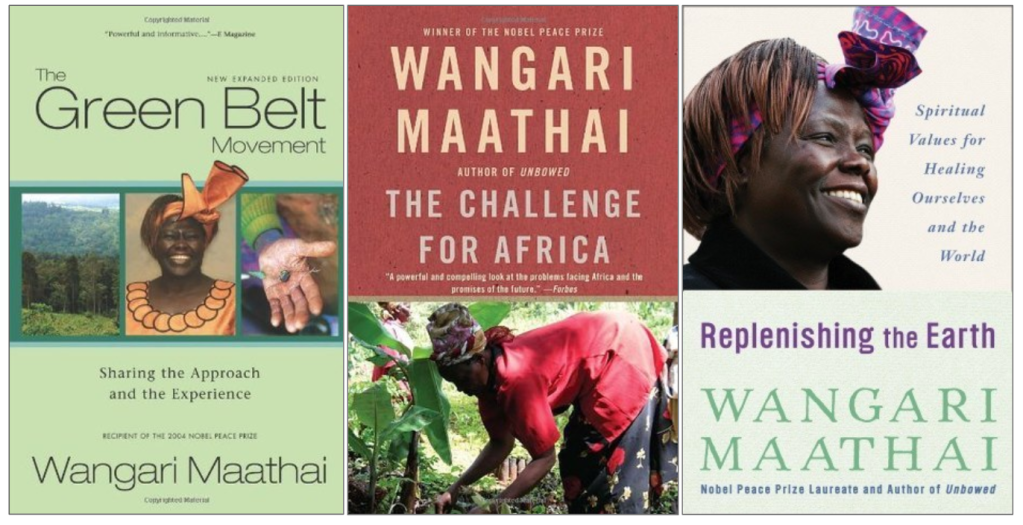
- The Green Belt Movement: Sharing the Approach and the Experience (1988) – by Wangari Maathai
- The Challenge for Africa (2009) – by Wangarĩ Maathai
- Replenishing the Earth: Spiritual Values for Healing Ourselves and the World (2010) – by Wangarĩ Maathai
However, for readers of all ages that love picture books, I would recommend the book titled “Wangarĩ Maathai : The Woman Who Planted Millions of Trees” (2011) by Franck Prévot, illustrated by Aurélia Fronty, translated from French by Dominique Clément.

This book raises great awareness on the role that Wangarĩ Maathai played as an environmental leader across the world, and is relevant for young adult readers who are visual learners.
There are plenty of other picture and chapter books to choose from, to name a few:

- Mama Miti (2010) – by Donna Jo Napoli, illustrated by Kadir Nelson.
- Wangari’s Trees of Peace (2008) — by written and illustrated by Jeanette Winterson
- Dr. Wangari Maathai Plants a Forest (2020) — by Rebel Girls

A simple version of Wangarĩ’s story has also been made available in multiple languages (e.g., French, Kiswahili, Afrikaans, Hausa, Yoruba, etc.) via the African Storybook open access platform, titled “A Tiny Seed: The Story of Wangarĩ Maathai” authored by Nicola Rijsdijk and Maya Marshak.
When reading these books, we get inspired to connect with nature and understand the importance of preserving our planet, Earth.
To start us off, what do you think is the importance of trees in our environment?
Wangarĩ Maathai was born in a small village near Mount Kenya, where she discovered her love for nature while working in the family fields. Despite having some initial challenges, she convinced her parents to let her attend school, where she quickly became an outstanding student. Wangari’s academic journey later took her to the United States, where she studied biological sciences at Mount St. Scholastica College and the University of Pittsburgh. Her childhood memories of playing in her family fields in Kenya fuelled her passion of getting back home to nurture forests and preserve the local environment in her homeland.
Returning to Kenya, Wangarĩ was troubled by environmental destruction through the cutting down of trees and poverty. She sought innovative solutions by teaching local women on how to grow and sell trees. This approach not only helped to reforest the land but also transform communities by providing economic opportunities for struggling families.
I once visited Karura Forest in Nairobi and was privileged to witness Wangarĩ’s movement living on years after she was gone. We were shown a short video of her biography, after which we toured the forest, had an opportunity to plant trees in the forest and be part of her legacy.
Wangarĩ’s local environmental movement spread across boundaries and across Africa, resulting in millions of trees being planted. Wangarĩ’s remarkable work earned her global recognition, where she won the Nobel Peace Prize, and became the first African woman to be among a Nobel Laureate.
Although Wangarĩ Maathai passed away in 2011, her vision of environmental conservation and community empowerment continues to inspire people worldwide. Her life demonstrates how one person’s determination can create significant positive change and leave a lasting impact. I encourage each of us to read Maathai’s stories, become great environmental ambassadors who combat climate change, nurture tiny forests individually or among groups, and raise awareness on environmental preservation.
Therefore, let us pick up a book regarding our planet, and begin making a difference today! Together, we can save our Earth!!
Taking Responsibility in Saving Our Environment: Case Study at Le Bocage International School
In Mauritius, we now have projects such as “Tiny Forests” where students and teachers step out of the classroom to plant trees so as to nurture multiple tiny forests that eventually become huge forests. By embracing service learning as a lifestyle, students do not ask what the community can do for them, rather they are driven to inquire on what they can do for their community.
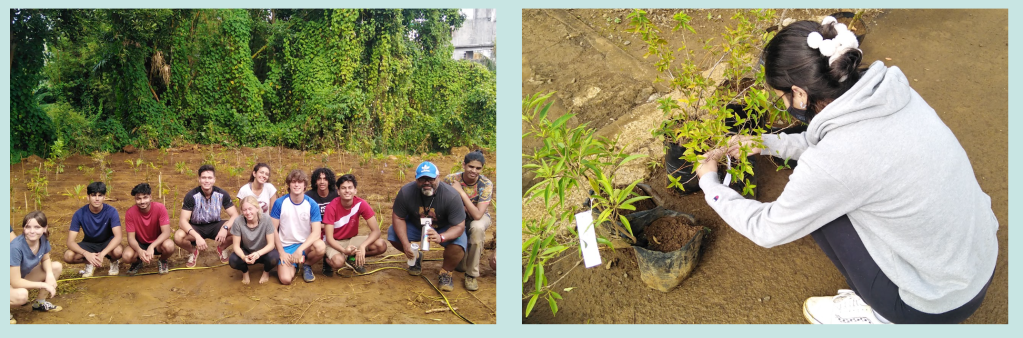
Students from Le Bocage International School (Mauritius) advocate for a greener environment through creation of tiny forests in different locations of Mauritius. Tiny forests can also be seen at Beau Plan, and other regions in Mauritius.
Some of the ways through which reading helps us to raise awareness for a greener environment include:
- understanding environmental issues – reading people’s real-world stories that inspire action.
- reading books and sharing stories about environment preservation conservation with family and friends,
- promoting sustainable lifestyle (such as the Japanese concept of mottainai, meaning “don’t waste”),
- empowering communities who after reading her stories become motivated to run this green race.
Every time I remember Wangarĩ Maathai’s impact, I celebrate our environment preservation, International Women’s Day, and our Nobel Laureate award winner as a reader, a leader, and a visionary. Wangari Maathai’s resolve to plant trees is a solution to the trending global warming predicament. Wangari Maathai’s impact lives on!
STUDENT ACTIVITY : Google Form Quiz with 12 simple multiple-choice questions.

Habel Amolo is a school librarian at Le Bocage International School in Mauritius. He loves fostering the love of reading among young learners, and teaching research skills to students. He also teaches Theory of Knowledge (TOK) and is an IBEN member, as an IB workshop leader, examiner and programme leader for school evaluation visits. Habel is also a member of SLAK (School Librarians Association of Kenya), and previously won LOYA Award (Library Of the Year Award) in Kenya. Ben Carson in his book titled ‘Gifted Hands’ states that “No knowledge is ever wasted”. Therefore, Habel advocates for reading for all ages so as to make a positive difference in life.
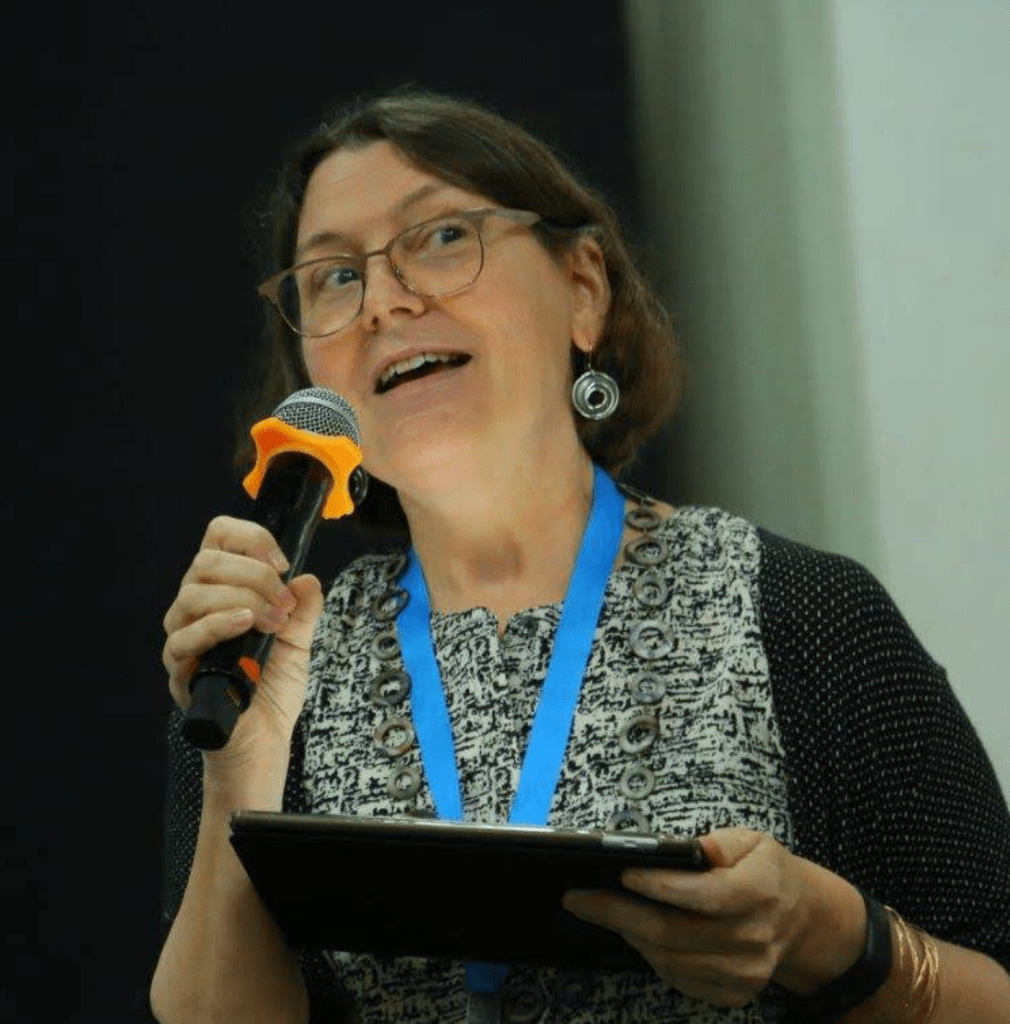
Katie Day is an international school teacher-librarian in Singapore and has been an American expatriate for almost 40 years (most of those in Asia). She is currently the chair of the 2025 GLLI Translated YA Book Prize and co-chair of the Neev Book Award in India, as well as heavily involved with the Singapore Red Dot Book Awards. Katie was the guest curator on the GLLI blog for the UN #SDGLitMonth in March 2021 and guest co-curator for #IndiaKidLitMonth in September 2022.
 Global Literature in Libraries Initiative
One thought on “#INTYALITMONTH: Wangarĩ Maathai”