
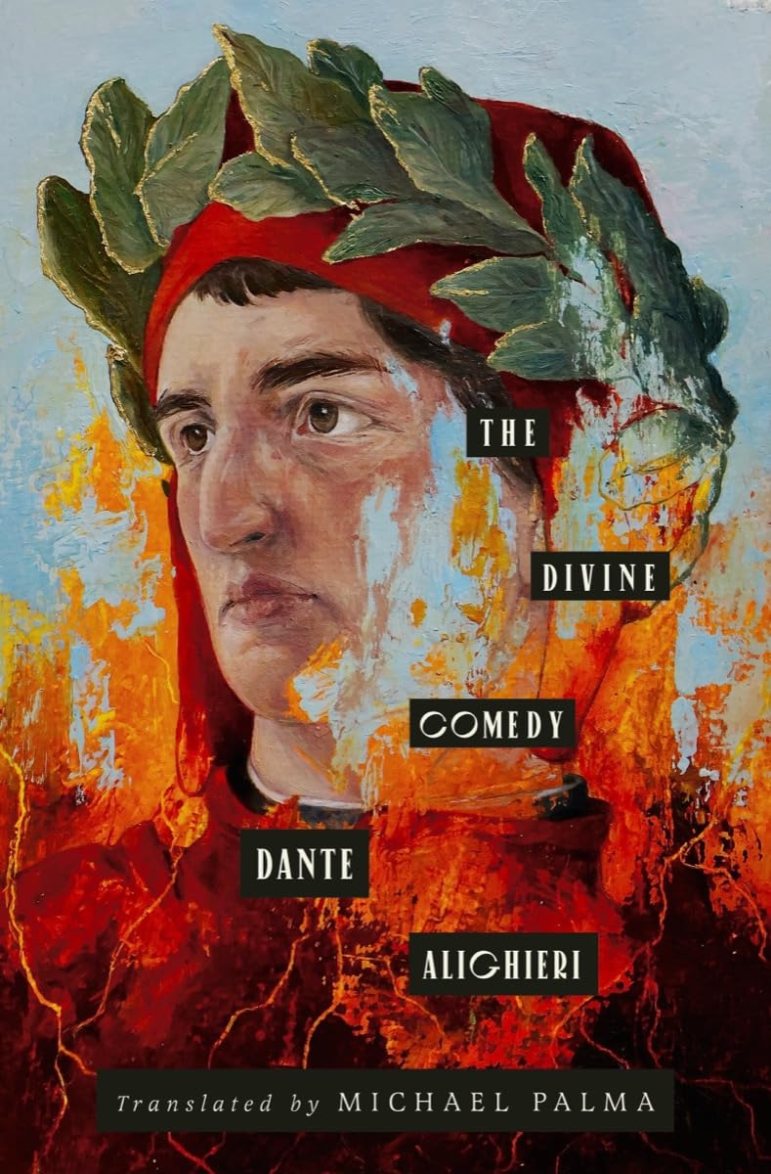
by Michael Palma
Dante’s contemporary fortunes have been especially various, I believe, in the United States and Great Britain, where translations have appeared, and continue to appear, at a remarkable rate. About a decade ago someone observed that the first ten years of the new century had seen the publication of at least ten new translations of the Inferno. In the past two decades there have also been several new versions, in both single- and multi-volume editions, of the entire Commedia. And all of this activity builds upon scores of English-language Dante translations published in the previous two centuries. I think it is safe to say that there are far more translations of Dante into English than into any other language, and that there are far more translations of the Commedia, in whole or in part, into English than there are of any other foreign-language work of literature.
It is only reasonable to assume that all Dante translators feel that they have something to contribute, something that they don’t find in the other available versions, else why would they undertake such a demanding enterprise in the first place? I have cited elsewhere Bob Dylan’s response, in the 1970s, to an interviewer’s query about what had prompted him to record his latest album, to the effect that “nobody else was making the music that I kept hearing in my head.” That statement sums up my own principal motivation when I began to translate Dante’s Inferno more than twenty-five years ago. And it was once again the animating spirit of my approach when I set to work to translate the rest of the Commedia a little more than three years ago. As I said above, Dante’s magisterial trilogy is, without question, the work of literature most frequently translated into English over the last several decades, and though people often ask why that should be so, the reason is clear. A single translation of a dry philosophical tract from the Middle Ages would almost certainly suffice. A book-length medieval poem narrating a stirring tale of battles and conquest or telling a tender tale of love, adulterous or otherwise, would likely require only a couple of modern English versions to find all of its potential audience. But the Commedia is, of course, a work of stunning depth, richness, and complexity, and readers without access to the original text come to it with a number of different—and, to some degree, mutually exclusive—intentions.
All translators are themselves readers first, and they approach the text with the same emphases and intentions as the readers they have in mind when they work. For those who want a translation that precisely renders the paraphrasable content of the text, to the exclusion of all other considerations, there are several available versions that do this, often with extensive and extremely valuable annotations and commentary, with Dante’s poetry put into what amounts—whether arranged in margin-to-margin paragraphs or three-line units—to prose. For those who prefer a blank-verse version, on the ground that preserving the rhyme scheme inevitably leads to an unacceptable level of distortion of the original, there are, again, several excellent translations in print. But, over nearly fifty years of translating Italian poetry into English, the audience I have always had in mind consists of readers for whom the pleasures of poetry include the pleasures of rhyme and meter, the pleasure of watching tennis played with the net up, readers who are not satisfied with “The mating urge is strong in all species” when they can have “Birds do it, bees do it, / Even educated fleas do it.”
Obviously, such an approach presents challenges and difficulties in all cases, and, equally obviously, they are compounded in the case of Dante’s terza rima. And here was where I felt that a glaring gap existed in the available translations. When I published my translation of the Inferno in 2002, the last fully rhymed American version of the entire Commedia to achieve a wide circulation was more than eighty years old; it has its merits, but it is quite dated. Several terza rima translations had appeared in Britain in the twentieth century; like many of the other versions currently in print, they also possess various merits, but they all have serious limitations as well—in one instance, archaic diction and inversion, in the service of an almost excessive fidelity to the original, making for a difficult reading experience; in another, a highly idiosyncratic approach that scores some hits but also quite a few misses, along with extreme variations in tone; in yet another, an unacceptable level of awkwardness and egregious rhyme-forcing, leading in many instances to distortion of Dante’s statements. As a poet with nearly sixty years’ experience in writing formal verse, I am quite familiar with the demands that can be made by the exigencies of rhyme (much more so than the many commentators who offer involved and often ingenious interpretations of this or that crux in the Commedia without taking such demands into account). Admittedly, keeping the rhymes will occasionally force the translator into supplying words with no equivalent in the original, and other bits of padding. But I have a hard time with the attitude that such instances effectively discredit an entire translation, while it is perfectly acceptable, even preferable, for another translation to completely fail, or even refuse, to capture any of the poem’s poetry.
Needless to say, none of the versions I am familiar with made the music that I kept hearing in my head when I engaged with Dante’s text. One of the great pleasures of reading the Commedia—and it is a pleasure to read it; otherwise, it would be of interest only to academics—is the music of the lines, created by Dante’s masterful handling of rhyme and meter, syntax and sounds. As I have said, I believe that there is a significant audience that wants to enjoy all of these features in an English version of the Commedia. Working with that audience in mind, I have tried to produce a text that is as clear and readable as Dante himself will allow, that employs a contemporary idiom and natural diction, and that reflects the meaning of the original—though not always the equivalent of its exact wording—as precisely as possible, all while preserving the formal properties of that original.
I want to emphasize that the last of these aims is not necessarily at odds with any, let alone all, of the other ones, if the translator is willing to work hard and not be too easily satisfied. (One of the most esteemed—in large part, justly so—of modern Dante translations, whose technique could be described as seconda rima, departs far more extensively from the original than I do.) As I have proceeded through the Purgatorio and Paradiso, I have glanced frequently at the sign on my desk that reads “Revise, Revise.” I have also constantly consulted a number of published translations, the ones alluded to above and several others, both to ensure that I stayed as close as possible to the sense and to avoid the rhymes that other translators had used. In connection with this last point, I often felt that not only was I fighting with one hand tied behind my back, but that the wrist of my free hand had a five-pound weight attached to it. But to do justice to Dante required no less. As I suggested above, for those who feel differently, there is an abundance of other choices. For those who agree with me, I hope that I have given them what they are looking for.
This article originally appeared in the Fall 2021 issue of the journal Gradiva and was reprinted in the volume La “varia fortuna di Dante” in Italia e in Europa, ed. Floriana Calitti, Sandra Covino, and Enrico Terrinoni (Edizioni dell’Orso, 2023).
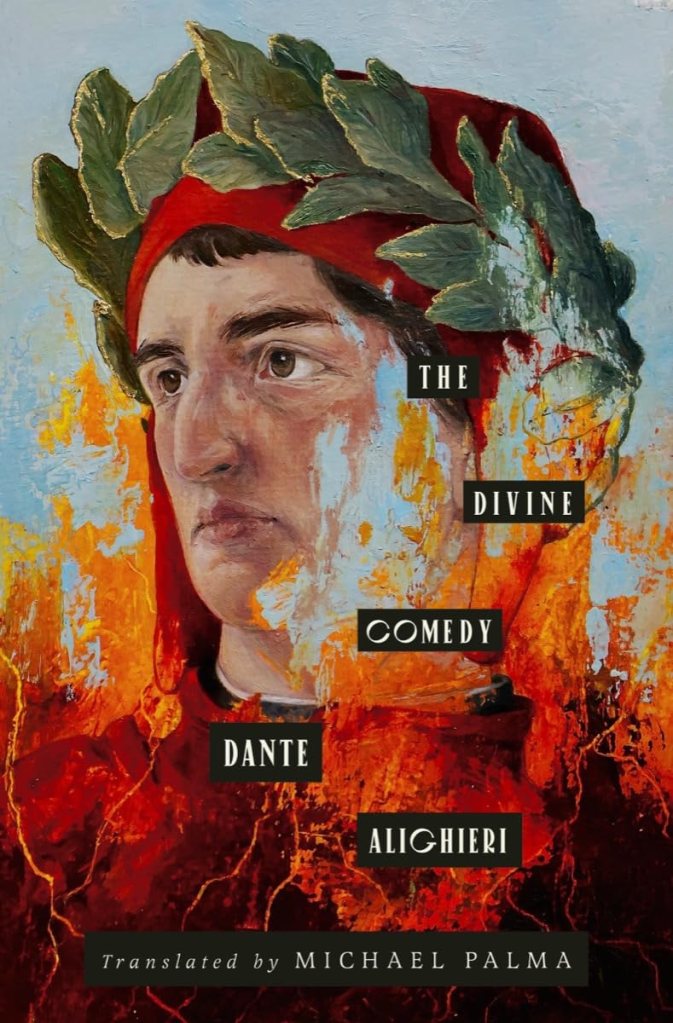
The Divine Comedy
- by Dante Alighieri
- Translated from the Italian by Michael Palma
- Original title: La divina commedia (1321)
- Pages 624
- Publisher: Liveright
- ISBN: 9781324095545
- Forthcoming on December 3, 2024
- Treat your bookshelf to a taste of Italy! Pre-order the book here.
MORE FROM MICHAEL ON TRANSLATING DANTE:
Dante’s Inferno: A 13th-Century Scared Straight (Inferno, Part One – 35 minutes)
(Norton Library Podcast) “In Part 1 of our discussion on Dante’s Inferno, we welcome translator Michael Palma to discuss Dante’s life and the context in which he wrote the Inferno, the narrative structure of The Divine Comedy, and what makes the Inferno so durably compelling.”
Dante’s Inferno: Funny as Hell! (Inferno, Part Two – 35 minutes)
(Norton Library Podcast) “In Part 2 of our discussion on Dante’s Inferno, translator Michael Palma discusses his own history with the poem and how he came to translate it, the terza rima rhyme scheme Dante employs, and in what ways the Divine Comedy is really a comedy.”
1st Wednesdays: Michael Palma – Translating Dante’s Inferno (90 minutes)
(Brooks Memorial Library) “The most frequently translated work in America today is Dante’s Inferno—a seven-hundred-year-old book-length poem. Dante translator Michael Palma considers its enduring appeal and what it has to say to a contemporary audience.”
Michael Palma’s poetry volumes are the chapbooks The Egg Shape (1972), Antibodies (1997), and The Ghost of Congress Street (online, 2008), and the full-length collections A Fortune in Gold (2000), Begin in Gladness (2011), and Local Colors (forthcoming in 2025). He is also the author of Faithful in My Fashion: Essays on the Translation of Poetry (2016). He has published twenty volumes of translations from modern Italian poets and a translation of Dante’s Inferno (2002). He has received numerous awards, including the Italo Calvino Award from the Translation Center of Columbia University. He lives in Vermont.
Photo by Victoria Palma


Italian Lit Month’s guest curator, Leah Janeczko, has been an Italian-to-English literary translator for over 25 years. From Chicago, she has lived in Milan since 1991. Follow her on social media @fromtheitalian and read more about her at leahjaneczko.com.
 Global Literature in Libraries Initiative
One thought on “#ItalianLitMonth n.49: A New Translation of Dante: The Music I Kept Hearing in My Head”