
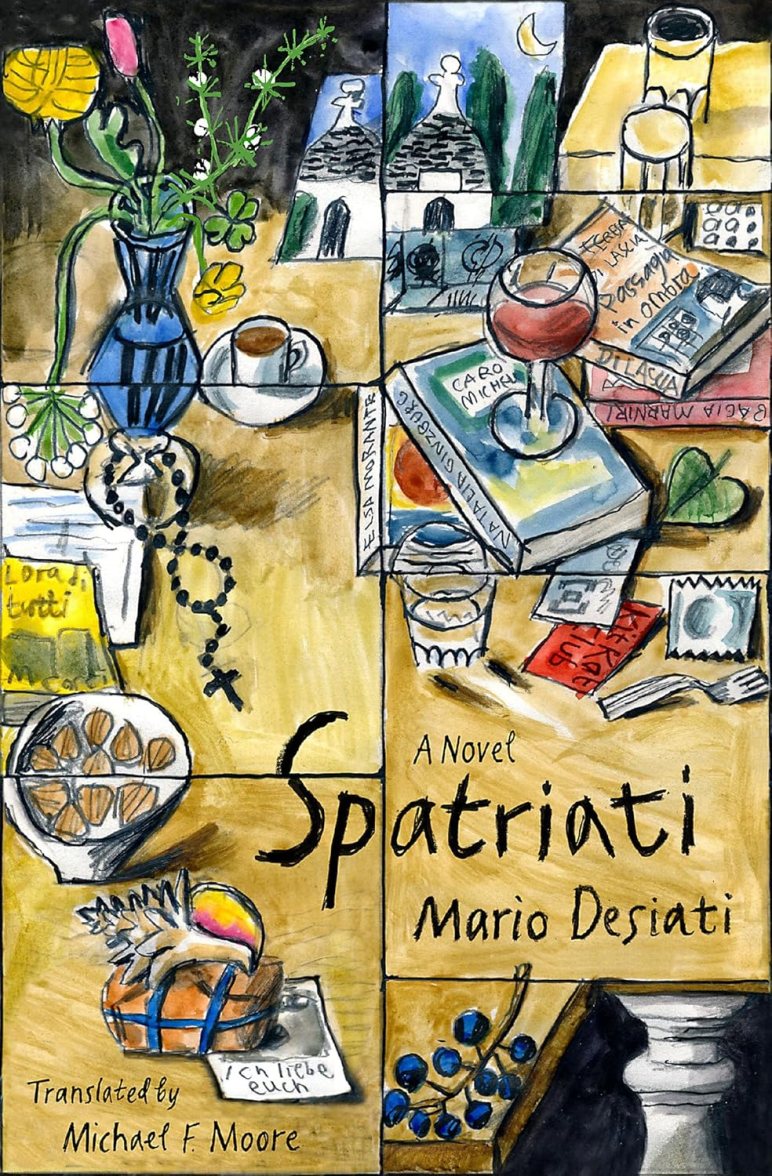
by Michael F. Moore
Martina Franca, in Puglia, is the hometown of the writer Mario Desiati, and the setting of almost all of his novels. The town, and indeed the region as a whole, is so ubiquitous in his latest, the Strega Prize-winning Spatriati, as to become one of the book’s main characters, alongside the two young protagonists. In addition to being the story’s location, with its streets and buildings made from the same local limestone, pietra leccese, it is the magnetic pole that holds in its grip the narrator, Francesco, and calls him back from his only adventure abroad.
The novel is replete with words from the local dialect, Martinese, starting with the title, Spatriati, which has a broad range of meanings explained on the first page, from which I would privilege the idea of “Misfits,” in keeping with the typical way residents inquire about your situation in life, “Come ti metti?” – Where do you fit. And not just individual words. The cadences of his prose and the peculiarity of some of his expressions are derived, as he explained to me, from the poetry of Puglia.
Throughout the narrative, references are made to significant moments in the recent history of Puglia: for example, he mentions the August 8, 1991 arrival at the port of Bari of the Vlora, a ship carrying tens of thousands of Albanians escaping from the unrest in their country following the collapse of Communism. And the election of Nichi Vendolo, an openly gay politician, as governor of the region, inaugurating the optimistic period that some called “the Pugliese Spring.”
Many of the books read by the protagonists, Francesco and Claudia – whom he introduces to the reader as his “opposite front,” his best friend from childhood into adulthood, for whom he harbors an unrequited love – are by writers from Puglia. And in an unusual gesture, for a novel, Desiati appends an endnotes section titled, “Notes from My Desk or Room of the Spirits,” in homage to the Swiss writer, Robert Walser. Here he explains various realities of Puglia, from architecture to cuisine, as well as more information about the books mentioned. When the location moves to Germany, he also includes glosses on the city of Berlin and the venues that Francesco frequents.
On the last page, Desiati inscribes his dedication: “This novel is dedicated to the memory of the writers of my region, since without them my imagination would not exist.”
While non-Italian readers might be puzzled by this strategy of setting a fictional story alongside such an overt call for Puglia recognition, Desiati is not alone in trying to free his region from the misconceptions and minimization to which it has been treated by cultural and literary historians, whose propaganda has tended to privilege other regions and to catalogue Puglia as a subset of Naples.
For me, this feature made it imperative to visit Martina Franca, to see with my own eyes the town described in the pages of the novel, to savor the local food, and most importantly, to get to know the author on his home turf. Shortly after I was asked to translate the book, I had the opportunity to meet him when I was in Rome in May of 2023. The meeting was not completely satisfactory, perhaps because we were struggling to establish a relationship of trust. He might have thought I was too conventional to translate his novel with the necessary degree of insight and participation. For my part, I was skeptical about embarking on what looked to be a difficult project, having only recently finished a translation that had occupied too many years of my life.
That summer I was in Italy again, for a residency on Lake Garda, so on what must have been the hottest day of the year I flew down to Bari and picked up a Fiat 500 at the airport for the drive to Martina. Once I got there, Mario took me on a tour of the city, pointing out all the locations mentioned in the novel. He was joyful and affectionate, fascinated by his hometown and happy to share what he knew with me. He was delighted to find that a local bookshop still had a copy of the Italian-Martinese dictionary he himself had consulted, and he gave it to me as a gift. After he learned more about me, he determined that I, too, was a “Spatriato” like him and the main characters in the novel.
One moment in those three days stood out for me, and I can still picture it in my mind’s eye. When we entered the Basilica of San Martino, Mario stopped to bless himself from the holy water font at the entrance, bowing his head reverentially. And in that instant I saw both the man and the boy, the mature writer and the altar boy he had once been. With that image I knew I had identified the narrator of the novel and found his voice, a realization that would guide me through the months ahead as I set out to translate Spatriati.

Spatriati: A Novel
- by Mario Desiati
- Translated from the Italian by Michael F. Moore
- Winner of the 2022 Premio Strega
- Original title: Spatriati (2021)
- 384 pages
- Publisher: Other Press (October 22, 2024)
- ISBN: 9781635424034
- Treat your bookshelf to a taste of Italy! Order the book here!
Michael F. Moore is the award-winning translator, most recently, of The Betrothed, the classic nineteenth-century novel by Alessandro Manzoni. His translations range from twentieth-century classics to contemporary novels and non-fiction. In 2024 he was awarded the Thorton Wilder Prize for Translation from the American Academy of Arts and Letters. For over twenty years he was the staff interpreter and translator for the Italian Mission to the United Nations. He received his PhD in Italian Studies from New York University.

“The English language became far richer in the 16th century thanks to translations of the literary masterpieces of the Italian Renaissance. Today’s translators continue that tradition by bringing into English some of Italy’s most innovative and daring writers, exposing us to completely new approaches to story-telling and to the novel.” —Michael F. Moore

Italian Lit Month’s guest curator, Leah Janeczko, has been an Italian-to-English literary translator for over 25 years. From Chicago, she has lived in Milan since 1991. Follow her on social media @fromtheitalian and read more about her at leahjaneczko.com.
 Global Literature in Libraries Initiative
One thought on “#ItalianLitMonth n.47: Reclaiming Puglia in Mario Desiati’s Spatriati”