
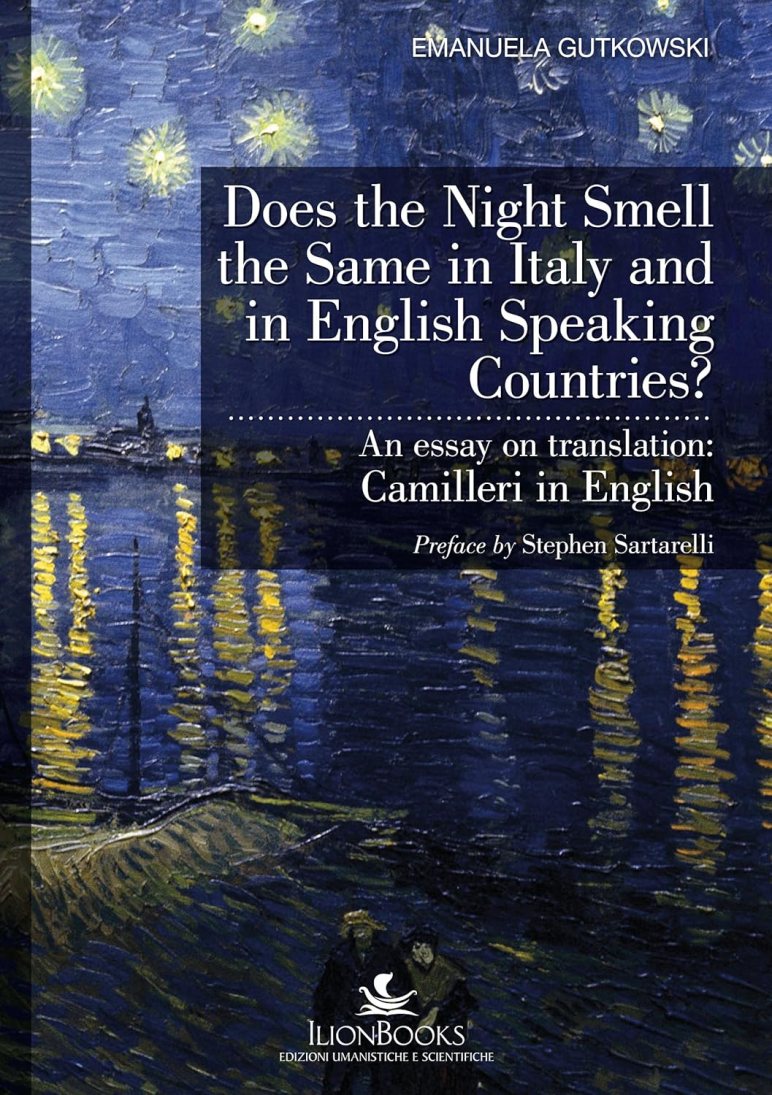
by Stephen Sartarelli
I have always believed—at least when translating prose—that a literary translator should be like the arbiter or umpire of a sporting event: the less noticed the better. Whenever readers and critics praise, for example, the stylistic elegance of an author I happen to have translated, I take this as a compliment to my own quiet work, an implicit acknowledgement of the grace of my invisible hand. Translating an author with the immediate appeal of Andrea Camilleri, however, I am finding it harder to remain anonymous.
But of course, it is not just Camilleri’s charm that helps to foreground my humble role as handmaiden to the fortunes of his Montalbano novels in English. The problem of language in general, and more specifically of its infinite variability in our often unconscious use of it, lies at the heart of Camilleri’s literary enterprise and renders my role as translator more problematic than usual. This is why, I think, I get asked how I go about translating his works far more often than I do with any other author I have worked on.
The Italians always ask the thorniest questions, and this is only natural, since, to them, and especially to those versed only in “official” Italian—an ever growing majority, alas—Camilleri’s language (a curious pastiche, in the Montalbano novels, of the particular Sicilian of Agrigento, Camilleri’s native region, combined with “normal” Italian, contemporary slang, comic stage dialogue, lofty literary flourishes, and the sort of manglings of proper Italian made by provincials who have never learned it correctly) remains unique and often irremediably foreign. These questions usually boil down to the same one: How could one ever render a proper equivalent of this linguistic stew in English? The answer is very simple: One cannot. But, on fait ce qu’on peut, as the French say. One does what one can. That is, one cannot hope to reproduce, even remotely, in the translation, the same distancing effects, from proper Italian, that one finds in the original.
Dialect is inherently local. Montalbano’s world of cops, hoods, lovely ladies and eccentric petit-bourgeois could hardly be made to speak American ghetto jive or Scots or Faulknerian Mississippian or any other geographically specific idiom without appearing absurd. But they can be nudged in certain directions. I have tinged some of the policemen’s speech with Brooklynese, for example, since many of the cops in New York City, where I used to live, happen to be (or used to be) of either Sicilian or Southern-Italian extraction. This seemed to me at least superficially plausible, however artificial. But such a choice came to me almost without reflection, as second nature, so to speak. The larger problem of rendering the spirit of Camilleri’s vision intact has always seemed to me of greater importance. For it must also be said that, for all their linguistic patchwork and invention, Camilleri’s texts, in the original, read quite naturally—once one gets used to his idiom(s), that is—and are really quite limpid and clean. To me it has always seemed more important to preserve this naturalness, this clarity of design and purpose than to try to create an inevitably pale and inaccurate imitation of his linguistic mosaic, which would, of necessity, in translation, compromise the rather streamlined quality of his tales.
In any case, Camilleri’s playful approach to language need not be aped on a case-by-case basis to come across in the English translation. When I can, of course, I do try, to the best of my ability, to create puns where the author himself puns, to mangle English where Catarella mangles Italian, and so on. But to make up for those many instances where for the sake of fluency I have no choice but to sacrifice some oddity in the original, I am always on the lookout for opportunities to take a few liberties myself. Once such instance is Catarella’s word—in my translation—for the internet: “interneck.” In the original, Catarella miraculously has no trouble pronouncing the proper, indeed English word “internet.” But the idea occurred to me to have him say “interneck” from the very first, because I had already taken to using the distortion myself, in an imagined form of “immigrantspeak” of the sort that I sometimes indulge in at sillier moments (my parents emigrated to the U.S. from Rome). I think the word may have originally been suggested to me unconsciously by the fact that, once I first started using the internet, I would spend more time than before at the computer, resulting in acute pain at the base of my neck. (I have thus far resisted the temptation to take the distortion one step further and elide the “t” in “inter”, American-style, which would yield “inner neck”—an esoteric concept, to be sure, but one probably not, however, entirely foreign to a Catarellian Weltanschauung.)
So much, then, for the impossible task of properly translating Camilleri, at least for the Italians, who fairly shudder—and rightly so—at the thought of their beloved author having to “rise,” in the famous words of Walter Benjamin, to the “purer linguistic sphere” of translation. [In the famous 1923 essay, “The Task of the Translator” (“Vorwort über die Aufgabe des Übersetzers”), written as a foreword to his translations of Baudelaire.] Far easier, on the other hand, are the questions of the English-language readers of my versions of Camilleri, questions which, for their part, usually boil down likewise to the essential: What is it like to translate Camilleri? To which there is an equally simple answer: fun!
Which is, mind you, not usually the case with translation, the physical and intellectual effort of which has left me, as I once put it in a poem of mine, “hunched from a kind of lip-synch scoliosis.” Gratifying, sometimes, stimulating, often, but fun, no. Indeed, so unfun is it that my wife, normally accustomed to hearing me curse aloud at my desk or hurl books against the wall in despair over the sentences of my authors, nearly fainted when, passing by my open study door as I was working hard on my first Camilleri novel, she actually heard me laughing.
The historical novels of Andrea Camilleri present their own set of problems for the translator. And while in some respects, particularly as concerns the question of dialect, the problematics remain closely related to those of the Montalbano novels, the simple fact that these stories are set in the past, usually in the years between 1870 and the century’s end—two notable exceptions being Il re di Girgenti (early 1700s) and La presa di Macallé (the Fascist era)—dictates that the translator use a somewhat different range of criteria in his or her word choices.
But where do we draw the line? That is, to what degree should the translator abandon the natural idiom of his or her epoch in order to convey a sense of the past? The question is far from simple, since Camilleri’s historical novels nevertheless remain works of contemporary fiction, where the past is evoked more, perhaps, in the fictional circumstances, and in the language of those passages standing outside the narration—dialogue, letters, quotations from fictional books, etc.—than in the language of the narration itself.
A possible example of “going too far” in trying to evoke this “sense of the past” might be the approach adopted by one of Camilleri’s two French translators, Dominique Vittoz, a professor of Italian at the University of Lyon, her hometown. Vittoz has chosen to translate the author’s Sicilian (or rather, Sicilian-Italian mélange) into patois lyonnais, with temporal variants depending on the historical epoch evoked in the original. Thus, in her translation of Il re di Girgenti (published in France as Le roi Zosimo), we get early eighteenth-century lyonnais, and in La stagione della caccia, late nineteenth-century lyonnais, to cite two examples.
While certainly highly ambitious, admirable, and requiring, no doubt, a great deal of effort, such an approach is, in my opinion, problematic. As I mentioned above, dialect is inherently local, and thus Professor Vittoz’s lyonnais remains inescapably linked with that French city, a world away from the “glorious and tortured island” of Sicily. [Donna Leon’s phrase, often quoted on the covers of my translations of the Montalbano novels.] Perhaps more importantly, prose that in the original is normally clear and precise, dialect notwithstanding—as in the eminently readable La stagione della caccia—becomes, in her obsolete provincial idiom, fairly arcane and dependent, for full comprehension, on the otherwise fascinating glossary of lyonnais terms at the back of the book.
More felicitous, perhaps, has been the inventive strategy of Serge Quadruppani, Camilleri’s other French translator, which consists principally of “Sicilianizing” and “southernizing” the French language. While admittedly artificial, such an approach, manifested predominantly in the morphology of the words used, is well within the spirit of Camilleri’s own inventive experiments with language. Thus, for example, the French verb penser [to think] becomes, in Quadruppani’s Sicilianized version, pinser, in keeping with the Sicilian corruption of Italian vowels in the original, and eliciting a similar comic effect, sounding as it does like pincer [to pinch]. As a native of the Southeast of France, moreover, Quadruppani (a noirish novelist when not translating) will often use snippets of the patois of that quasi-Italian corner of the country to evoke, alongside his “Sicilianizations,” the very specific distancing effect that Camilleri’s language creates with respect to standard usage, but without creating the difficulties one encounters in Vittoz’s renderings.
It is curious to note, too, that in his translation of Camilleri’s historical novel Il birraio di Preston, Quadruppani’s evocation of the earlier epoch goes no further than an application of his morphological approach to a prose style in a more nineteenth-century vein. [Quadruppani also chooses not to translate at all that novel’s brief dialogues in other dialects—Piedmontese, Milanese, Roman and other—but merely provides explanatory footnotes, thus preserving the sort of linguistic mosaic of post-Unification Sicily present in the original text.] And here, too, I agree with him. In this novel the shifts and leaps of style are so varied and numerous that the mere act of properly rendering the text in decent prose will convey a great deal of the archaism or simple eccentricity of the original, without needing to add yet another patina of language to an already complex text. That is, the “sense of the past” that one seeks to convey in the translation often already exists in the very structures and rhetorical figures of Camilleri’s original sentences. The translator must simply be up to the task of rendering them well and effectively.
Perhaps the most obvious example of such “archaism” inherent in the language of the original, and needing only to be coaxed forth by the translator, would be the memos and letters that figure among the cose scritte (the“things written”) which, alongside the cose dette (the “things said”), advance the plot of La concessione del telefono, to my mind Camilleri’s masterpiece, at least from a stylistic point of view. In these letters the mind-numbing complexity and convolution of the bureaucratic prose of Southern Italian administration under the Bourbon monarchy (here carried over into post-Risorgimento Sicily) are already so foreign and outdated to a contemporary reader of English that the translator need only re-create the same stylistic extremes within the limits of plausibility inherent in his own language to create the same effect.
Of course, as the Italians say, fra il dire e il fare, c’è di mezzo il mare—that is, it’s easier said than done. But it is all part of the journey to the “purer linguistic sphere” evoked by Benjamin, and the going is not always easy. For translation is first an act of reading, then of transformation, and in the reading there is always a process of clarification taking place, which the transformation, if successful, cannot help but reflect. Absent this clarification, there will inevitably be problems with the translation. Because in a translation, the language used can never be inseparably one with its subject the way the original is, as Benjamin said. It does not grow out of its subject from within, as an original composition does, even with all its flaws. It must be made to fit from without. And if it does not fit well, the reader will be the first to know.
Moshe Kahn, Camilleri’s peerless German translator, as well as a professional musicologist and musician, once said, in reference to our author (and I paraphrase from memory), that “dialect can never be translated as such. But it must be rendered in its every aspect.” I believe that Kahn, in so saying, was applying the Benjaminian paradigm, wittingly or unwittingly, to another, additional problematic, that of dialect in its relationship to an “official” tongue, and the extra semantic layer through which the meaning must therefore pass on its way to the “higher sphere” of the translation. In other words, for a dialect writer such as Camilleri, the language that grows most directly out of its subject, without mediation, is dialect, at least part of the time—that is, he chooses to say certain things in dialect because in those instances the dialect is the linguistic expression most organically suited to the thing expressed—and the translation must somehow intrinsically express this relationship and its difference from expression in an “official” or “classical” tongue, even while recuperating all the meanings contained within the dialectal expression.
But can it really be done? Do my translations of Camilleri convey a sense of arising from a language different from that in which all the other Italian writers I have translated express themselves? I think they do, at least a little, although I would be at pains to explain exactly how. There is something instinctual in all this, I believe, beyond rational explanation, rather like the emotion or nuances the musician senses behind the simple black-and-white notation of the score to be interpreted. As a music aficionado and amateur musician myself, I have always liked the analogy of translation as musical interpretation. Like a musical score, the original lies in there immutable for all eternity, waiting to be given life. The new versions will always differ, but each new interpretation will have a life of its own, always dependent upon the original, but always distinct in itself.
In this perspective, however, there is again an additional stage through which the music of the translation must pass to become the finished work. If the original text is the score, then the language in which it is written, or more precisely, the oral expression of that language, is the instrument—or the orchestra or ensemble of instruments—for which it was written. We translators, then, are first transcribers—that is, we rewrite the music for another instrument, our language—and then musicians, as we give voice to the instrument and new score. And it is through this transcription, and our initial interpretation of it, that you, the readers, will then create your own version of it in the reading. For in the simple act of reading we are all translators, all musicians interpreting the songs of others for our enjoyment and edification.
This essay first appeared as the preface to the book:
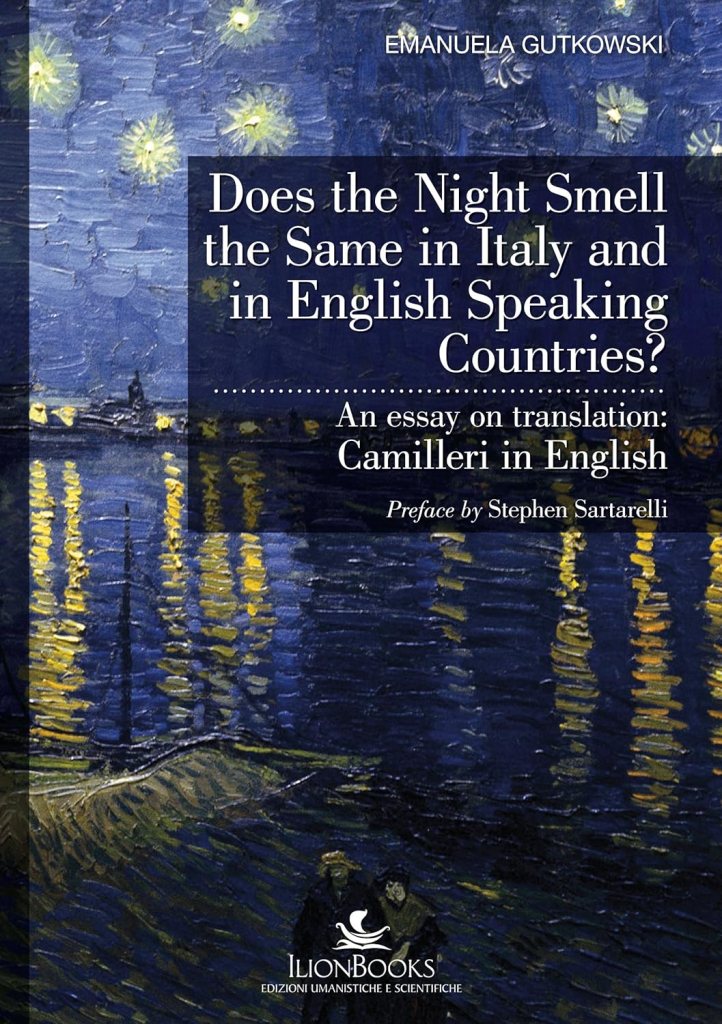
Does the Night Smell the Same in Italy and in English Speaking Countries? An Essay on Translation: Camilleri in English
- by Emanuela Gutkowski
- 80 pages
- Ilion Books (2009)
- ISBN: 8890362618
STEPHEN RECOMMENDS:
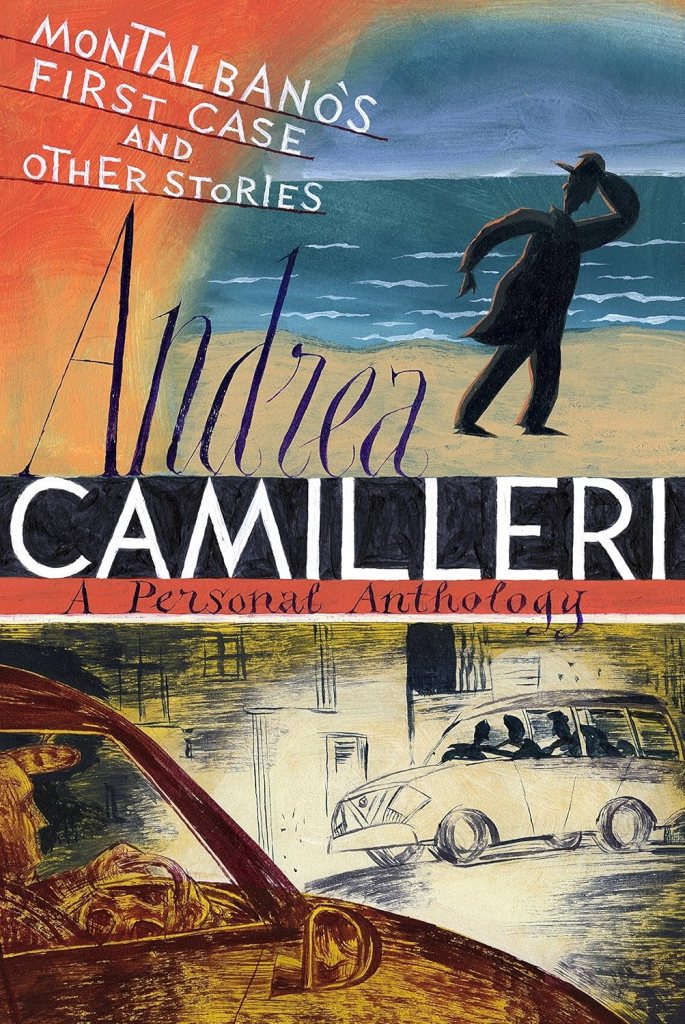
Montalbano’s First Case and Other Stories
- by Andrea Camilleri
- Short stories selected by the author
- Translated from the Italian by Stephen Sartarelli
- Pages 576
- Publisher: Mantle (2016)
- ISBN: 9781447298403
- Treat your bookshelf to a taste of Italy! Order the book here!

Hunting Season
- by Andrea Camilleri
- Translated from the Italian by Stephen Sartarelli
- Original title: La stagione della caccia (1992)
- 192 pages
- Publisher: Mantle (2019)
- ISBN: 9781447265948
- Treat your bookshelf to a taste of Italy! Order the book here!
Stephen Sartarelli has translated widely from Italian and French, most recently works by Andrea Camilleri and Gabriele D’Annunzio. His translations have won numerous prizes, including the Raiziss-De Palchi Award of the Academy of American Poets twice: once for Songbook: Selected Poems of Umberto Saba and again for The Selected Poems of Pier Paolo Pasolini; as well as the Foreign Dagger Award of the UK Crime Writers Association for The Potter’s Field, by Andrea Camilleri and the John Florio Award of the UK Society of Authors for Prince of the Clouds, by Gianni Riotta. He is currently completing his lifelong project of translating the monumental novel Horcynus Orca, by Stefano D’Arrigo.


Italian Lit Month’s guest curator, Leah Janeczko, has been an Italian-to-English literary translator for over 25 years. From Chicago, she has lived in Milan since 1991. Follow her on social media @fromtheitalian and read more about her at leahjaneczko.com.
 Global Literature in Libraries Initiative
One thought on “#ItalianLitMonth n.44: On Translating Camilleri: Notes from the Purer Linguistic Sphere of Translation”