
Author interview by Lisa Mullenneaux
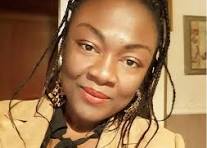
Yvette Samnick was born in Okala, Cameroon, in 1985 of a polygamous father, who had four wives. She earned a Master’s degree in Political Science and International Affairs from the University of Calabria in 2016 and in 2019 published her first book, Perché ti amo (Pelligrini, Cosenza). In 2024 Edizione E/O (Rome) launched her second book Nata ribelle. “Born a rebel” is not only an apt title for her new book, but the perfect credo for a woman who has fought for her rights as a woman of color. Samnick collaborates with Trama di Terre in Forlì, where she organizes creative writing classes for women exiting violence, with a specific focus on violence suffered by foreign-origin women.
Lisa Mullenneaux (LM): This spring Europa Edizioni launched your second book Nata Ribelle (Born a Rebel). How does this memoir differ from Perché ti amo (Because I Love You)?
Yvette Samnick (YS): Born a Rebel and Because I Love You both tell stories of violence, resilience and resistance, the first by the mother and the second by her daughter. In this second memoir, I wanted to tell the story of many women of my country, Cameroon, and the battles they lead daily for self-determination. The publication of my first book taught me a very important lesson: it showed me how we are looked at. As a black African female author, my first book was received with a Eurocentric, colonial bias. I failed to achieve my goal with Because I Love You because it was considered through existing stereotypes and prejudices of black African women and somehow it ended up reinforcing them. I was considered a victim because I spoke about taboo topics, such as domestic and marital violence, racism, and colonialism, especially – but not limited to – relationships between Italian men and black women. Sharing my experience of domestic violence with other women also sent a message that it could be overcome. That was very positive versus the mistaken notion that by immigrating to Italy I was “saved”; that is, that I had evolved from a backward, traditional condition to the Western, civilized one. At times I heard myself referred to as a Westernized woman.
It is in this context and from these lessons that I wanted to publish Born a Rebel. My goal was to narrate a personal story and control the narration. Through the story of my mother I wanted to dismantle the prejudices about black African women who leave their home countries for Italy. Born a Rebel argues that there isn’t one model of patriarchy nor of resistance to it. On the contrary, it shows that “every woman has her patriarchy.” I wanted to confront the arrogance of Western feminists. Women of the South have their own patriarchy and find their own ways to fight against it. If the methods they use aren’t discussed enough, it’s simply because their methods don’t align with the canons of resistance of Western feminism. Born a Rebel tries to prove that women struggle for and resist with tools connected to their particular situations.
LM: How do teaching and writing support each other?
YS: Writing is a form of self-care for me. I am more introverted than extroverted. It’s much easier for me to express what I think than what I feel. Writing helps me to discover who I am, very often because the things I write about myself aren’t only about me. My writing is radical, and the ideas I put out there often make me feel naked, but that self revelation is useful and important. Through my personal history and work, I’m also relating the histories of black women in Italy, the practical challenges in our daily lives, the struggle to live and thrive as a black woman.
What I share in university classrooms is aimed at finding alternatives to existing narratives, counter-narratives, and encouraging a critical spirit. What I realized by attending university—and coming back from time to time to do workshops and other activities—is the gap between academia and the outside world. Very often they aren’t in sync. Experiences outside the classroom stay outside and don’t promote critical thinking, and theories learned at university often ignore more practical considerations. My aim as a teacher is to bring the outside inside the university and to create subjects of epistemological analysis, disseminating a critical spirit among the students.
LM: Can you describe your work with victims of domestic violence?
YS: I accompany women who have either survived or are currently enduring violence along their journeys of emancipation and elaboration. Listening is essential in both; in fact, it’s at the center of my work. I always assume that all women are strong. Both the one who has had the courage to leave and the one who is still suffering from that violence need to be reminded they have the strength to free themselves, to take back their lives. This is often the result of a loss of self-esteem caused by years of psychological abuse. My role is to support and encourage them to recover freedom of choice, and for that reason I never tell a woman what she should do. I don’t advise her. It may happen that I make suggestions, but I don’t give advice. For many women, this can be frustrating if they expect answers from me. But usually the answers are already there; they don’t want to see them because they are not ready.
LM: What suggestions would you give to a woman who is starting out as a writer, especially if she is adapting to a new country?
YS: In my working life, I have used writing as a tool to investigate violence done to women. I’ve seen that many women in moments or stages of depression remained locked in the past, controlled by emotions they couldn’t free themselves from. These woman have generally begun a path of self determination, carrying out their life project or recovering what they could of it. They are also working towards financial freedom. Writing helps them to remember who they are, to construct and reconstruct their physical and mental paths as they process a violent past. To admit that “I was the woman who experienced this and I have to live with that part of me but it doesn’t define me.”
At times of depression, the fear of being stuck in that past is always present and does not allow her to value the positive steps she is taking to get her life back. One thing that helps is to write every day about the positive things she has achieved, things that would never have been possible in the past. Every time she’s pulled down into depression, she can read to remember. Another exercise is to record the emotions she has in moments of anger, depression, anxiety and then reread them aloud. There are women who, once recovered, don’t recognize themselves in those words and emotions. They try to dissociate themselves from that person. It’s a defense mechanism they use to avoid facing that other self that makes them feel bad, that they’d like to erase.
Writing and reading is a form of healing. It allows abused women to deal with that part of themselves they want to forget. Many are afraid of those exercises simply because they are not yet ready to confront what they have lived. But it has helped many women and once the journey was over, they confessed to me that they continued writing because it helped them listen to themselves more closely and reconcile with that part of themselves split by the violence they suffered. They try to heal that part of themselves every day.
For immigrant women who want to write, I suggest first learning the new language because language is a tool of power, especially for those who aim at radical writing, women who want to produce counter-narratives. If I want to speak and be understood by my oppressor, I must learn his language. Through this, I break down the first barrier of communication between us and I am sure that my message has been understood, even if many times it is ignored. Language, as a tool of power, can also become a tool of liberation.
Interview conducted and translated by Lisa Mullenneaux
Yvette Samnick’s books
- Nata ribelle: Published in Italian by Europa Edizioni (March 2024), 88 pages
- Perché ti amo: Published in Italian by Luigi Pellegrini Editore (2019), 142 pages
Lisa Mullenneaux specializes in the translation of modern Italian authors, such as Maria Attanasio, Amelia Rosselli, Alfonso Gatto, and Giovanni Giudici. She also reviews books in translation for the Harvard Review and World Literature Today. She is the author of the critical study Naples’ Little Women: The Fiction of Elena Ferrante and has taught research writing for the University of Maryland’s Global Campus since 2015. More at lisamullenneaux.com.


Italian Lit Month’s guest curator, Leah Janeczko, has been an Italian-to-English literary translator for over 25 years. From Chicago, she has lived in Milan since 1991. Follow her on social media @fromtheitalian and read more about her at leahjaneczko.com.
 Global Literature in Libraries Initiative
One thought on “#ItalianLitMonth n.26: “Born a Rebel” Is a Cry for Gender Justice”