
by Paolo Grossi
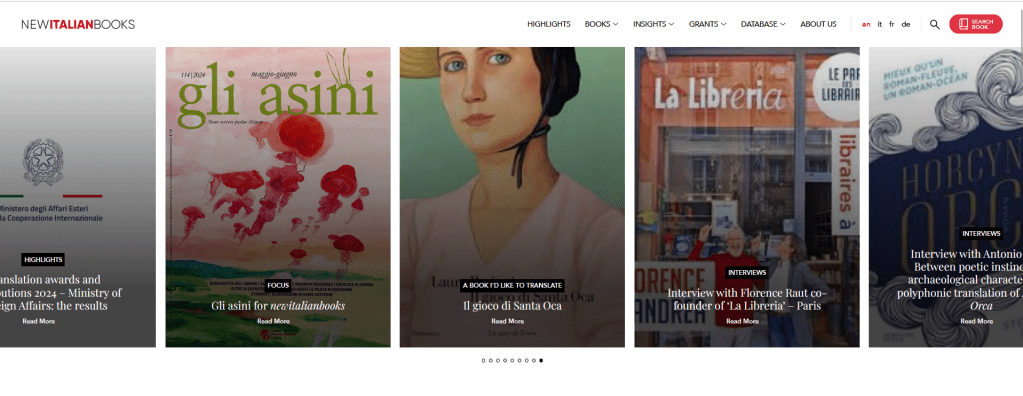
newitalianbooks.it is the web portal dedicated to the promotion of Italian books worldwide, comparable to similar European websites such as the German litrix.de and new-books-in-german.com, the French booksfromfrance.fr, the Spanish newspanishbooks.com, the Dutch letterfonds.nl, etc.
newitalianbooks.it was born in 2020, on my initiative, in a bilingual, Italian-English edition, thanks to the support of the Treccani publishing house in Rome and the collaboration of various public and private entities, including the Ministry of Foreign Affairs and International Cooperation (MAECI), the Ministry of Culture (MIC) and the Italian Publishers Association (AIE). Its earliest origins, however, date back to 2014, when the website booksinitaly.it was conceived and set up, again at my instigation, with the collaboration of the same entities mentioned above and, in the role of publisher, the Fondazione Arnoldo e Alberto Mondadori of Milan. booksinitaly.it was short-lived, from 2014 to 2017, for a whole series of reasons it would take too long to recall here. In the following two years, from 2018 to 2019, I devoted all my time and energy to the search for a new publisher, a search crowned with success in 2020 thanks to the investment that the Istituto della Enciclopedia Treccani decided to make to relaunch my previous project with a new layout and under a new name.
Over the course of four years (2020-2024) newitalianbooks.it has been enriched with new language versions and new sections. In 2022, in anticipation of the 2023 edition of the Festival du Livre de Paris, at which Italy was to be the guest of honour, the site was opened to the French language. Since autumn 2023, a fourth language version, in German, has been progressively introduced, this time with a view to the Frankfurt Buchmesse of 2024, which will also see Italy as the guest of honour. A fifth version, in Spanish, is currently being considered.
newitalianbooks.it can, firstly, be defined as a great showcase of Italian publishing. Italian publishers and literary agents who hold the rights of Italian authors can upload there, free of charge, files relating to their new books. Today, the site features over 2500 titles, uploaded by more than 260 publishers or agents. Publishers who register with newitalianbooks.it undertake to upload files in two languages (Italian and English), in which they must specify the name and address of the rights manager. In addition, the portal also offers the possibility of uploading translated sample texts, helping foreign publishers to make their own personal judgement of the books. The editorial staff of newitalianbooks.it then translates the entries into French and German and publishes them on the portal.

While the main raison d’être of newitalianbooks.it is to give visibility to all Italian publishers on the international market, it also aims to be a more wide-ranging instrument at the service of all those who work in the book industry (publishers and agents, of course, but also translators, booksellers, librarians, etc.), in short, a real overview of the reality of Italian books translated around the world. Special attention should be paid to the ‘Insights’ section of the portal, which includes surveys from the world of books and interviews with leading figures from the publishing world. In addition to the surveys and interviews, there is another subsection, which is very important to me and which is a feather in the portal’s cap. This subsection is called ‘In other languages’ and is intended to be a collection of files dedicated to Italian authors in translation. Dozens of specialists, scattered all over the world, regularly send concise profiles of the translation situation of our most important authors, both classic and contemporary. They are extremely concise but valuable summaries, allowing us to understand how the publishers of the various countries of the world see their relationship with Italian authors. The results, if read carefully, are often surprising and can be of help in orienting the choices of our publishing industry. This is a little explored field of study. In fact, there are no databases that systematically collect information on the sale of Italian authors’ rights abroad or on the translations of Italian works into the various languages of the world. In this sense, newitalianbooks.it hopes to be a platform for a study of the diffusion of Italian authors in the world.
Another important aspect of newitalianbooks.it is its close link with the reality of the Italian Cultural Institutes around the world and, more generally, with all the representatives of Italy abroad (embassies and consulates, etc.). newitalianbooks.it regularly publishes news of the events that the Institutes organise around the world to promote Italian books.
newitalianbooks.it also offers its readers a series of databases of publishers, agents and translators. All these databases are self-supplied, in the sense that it is the publishers, agents and translators themselves who ask to subscribe. I would like to emphasise in particular the uniqueness of one tool, the translator database (TRADIT), which now has over 400 names and allows us to find translators covering the most diverse languages of the world.
Among the latest novelties on newitalianbooks.it, I would like to mention the creation of two new sections, which are intended to further consolidate the participatory dimension peculiar to our portal: the first, entitled ‘A book I’d like to translate’, invites one translator each month to present a book that has never been translated into his or her own language: an opportunity that once again allows translators to perform that precious function of ‘mediators’ between publishers from different countries.
The other section, entitled ‘Focus’, invites competent readers (editors of literary festivals, trade magazines, booksellers, librarians, etc.) to propose selections, thematic or genre-based, of recent titles. By way of example, I would like to mention the two most recently published focuses, the one in June dedicated to books for young readers, edited by the editorial staff of Mignolo, the childhood supplement of the Indice dei Libri, and the one in July, edited by the editorial staff of the magazine Gli Asini and dedicated to politically and socially engaged nonfiction.

Finally, the third and latest novelty of the past few months is the publication, in print and digital versions, of A short guide to grants and awards for translation of Italian books into foreign languages. The result of a collaboration with the partners of newitalianbooks.it, but also with other institutions, such as SEPS (European Secretariat for Scientific Publications), the Guide collects and synthesises in a language as clear and simple as possible all the various support mechanisms for the publication of Italian books in foreign languages, which are otherwise scattered in various places and sometimes difficult to find. The Guide is available in paper version in English and Italian and can also be downloaded as a pdf in four language versions: Italian, English, French and German.
With the publication of this Guide, newitalianbooks.it reaffirms and consolidates its mission to be a tool at the service of all those who work daily, in Italy and abroad, to promote Italian books around the world.
Paolo Grossi, Editorial Director of newitalianbooks.it
Paolo Grossi, PhD in Romance Languages, has taught Italian literature at the universities of Uppsala (Sweden) and Caen (France). From 2003 to 2008, he was Cultural Attaché in Paris, and later directed the Italian Cultural Institutes in Stockholm and Brussels. Since 2020 he has been the editorial director of the web portal newitalianbooks.it, dedicated to the promotion of Italian books abroad. In Paris, he created and still directs the series of studies and texts on Italian literature ‘Cahiers de l’Hôtel de Galliffet’.

“Italian literature today can count on authors of great value. Among novelists, I would like to mention at least Antonio Franchini, Helena Janeczek, Francesco Pecoraro, Emanuele Trevi and Vitaliano Trevisan. Among poets, Antonella Anedda and Eugenio De Signoribus.” —Paolo Grossi

Italian Lit Month’s guest curator, Leah Janeczko, has been an Italian-to-English literary translator for over 25 years. From Chicago, she has lived in Milan since 1991. Follow her on social media @fromtheitalian and read more about her at leahjaneczko.com.
 Global Literature in Libraries Initiative
One thought on “#ItalianLitMonth n.20: newitalianbooks.it: Your Portal to the World of Italian Publishing”