
by Anne Milano Appel
I first came upon Daniele Del Giudice in a bookstore window in Rome, while waiting for a bus on Via Vittorio Emanuele. In the window was a copy of his Staccando l’ombra da terra and I went in and bought it. As I read it, I got a sense that this was a writer whose work I would enjoy delving into. A few years passed before I was invited to translate an excerpt from his final work, Orizzonte mobile, for The European Union Prize for Literature: Twelve Winning Authors 2009.
My interest in this author’s work continued for years, before and after his death in 2021, following his years of inactivity due to Alzheimer’s. Somewhere along the way he became my white whale – or perhaps my obsession. Over the years I have published a number of his shorter pieces and an excerpt from his last narrative work: these include the short story Naufragio con quadro (Shipwreck with Painting); an excerpt from the novella Nel museo di Reims (At the Museum in Rheims); and an excerpt from Orizzonte mobile (Movable Horizon).
These few successes coupled with the fact that only two of Del Giudice’s works had been published in English translation – Staccando l’ombra da terra (Takeoff: The Pilot’s Lore) and Atlante occidentale (Lines of Light) – spurred me on. When a reviewer of Lines of Light in The Modern Novel commented: “that Lo stadio di Wimbledon (Wimbledon Stadium) has never been translated into English is a sad commentary on the state of the novel in the English language,” I was hooked – determined to see his first and last works made available to English readers.
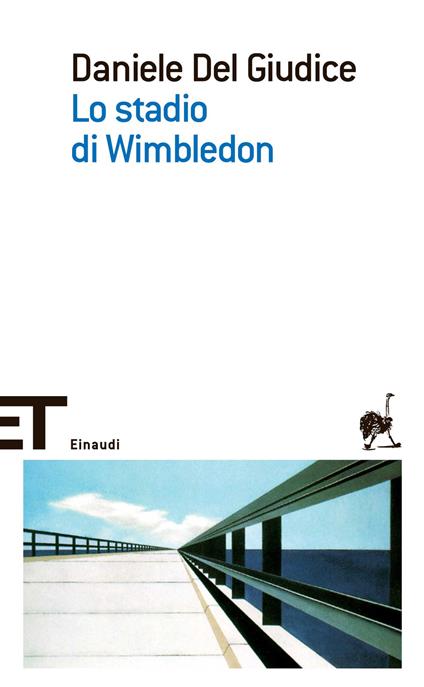
Lo stadio di Wimbledon (Einaudi, 1983, 2021) was of particular interest because I felt it gave a clear forecast of Del Giudice’s writing ethic, a clarion call expressing why he considered the art important, and how he viewed the writer’s moral responsibility. The expectation is communicated by contrast, specifically between the figure of Roberto ‘Bobi’ Bazlen and that of the book’s narrator. Bazlen was a prominent literary notable at the time who chose not to write, famously stating: “I believe that it is no longer possible to write books. That is why I do not write books. Almost all books are footnotes that have ballooned into volumes (volumina). I write only footnotes.” (Quoted in Roberto Calasso, Introduzione, Roberto Bazlen, Scritti, Milan: Adelphi, 2002, p. 203.) This stance was puzzling to the narrator (who is viewed by many as the author’s alter-ego), who set out to unravel the enigma by tracking down those who knew him, and ended up formulating an apologia on writing.
My interest in Del Giudice’s work was further kindled by the fact that Claudio Magris, another writer with whom I felt affiatata, expressed great admiration for his colleague Daniele. In 2009, around the time Orizzonte mobile was about to come out, the two engaged in a dialog (“Morto Daniele Del Giudice: il suo dialogo con Claudio Magris,” Corriere della Sera), in which Magris observed that they shared “una grande affinità.” At one point Magris compared Del Giudice’s way of being in the world to the penguins he writes about in that book, noting a similarity to that which Del Giudice attributes to the Antarctic penguins he observed on the ice fields: that is, being impeccable and awkward at the same time. Impeccable in his measured, implacable writing and in the entire style of his person and, though certainly not outwardly awkward, showing signs of a metaphysical awkwardness; the profound sense that life is awkward, a muddle, a breach between precision and dismay.
Elsewhere Magris wrote: “Daniele’s journey was interrupted as he was setting out, with his stark, inexorable poetry, towards ever-loftier destinations…. I am absolutely convinced that, after his meteoric debut, Daniele was progressively growing. Like everyone else, I love Lo stadio di Wimbledon and Atlante occidentale, but I believe that his greatest works were written subsequently.” (From Magris’ essay in Luce e ombra. Leggere Daniele Del Giudice, Alessandro Scarsella, ed., Amos Edizioni, 2021, p. 82.)
Which bring us to Orizzonte mobile (Einaudi, 1983), the final book Del Giudice wrote before his illness claimed him. It is an account of the narrator-author’s actual journey to Antarctica in 1990, that of two early explorers told in recreated expedition logs, and a fictional journey of 2007. The author termed it a reconstructed “hyper-expedition” recounted “in continuity and in a kind of simultaneity,” what he often referred to as compresenza, co-presence.
Now that his first novel, Lo stadio di Wimbledon is poised for publication in 2025 as A Fictional Inquiry, I am hopeful that Orizzonte mobile will garner some attention and follow along.
“The publication of this translation has been made possible thanks to a contribution awarded by the Italian Ministry of Foreign Affairs and International Cooperation.”
Daniele Del Giudice was born in 1949, in Rome, and later lived in Venice. He published his first narrative, Lo stadio di Wimbledon, in 1983. This was followed by other novels and shorter works including Atlante occidentale (1985), Nel museo di Reims (1988), Staccando l’ombra da terra (1994), Mania (1997), Orizzonte mobile (2009) and more recently I racconti (2016). Considered a leading representative of a new generation of Italian writers, Del Giudice’s works have won numerous awards: the Viareggio Prize in 1983, the Bergamo Prize in 1986, the Bagutta Prize in 1995, the Premio Flaiano in 1995, the Selezione Campiello Prize in 1995 and 1997, the Accademia dei Lincei award for fiction in 2002, and the European Union Prize for Literature in 2009. His works have been translated into sixteen languages. Staccando l’ombra da terra and Atlante occidentale were published in English as Takeoff: The Pilot’s Lore (Houghton Mifflin Harcourt, 1997) and Lines of Light (Harcourt, 1988) respectively. For some years before his death, in 2021, he resided in a care facility in Venice.
English Translations
- Staccando l’ombra da terra (Takeoff: The Pilot’s Lore, Houghton Mifflin Harcourt, 1997), translated by Joseph Farrell
- Atlante occidentale, (Lines of Light, Houghton Mifflin Harcourt, 1988), translated by Norman MacAfee and Luigi Fontanella
- Naufragio con quadro (Shipwreck with Painting, The Massachusetts Review, Spring 2017), translated by Anne Milano Appel
- Nel museo di Reims (excerpt) (At the Museum in Rheims, Translation Review, 117, November 2023, and online), translated by Anne Milano Appel
- Orizzonte mobile (excerpt) (Movable Horizon, Translation Review, 116, August 2023, and online), translated by Anne Milano Appel
- Lo stadio di Wimbledon (A Fictional Inquiry, New Vessel Press, 2025), translated by Anne Milano Appel
Anne Milano Appel has translated texts by a number of leading Italian authors – among them Claudio Magris, Primo Levi, Giovanni Arpino, and Goliarda Sapienza – for US and UK publishers. Her shorter works have appeared in a variety of literary journals. Her awards include the Italian Prose in Translation Award, the John Florio Prize for Italian Translation, and the Northern California Book Award for Translation. Her work on Daniele Del Giudice has appeared in Translation Review and Massachusetts Review. Her translation of his final novel Orizzonte mobile is currently seeking a publisher, and Lo stadio di Wimbledon will soon appear in English from New Vessel Press as A Fictional Inquiry. Translating professionally since 1996, she is a former library administrator, and has a doctorate in Romance Languages and Literature.

Her website is: http://www.annemilanoappel.com/.
Social Media
- @AnneMilanoAppel on Twitter
- Anne Milano Appel on LinkedIn
- @annemilanoappel.bsky.social on Bluesky
“Every text has its secret… The translator’s task is to tease out that secret. And share it.” —Anne Milano Appel

Italian Lit Month’s guest curator, Leah Janeczko, has been an Italian-to-English literary translator for over 25 years. From Chicago, she has lived in Milan since 1991. Follow her on social media @fromtheitalian and read more about her at leahjaneczko.com.
 Global Literature in Libraries Initiative
One thought on “#ItalianLitMonth n.19: My White Whale: Translating Daniele Del Giudice”