
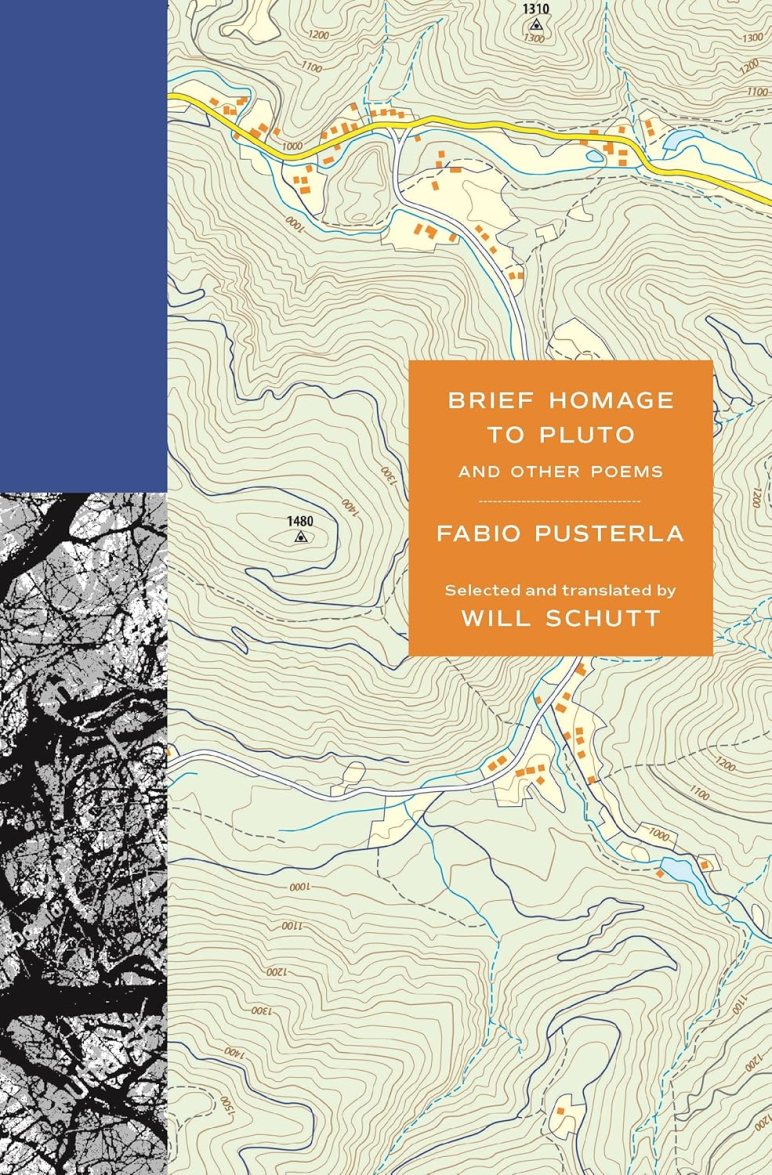
by Will Schutt
The Pluto that appears in the title of the Swiss Italian poet Fabio Pusterla’s selected poetry in English is not the planet. It isn’t the Disney character, either. It is Hades’ Roman counterpart, the god of the underworld. That fact might suggest that many of the poems in Brief Homage to Pluto have an elegiac strain. (They do.) But it is worth remembering that Pluto is a largely positive figure whose name comes from a Greek word meaning “wealth-giver”—for wealth is what the earth provides. And, as they unravel down the page, many of Pusterla’s poems seem to mine their richness from the depths, from the mineral life. Some poems even exhort us to:
lower ourselves into the earth if need be
to see the strange rock formations
the buried white stars that shine
calcite crystals
in the dark.
Elsewhere I have written that Pusterla is a poet both rooted and rootless. His poems take pleasure in the taxonomies of his natural surroundings and frequently namecheck the towns and villages in Canton Ticino, the Italian-speaking part of Switzerland where he has spent most of his life, as well as the Valsolda, the neighboring Italian comune he calls home. This remote area—remote, I mean, to the literary and cultural epicenters of Italy—has produced a small but vibrant community of writers and publishers for much of the mid-twentieth and twenty-first century, thanks in no small part to Pusterla, who for many years taught literature at a Swiss high school and at the University of Italian Switzerland in Lugano. He also continues to foster emerging or under-recognized poets as the editor of the Ali poetry imprint of Marcos y Marcos. Other Ticino writers of note include the cousins Giorgio and Giovanni Orelli. Both figured importantly in Pusterla’s writing life, and both remain too little known to English-language readers.

But to speak of Pusterla in terms of region would be to diminish him. His local poems have global designs. His idiom is modern and his subjects often of national or universal concern: environmental degradation, media saturation, the rise of rightwing extremism and xenophobia in Italy and Europe. In translating and selecting the poems in Brief Homage to Pluto, I hoped to present English-language readers with all these facets of Pusterla’s poetry. He is a nature poet, an elegiac poet, a poet of political responsibility. He sings for the individual and the tribe—sometimes in a single poem.
In an essay about how he came to poetry (which I recently translated and published on LitHub), Pusterla writes, “It isn’t easy to say what poetry is with any clarity or concision. It isn’t easy and might not be possible or even worthwhile. I have the feeling that when something is too narrowly defined it loses its vitality…” It isn’t easy to say what Pusterla’s poetry is, either; maybe the poems should speak for themselves. Here, in full, is my translation of “Up and Down the Steps of Albogasio,” a poem that seems to encompass everything I’ve said about his work thus far and that finds Pusterla, once again, descending into poetry:
Up and Down the Steps of Albogasio
Houses on cliffs, minor asperities,
a child in mind; and, crosswise, the breva
taking the lake at a slant, a shapeshifter,
sweeping down from Saint Martin’s Pass,
hugging the rocks and roads, then gusting
past Gandria, where the water widens.
It is an evening of strong winds when I
descend the village stairs, as if in a chorus,
my hand gripping a stretcher that swings
and grazes the walls and at every turn
scrapes away white dust, a final
coat of lime for Erminia, the kind lady
who died somewhere else and is now
returning to her balcony of tiny flowers.
We pass into the dark: testing each
step down as we negotiate the steep
flight and narrow porticoes. The lake below
drops from sight but we can hear it
darkly lapping at the docks, and the tarred
wooden hearts of boats groaning.
Doors open, faces appear.
They don’t say a word as they watch
our strange procession lumber down to the black
houses of sleep. Yet something rises
from the bottom, a thick, moist draft,
a handful or swelling of air
slips in and demands a hearing,
unlikely life rising off the water, still formless
yet already present, already lording
its disembodied existence over us
on our way down, and keeps climbing,
like faint smoke. Ancient steps
the steps of Albogasio, where the living and the dead
brush past one another, mumbling their hellos.
Brief Homage to Pluto and Other Poems
- by Fabio Pusterla
- Translated from the Italian by Will Schutt
- 192 pages
- Publisher: Princeton University Press (2023)
- ISBN: 9780691245096
- Treat your bookshelf to a taste of Italy! Order the book here.
2024 Joseph Tusiani Italian Translation Prize, 2019 Raiziss/de Palchi Translation Award from the Academy of American Poets for manuscript in progress
Links:
- Review on Publishers Weekly
- Essay on Discovering Poetry by Fabio Pusterla on LitHub
- A Short Response to the Question “How does poetry help?” on the Princeton University Press blog
Will Schutt is the author of Westerly, winner of the Yale Series of Younger Poets Prize, and translator of My Life, I Lapped It Up: Selected Poems of Edoardo Sanguineti (Oberlin College Press 2018) and Brief Homage to Pluto and Other Poems by Fabio Pusterla (Princeton University Press 2023) among other works from Italian. He is the recipient of grants and fellowships from the National Endowment for the Arts, the PEN/Heim Translation Fund, the Trustees of the Amy Lowell Poetry Traveling Scholarship, and the Academy of American Poets. He lives in Rome where he teaches at John Cabot University.
More at www.wcschutt.com

“Maybe what translators do is let a reader ride on their shoulders. When they’ve done it well, she’ll have a clear view of the stage.” —Will Schutt

Italian Lit Month’s guest curator, Leah Janeczko, has been an Italian-to-English literary translator for over 25 years. From Chicago, she has lived in Milan since 1991. Follow her on social media @fromtheitalian and read more about her at leahjaneczko.com.
 Global Literature in Libraries Initiative
One thought on “#ItalianLitMonth n. 12: On Fabio Pusterla’s Brief Homage to Pluto and Other Poems”