by Katherine Gregor
I was struggling with the copious passages in regional dialect in a novel I was translating from Italian, so I asked my publishers to put me in touch with the author so that she could help me with those expressions I couldn’t find translated or explained on line. They kindly obliged.
A few weeks later, I happened to be chatting to the original Italian publisher of this book. “You know, when they requested the author’s details,” she said with a chuckle, “they sounded concerned about your knowledge of Italian. I had to explain that translators from Italian are expected to be proficient in Italian – not in all the dialects of the peninsula.”
After panic rose in my stomach (Oh, no, they think I’m incompetent!) then steadied into relief (Thank goodness the Italian publisher put them right), I thought about this calmly. Clearly, the person doubting my translating abilities was unfamiliar with Italy, its language and its literature, but then how many people outside Italy – even in the publishing world – are fully aware of the crucial, visceral role of dialects, or vernacular languages, in Italian culture? A Neapolitan friend, now in her early sixties, remarked that, like most Italians of her generation and earlier, she grew up bilingual: speaking Italian at school, at work and in official settings, and dialect (Neapolitan in her case) with family and close friends.
On my first trip to Milan, in 2019, I asked the hotel receptionist for an extra coat hanger. I used the word stampella. The receptionist’s eyes widened into a blank grey behind his thick lenses. “Una stampella?” he repeated slowly and expressionlessly.
“Sì, una stampella,” I insisted, wondering if I was requesting something considered illegal or immoral in Milan. For hanging our clothes, I added in Italian.
Expression drifted back into the receptionist’s eyes. “Ah, una gruccia,” he said, removing his glasses and wiping them, I suspect to distract himself from an urge to giggle.
Neither gruccia nor stampella are dialectal words. They are standard Italian. Only in Rome, where I grew up, stampella tends to refer to a coat hanger (although its other meaning is crutch). In Milan, it seems, it is used only to mean a crutch. So here I was, encountering region-based language miscommunication even in standard Italian.
I recently read that at the time of Italy’s unification, in 1861, only 2.5% of the population are estimated to have been fluent in the standardised language we call Italian. This may go some way towards explaining why, even now, a very large number of Italian writers have dialectal words, idioms and sayings escape the lips of their fictional characters. As far as I am concerned, the frequent presence of dialect, or vernacular, in Italian literature is an added challenge – and treat – to my work as a literary translator.
My first conscious encounter with an Italian dialect that was non-Roman came in the form of venesiàn, witty, wispy, histrionic, suffering no fools and delivered at breakneck speed by gondoliers and shopkeepers in Venice. I listened to them, fascinated, able to make out only the odd word, though I immediately fell for its sound. A lover of the Commedia dell’arte, I subsequently had huge fun translating – solely for my entertainment – passages from Carlo Goldoni’s Venetian plays. As a professional translator, I have so far tackled Piedmontese, Sardinian, Lombard, Friulian and, most notably, Sicilian while translating I leoni di Sicilia and its sequel. Sicilian, I learnt, varies depending on the area of this 25,711 km2-island. As Stefania Auci, the author of I leoni, explained, what is said in Palermo is not necessarily said in Trapani, and vice-versa. The same is true of the other twenty regions of Italy. In Venice, fog is caìgo. In Verona, less than two hours away, it is nèbia. I have just been told that maize is called melgòt in Bergamo and furmintù in Brescia, even though the two cities are 53 km apart and both in Lombardy.
I have long wondered why, in the 20th and early 21st centuries, dialect is still so often used in Italian fiction. I suppose that if a novel aims to be an albeit intensified reflection of Italian social reality, then you cannot ignore that fact that Italian social reality tends to be, if not dressed in, then sprinkled with regional words and expressions. Perhaps because Italian is an official language, it operates more on a cerebral, rather than an emotional level. Historically, it is the lingua franca that permits communication with the others, those who – you assume consciously or unconsciously – cannot understand you fully because their ear is not attuned to the rhythm of your heart in your tongue. Dialect, on the other hand, can convey your emotions to those to whom you don’t need to spell everything out because they truly get – and not just literally – where you’re coming from.
Nobody can question my love for the Italian language. I have spoken it practically since birth. Although I also translate from French, which I feel as close to my heart as Italian, having partly grown up in France, it was reading an Italian writer’s books that first inspired me to become a literary translator. However, my devotion does not prevent me from often finding Italian prose somewhat didactic and overwritten. Very little is left to the imagination of the reader, when every i is dotted, every t crossed and every piece of information detailed within an inch of its life. And, while at times compelled to tighten the English rendition slightly to accommodate modern Anglophone ears, most of whom subscribe to Polonius’s adage that “Brevity is the soul of wit”, I wonder if this tendency towards over-explaining derives from the now forgotten, unacknowledged, but still deeply-rooted sense of Italian as a language of communication rather than personal expression. I speculate, of course.
What I find to be true is that the brevity and conciseness so treasured by Anglophone and French literati can undoubtedly be found in Italian dialects in abundance.
Although my family were not Italian, I was born in Rome and spent half my childhood and adolescence there. Even now, decades later, I sometimes find myself using the little romanesco I know when I need to express something that comes from my gut. I shout Dajeee! when cheering on a football team (sometimes even England) while watching the Cup Final on television with my husband. When he asks me if he has put a sufficient quantity of an ingredient into a dish we are cooking, I often reply Avoja (in Italian: a voglia, means “more than enough”). And I’m afraid that less than elegant Roman insults shoot out of my mouth when I watch some of our British politicians being interviewed on a news programme, insults involving the said politicians’ ancestors. When I chat to my old Roman friends, the odd word in romanesco, so maligned by non-Romans, who call it coarse, leaps into our speech and immediately adds colour and spice to it – a warming kind of spice. Sometimes, there is nothing like the sound of dialect to convey the taste of how you really feel.
End of part one. To be continued in a later Italian Lit Month post.
This article originally appeared in its entirety on newitalianbooks.it.
MENTIONED IN THIS ARTICLE
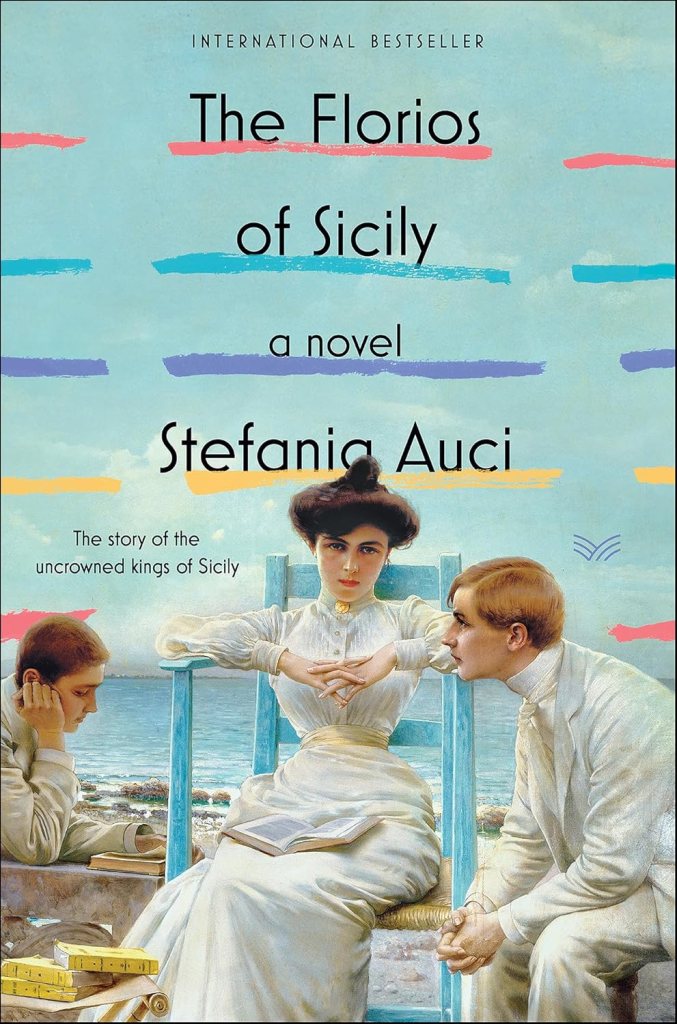
The Florios of Sicily
- by Stefania Auci
- Translated from the Italian by Katherine Gregor
- Original title: I leoni di Sicilia (2019)
- 464 pages
- Publisher: HarperVia (2020)
- ISBN: 9780062931672
- Treat your bookshelf to a taste of Italy! Order the book here.
Katherine Gregor is a writer of fiction, non-fiction and plays, as well as a literary translator from French and Italian. She was born in Rome, where she lived on and off for twelve years, spending six years also in France before moving to England in 1988, where she graduated from the University of Durham. She has also worked as a teacher of English as a Foreign Language, a press agent and an actors’ agent.
She also blogs at Scribe Doll.


Italian Lit Month’s guest curator, Leah Janeczko, has been an Italian-to-English literary translator for over 25 years. From Chicago, she has lived in Milan since 1991. Follow her on social media @fromtheitalian and read more about her at leahjaneczko.com.
 Global Literature in Libraries Initiative
3 thoughts on “#ItalianLitMonth n.10: The Sorrows and Joys of Translating Italian Dialects: Part One”