
by Johanna Bishop
Florence is full of American students—18,000 of them in 2024 alone. And most, of course, are undergraduates who arrive unequipped with enough Italian to let them simply pick books off the shelf in a shop or library. Back in 2016, the young people in Alessandro Raveggi’s class at NYU Florence had the same problem. Their professor, an Italian author, soon realized that while they might be familiar with Dante or even Ferrante, they had no way to get a feel for the varied landscape of contemporary Italian literature. This gave him the idea of founding a bilingual literary review, as a one-of-a-kind showcase in English for contemporary Italian writing.
The magazine’s concept is simple: for each issue, five writers of fiction and two poets are invited to contribute new pieces on a specific theme. Their work is then ferried into English by a small team of experienced literary translators, giving special prominence to a new “guest translator” each time. And each time, a different Italian artist is commissioned to create the cover and illustrations. For the last few years, the journal has also held an open contest on the same theme and published the winning poem and short story in both languages.
After five issues under the name The FLR, as a project linked to the anglophone periodical The Florentine, the magazine joined forces with historic local publisher Le Lettere in 2022. The three issues that have come out since, with the new moniker The Florence Review, feature the same format, production standards, and general design as before: about 90 colorful pages in which the English and Italian are presented face-to-face, with illustrations beautifully interwoven into the text of each piece.
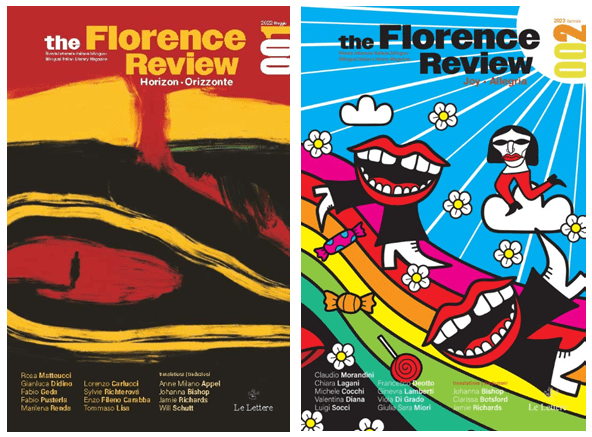
“Invasion,” “Desire,” “Sacred,” “Landscape,” “Fake,” “Horizon,” “Joy,” and “Work” are the themes that have been explored to date by dozens of authors, many of them quite well known in Italy. Listing names here wouldn’t mean much, though, since in most cases they have barely been translated into English before, if at all—and that’s the whole point of the undertaking. The bilingual concept makes the review a perfect tool for students who want a more varied and up-to-date picture of Italian culture than they can get from the classics on their syllabus, but who aren’t quite ready for independent reading in the original language yet. Comparison of the parallel texts is also an intriguing way to learn more about literary translation, especially given the magazine’s commitment to quality in this field, which has led it to seek out award-winning figures such as Anne Milano Appel, Frederika Randall, and Clarissa Botsford. As a matter of fact, at the time of writing, its frequent translator Jamie Richards has just been shortlisted for the American Literary Translators Association’s National Translation Award.
The Florence Review (formerly The FLR)
- Editors: Alessandro Raveggi and Martino Baldi
- 80-95 pages per issue
- Publisher: Le Lettere
- ISBN (most recent issue): 978 88 9366 458 5
- Published at no fixed interval, generally once/twice yearly
- Treat your bookshelf to taste of Italian! Click here to order The Florence Review or here, for back issues of The FLR
Johanna Bishop is a translator from Italian with a particular interest in the overlap between literature and visual art. Her work has appeared in journals such as The Massachusetts Review, Bennington Review, and AGNI, and she regularly translates poetry and prose for the bilingual Florence Review. Recent books include Oh mio cagnetto, by the artist Diego Marcon, and the forthcoming The Sioux / Little Dragon, by Anna Maria Ortese.
More at: https://johannabishop.net/


Italian Lit Month’s guest curator, Leah Janeczko, has been an Italian-to-English literary translator for over 25 years. From Chicago, she has lived in Milan since 1991. Follow her on social media @fromtheitalian and read more about her at leahjaneczko.com.
 Global Literature in Libraries Initiative
One thought on “#ItalianLitMonth n.4: The Florence Review: Italy’s First Bilingual Lit Mag”