Review by Luke Tillier
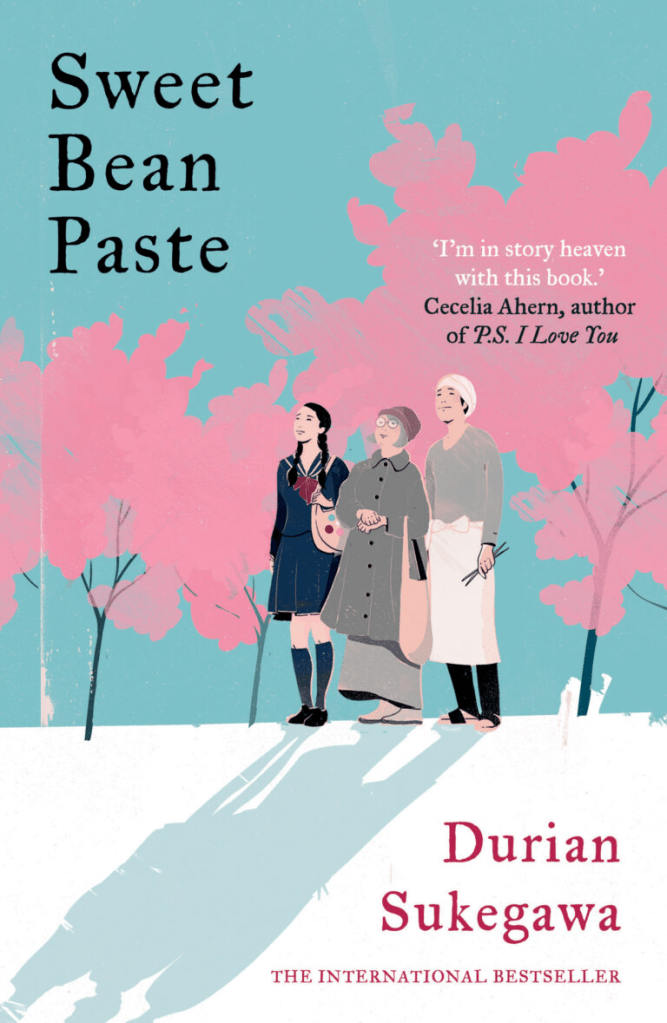
Sweet Bean Paste by Durian Sukegawa is a wonderful and contemplative story, providing the reader with a rich group of characters who form deep and meaningful friendships across the course of the story. The use of language by Sukegawa and Alison Watts (translator) is beautiful, and the description of the taste of the titular bean paste is almost palpable.
The protagonist, Sentaro, is a young man who has found himself simply living. He works in a small confectionery shop making and selling dorayaki (pancakes filled with sweet bean paste) to pay off a debt he incurred after serving time in prison. He drinks alone in the evenings, works alone in the shop, and doesn’t seem to care for his customers or the job he does. Sentaro is not a pitiful character; Sukegawa enables the reader to understand the depth of Sentaro and to find emotions and feelings in him that I believe many of us could relate to. Who hasn’t felt stuck in a bad job or been lonely at some point in their lives?
Sentaro’s life is changed when Tokue, an elderly woman, appears at the shop asking for a job, offering a sample of the sweet bean paste she can make as evidence of her skills. After tasting it, Sentaro accepts and begins to learn from the experience of Tokue. As their friendship develops and they begin to share more of themselves, we learn more about Sentaro’s and Tokue’s lives, including Tokue’s Hansen’s disease. Sukegawa shows us the challenges faced by those who suffer from the disease and how the stigmas associated with it are persistent today. Although not surprising, gaining an insight into the struggles faced by members of that community is upsetting but important.
The novel encourages the reader to see how people can move through the struggles of life and still make a difference in the lives of others, no matter the size of that impact. The novel could be finished over the course of a couple of hours, and I would recommend sitting down to do so over a quiet afternoon. My only criticism is that the novel finished too soon. I assume Sukegawa wants the reader to imagine the “what happens next?”, but I don’t feel I was quite ready to let go of these characters. Early goodbyes are just a part of life, and one that the book wants us to learn to accept.
Sweet Bean Paste
Written by Durian Sukegawa, translated by Alison Watts
2017, Oneworld Publications
ISBN: 9781786071958
Reviews: The Japan Society, The Guardian

Luke is currently on a PGCE course to work as a teacher in primary school. He hopes to foster a love of reading with the children in his class and his own son. Luke has loved reading since he was eight years old, has explored many genres beyond the fantasy that first captured his imagination. His favourite moments are the times he can sneak in a few pages throughout his day and reading bedtime stories at night, although they don’t seem to send his son to sleep any quicker; clearly the books are far too interesting!
—

GLLI’s 2024 International YA Literature Month has been curated by Dr Emily Corbett. She is a lecturer in children’s and young adult literature at Goldsmiths, University of London, where she leads the MA Children’s Literature: Theoretical Approaches to Children’s and Young Adult Literature programme. Her research focuses on the growth and development of YA from literary, publishing, and cultural perspectives. She is also General Editor of The International Journal of Young Adult Literature and was founding Vice President of the YA Studies Association. Her monograph, In Transition: Young Adult Literature and Transgender Representation (2024), is forthcoming with the University Press of Mississippi in June. You can find her contact details on her institutional website and connect with her on Twitter and Instagram via @DrEmilyCorbett.
Opinions expressed in posts on this site are the individual author’s and are not indicative of the views of Global Literature in Libraries Initiative.
 Global Literature in Libraries Initiative
One thought on “#IntlYALitMonth Review: Sweet Bean Paste”