Review by Emma Tueller Stone
“Once, there was a little girl who prayed for heroes… But that little girl is long gone… I am a monster. I am one of them” (Falaye, p. 362).
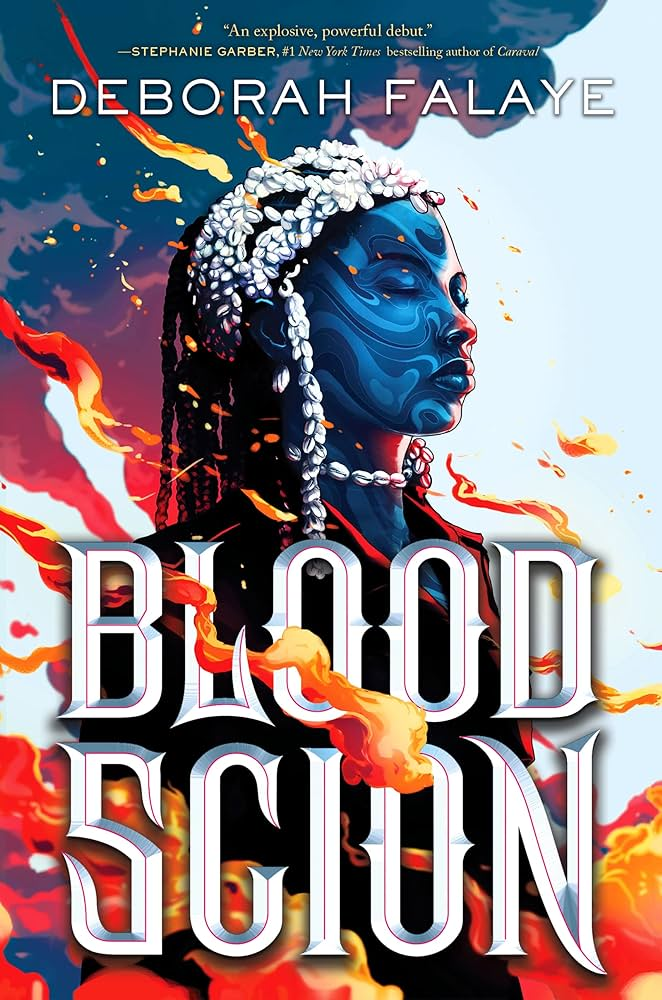
If anyone finds out who or what Sloane is, she will die. She is a Scion, the descendent of powerful Orisha gods, able to control fire at her will. Yet her magic is not only banned but a death sentence under Lucis rule. When Sloane is conscripted to become a child soldier for the Lucis’ regime, she is entirely aware that the training she is about to endure could cost her life, or more.
Blood Scion, the debut novel of Nigerian Canadian author Deborah Falay, is a young adult novel inspired by Nigerian and Yoruba mythology, as well as stories of child soldiers told in books like They Fight Like Soldiers, They Die Like Children by Dallaire. Falaye does not shy away from the brutal implications of these sources. While Sloane learns to be a soldier – fighting for the racist, colonial ruling power she despises against her will – she makes devastating sacrifices to stay alive. And she does not emerge from the story unscarred.
Sloane and her peers have differing motives and various vengeance plots, but Falaye’s representation of how those opposing the Lucis’ regime find community provides a bright spot in an often-horrific story. As the characters suffer to survive, they are not defined by their pain, but by their will to live. Constantly affirming a right to rebel, Blood Scion offers a heartbreaking look at what it means to resist colonization.
One of the most delightful elements of Blood Scion is the brilliant construction of a magic system built around Yoruba mythology and language. Sloane’s research into her magic, her heritage, and her history corresponds to a discovery of Sloane’s long-lost mother’s cultural background, which is captivating.
With something to offer fans of epic fantasy, dark academia, and myth retellings, Blood Scion offers an uncompromising, unapologetic look at what it means to survive extreme cruelty. Though not for the faint of heart, Falaye’s novel is a fascinating depiction of trauma and danger in a world with exciting depths. Falling on the upper end of YA, Blood Scion might appeal to those who enjoyed books like N.E. Davenport’s The Blood Trials, Saara El-Arifi’s The Final Strife, or Maiya Ibrahim’s Sprice Road.
Blood Scion’s sequel, War Widow, is scheduled for release on 12 September, 2024.
Blood Scion
Written by Deborah Falaye
2023, HarperCollins
ISBN: 9780062954053
Reviews: Kirkus, School Library Journal, Publishers Weekly

Emma Tueller Stone (she/her) is a PhD candidate at Cambridge researching the connection between YA speculative fiction published by Latter-Day Saint authors and Mormon cosmological thought regarding gender, sex, marriage and pregnancy. Looking at texts like Mistborn, Twilight, Ender’s Game and Matched, Emma’s dissertation uses Mormon studies research, post-secularism, posthumanism and queer theory to elucidate how Mormon ideologies underpin these popular books. Her chapters include discussions of how YA love triangles speak to legacies of Mormon polygamy, dystopian worlds’ eugenic agendas and God’s “monster body.” When she is avoiding her real work with side projects, Emma is interested in the intersection of YA literature, popular culture, religion, imagined worlds, and social media. Away from Cambridge, Emma is a dedicated plant mum who hosts a tragic (yet compelling) plant funeral. She can be found @emmatueller on Instagram or @emma2reads on TikTok.
—

GLLI’s 2024 International YA Literature Month has been curated by Dr Emily Corbett. She is a lecturer in children’s and young adult literature at Goldsmiths, University of London, where she leads the MA Children’s Literature: Theoretical Approaches to Children’s and Young Adult Literature programme. Her research focuses on the growth and development of YA from literary, publishing, and cultural perspectives. She is also General Editor of The International Journal of Young Adult Literature and was founding Vice President of the YA Studies Association. Her monograph, In Transition: Young Adult Literature and Transgender Representation (2024), is forthcoming with the University Press of Mississippi in June. You can find her contact details on her institutional website and connect with her on Twitter and Instagram via @DrEmilyCorbett.
Opinions expressed in posts on this site are the individual author’s and are not indicative of the views of Global Literature in Libraries Initiative.
 Global Literature in Libraries Initiative
One thought on “#IntlYALitMonth Review: Blood Scion”