Najla Al Owais here.
Disclaimer: I’m reviewing my father’s book here, whilst I may not be the most impartial reviewer, I think this book will strike a nostalgic chord with any Emirati because of its subject choice, and with non-Emiratis, because it provides an angle that is not usually accessible to them.

(Al Furdha) The Harbor & Other Stories
Written by: Mohamed Al Owais Illustrator: Ihsan Al Khateeb Translated from the Arabic by: Soad Khalil Published by: Austen Macauley (2022) ISBN: 9789948044611
The Harbor, translated from the Arabic word Al Furdha, is a collection of nine short stories by author Mohamed Al Owais. This is the author’s second book, and in the author’s notes he provides us with an explanation of how the stories of his first book were semi-autobiographical, compared to the ones presented now, which are “truly just stories”, that might have been related to certain incidents he witnessed, but with his imagination contributing the most. H.E Jamal Ibn Howaireb, CEO of the Mohammed Bin Rashid Al Maktoum Knowledge Foundation, penned an introduction to this literary piece of work.
The dedication of the book goes to the author’s father and is both heartfelt and moving.
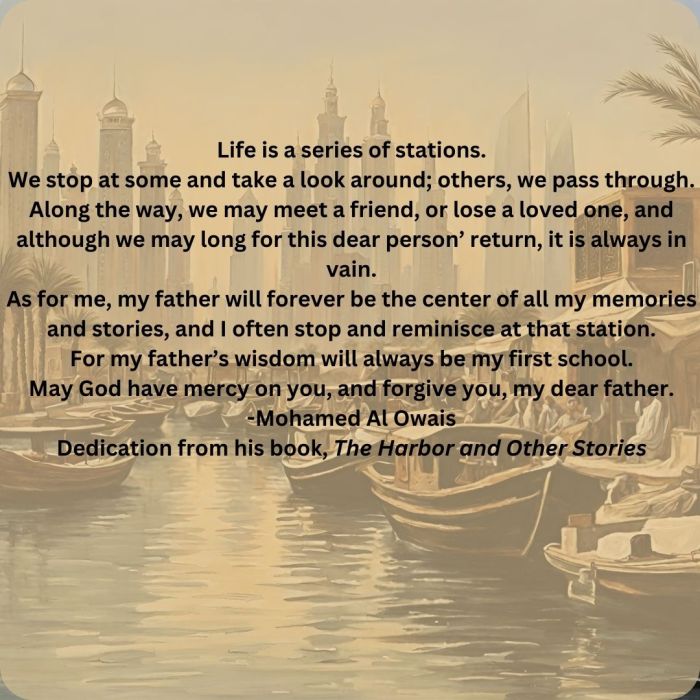
Unfortunately, I never met my paternal grandfather who passed away long before I was born, but through both The Harbor and Khor Dubai (Dubai Creek), I feel like I’ve seen snatches and glimpses of his kind soul, and for that, I’m eternally grateful.
“The window is Ahmed’s observatory through which he watches the bay where the ships and the canoes duck, and where the loads of goods brought by these ships pile up.”

The first story, Al Furdha, introduces us to young cheeky Ahmed as he helps his father in their shop in Dubai. His father sends him to certify some documents which take him across the creek to the opposite bay, and through Ahmed’s curious eyes, we are indulged to a view of Dubai in the past, that is both pleasant and evocative of the senses.
“Ahmed fills his lungs with the fragrance of the market, that same fragrance he remembers only too well, says his prayers for his father and for the ruler, and takes the old paths of the past back to the present.”
In Al Deira, we meet Ahmed the historian, as he studiously takes down notes of facts from conversations with his father and uncle, trying to give his city features; attempting to write down everything before it’s demolished from memory as it had been in real life. “Does anyone have the right to cancel a whole history? To take it away? And even to persistently disfigure it?” a sad lament by Uncle Obaid as he talks about his old neighborhood that was uprooted and left barren: “Why is it that our roots have been removed and our history violated?” Obaid’s sadness and anger is relatable, not just to people who have seen their neighborhoods changed, but to people everywhere who are forcibly displaced by war or whim.
“History, Obaid, is not sacred, but rather false and defiled. Anyone can write it and tailor it the way they like. History is not written by the noble and the pious, but rather, by liars and forgers.”


In Ibn Abi Ghassan we leave the surroundings of the familiar UAE with Ahmed and meet Ibn Abi Ghassan in present day Andalusia. There, we read of his thrilling encounter with the soldier, who knows history, poetry, and his share of grief and anger. In Salih Ibn Ali, Kareem and Sirpaz Cafe and Za’farana and Fareej Al-Sharq we encounter new regions in the Emirates, and situations that are as serious as they are witty.
In Kareem and Sirpaz Café, we meet Kareem, and see him through Ahmed’s eyes and indulge in invisible people watching (and judging) episodes with Ahmed at Sirpaz’s café.
“Kareem’s character could be classified as a mixture of genius and madness, for he always wavered between these two extremes.”

The warmth in Za’farana’s chapter is undeniable, and again, through Ahmed’s eyes, we are given a glimpse of issues like freedom, and slavery, and family dynamics.
The book is peppered with beautiful artwork by the talented Ihsan Al Khateeb, where his watercolor illustrations give us another nostalgic glimpse to life in the past in the UAE, and evoke strong emotions.
I have read The Harbor both in its original Arabic and translated English version, and I can say that Soad has done a seamless job at translating the book, with its vivid emotions, colors, poetry and conversations. This is a book that is close to my heart for apparent reasons, and I treaded with trepidation but was pleasantly surprised with this beautiful translation.
Some of the chapters of the book take place in the Al Ras area in Dubai which was, and still is, quite the commercial hub for traders. I always try and walk through the alleys and paths mentioned in this book when I go there, the places I visited with my father in my childhood, hearing the pilot version of these tales. To me, this book, much like my father’s previous book, are tales of a city, as much as they are tales of people.


The short stories in the book are: Al Furdha, Al Deira, Ibn Abi Ghassan, Salih Ibn Ali, Kareem and the Sirpaz Café, Za’franan and Fareej Al Sharq, The Blue Gate, Isma’il, and The Red Carnation Flower. Themes in the book include family bonds, life in the UAE, coming of age, slave trade in the gulf, grief, loss, longing, perseverance of history and culture.
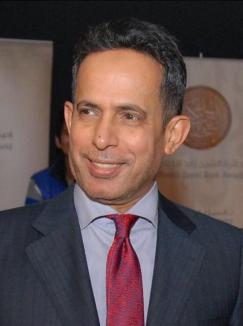 About the Author:
Mohammed Al Owais has worked for 40+ years in the Ministry of Foreign Affairs and represented the UAE in various countries such as: Japan, Oman, Germany, the Scandinavian countries, The Kingdom of Saudi Arabia, India and Switzerland. He speaks several languages and loves to learn more and is currently sparring with the Spanish language. He loves going on long hikes in nature, as well as biking at unnatural hours. He loves exploring both in the UAE and when he travels. He has published two fiction books and is writing his third short story collection.
About the Illustrator:
Ihsan Al Khateeb is the owner and consultant of the Inter. Craft Gallery in Sharjah since 1984 and has more than fifty-five continual years’ experience with Fine Arts, and practical experience with most of the arts of drawing and painting, such as oil painting, watercolor, charcoal, pencil, and others. He participated in many art exhibitions locally and internationally. His artworks are frequently printed in the form of posters, greetings, or calendars. He also spent twenty-four years serving and developing young people academically through teaching art education while developing talented young people and their artistic and literary commitment in the schools of the Ministry of Education in the United Arab Emirates, and inspired many students in becoming distinguished artists. He published the book Emergence and Advancement in Emirati Fine Art in 2014. Ihsan has a Master of Fine Arts (Honors) degree, from Ilam School of Fine Art – University of Auckland, New Zealand and has worked as a lecturer from 2005 – 2017, at many of universities in the Emirates in the subject of free drawing for students of architecture and interior decoration.
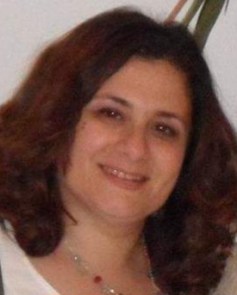 About the Translator:
Soad Khalil is an esteemed educator, teaching Research Methodology and Advanced Writing at Misr International University in Cairo, Egypt. With over three decades of experience, she is also a versatile freelance translator and interpreter, specializing in business, literature, and legal domains since 1990.
About the Guest Contributor for #UAEReads:
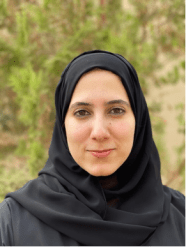 Najla Al Owais is a PhD candidate studying Math Education at UAEU. She has previously worked as a middle school mathematics teacher, and a freelance translator and interpreter. She is passionate about teaching mathematics, and is an avid reader, and loves finding the intersection between both mathematics and reading. She has a Bachelor’s of Science from Zayed University in Math Education and Masters of Arts from the American University of Sharjah in English-Arabic-English Translating and Interpreting. Wherever she goes, books find her. She hopes to one day publish her own book.

About the Guest Editor/Curator for March 2024 [#UAEReads]:
 Myra Garces-Bacsal has served as a teacher educator for 15 years and has led several research projects on reading and social emotional learning, diverse picturebooks and teacher practices, psychology of high creatives and exceptional people, culturally responsive and inclusive education. She is a quintessential lover and creator of booklists (see her Social and Emotional Learning bookshelf here and other publications below). Myra serves as the Assistant Dean for Research and Graduate Studies with the College of Education, UAE University. She is a self-proclaimed nerd who lives and breathes books and enjoys organizing events and festivals where fellow nerds converge and attempt to joyfully change the world.
Publications on booklists:
Garces-Bacsal, R. M., Alhosani, N. M., Elhoweris, H., Tupas, R. (2023). A diverse social and emotional learning booklist for gifted learners and advanced readers. Roeper Review, 45(1), 25-36. https://doi.org/10.1080/02783193.2022.2145397
Garces-Bacsal, R. M., Alhosani, N. M., Elhoweris, H., Al Ghufli, H. T., AlOwais, N. M., Baja, E. S., & Tupas, R. (2022). Using diverse picturebooks for inclusive practices and transformative pedagogies. In M. Efstratopoulou (Ed.), Rethinking Inclusion and Transformation in Special Education (pp. 72-92). IGI Global. https://doi.org/10.4018/978-1-6684-4680-5.ch005
Garces-Bacsal, R. M. (2021). Of grit and gumption, sass and verve: What gifted students can learn from multicultural picture book biographies. In S. R. Smith’s Handbook of giftedness and talent development in Australasian Pacific (pp. 431-453). Singapore: Springer International Handbooks of Education. https://link.springer.com/referenceworkentry/10.1007/978-981-13-3041-4_18
Garces-Bacsal, R. M. (2020). Diverse books for diverse children: Building an early childhood diverse booklist for social and emotional learning. Journal of Early Childhood Literacy, 22(1), 66-95. https://doi.org/10.1177/1468798420901856
 Global Literature in Libraries Initiative
what an amazing review dear Najla!
I loved the pictures as well. The questions that you asked in the beginning were so big and soul touching.. I would love to purchase your dad’s collection of stories..
LikeLike
What an amazing review dear Najla! I loved the big questions that you asked about taking away history or hiding it… The questions were soul touching!
LikeLike