Myra Garces-Bacsal here.
Poetry Friday consists of wonderful people (teachers, librarians, authors, poets, book lovers) from the blogosphere who are committed to sharing life-nourishing poems every Friday. It is hosted voluntarily by various people every week. As explained by Mary Lee Hahn here, it serves as “a gathering of links to posts featuring original or shared poems, or reviews of poetry books. A carnival of poetry posts. Here is an explanation that Rene LaTulippe shared on her blog, No Water River, and here is an article Susan Thomsen wrote for the Poetry Foundation.” It has been a long while since I’ve joined this community and I do miss it dearly. I hope to be more present this year, life circumstances permitting.
A special thanks and shout-out to Tanita at {fiction, instead of lies} for hosting this week.
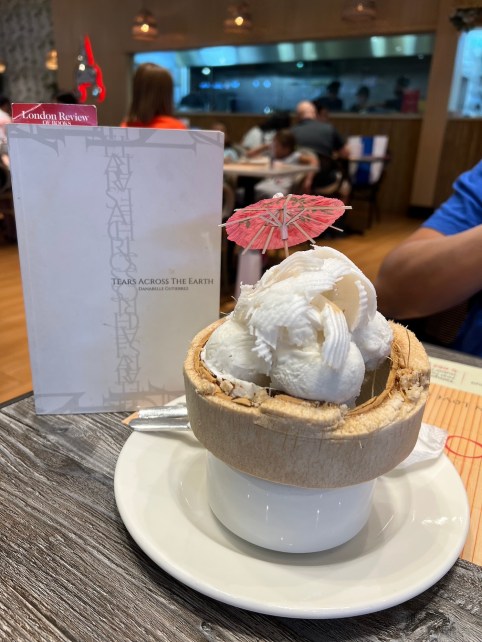
Tears Across The Earth
Poems by: Danabelle Gutierrez Published by: Independently published (2022) ISBN: 9798647169976. Book gifted to me by the poet.
I learned about Danabelle Gutierrez last year when I attended my very first Emirates Airline Festival of Literature. She figured prominently in quite a number of sessions with invited Filipino authors, as well as with celebrated Emirati poets and other international speakers. It was during this session on Kwentong Filipino: Filipino Stories with other renowned Filipino authors, however, when her star shone bright for me.
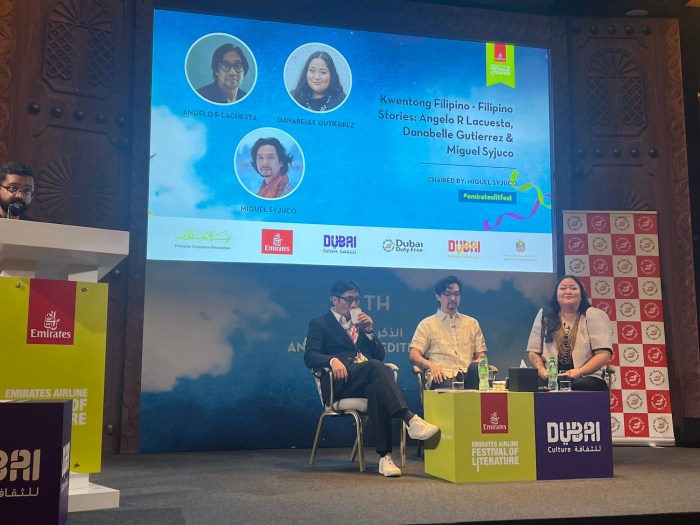
It was Danabelle’s groundedness, piercing and disarming complexity (yet so resonant and accessible) and utter lack of self-consciousness which struck me, and inspired me to invite her as one of our featured poets for our month-long reading festival which I co-convened last year in our university (see here).

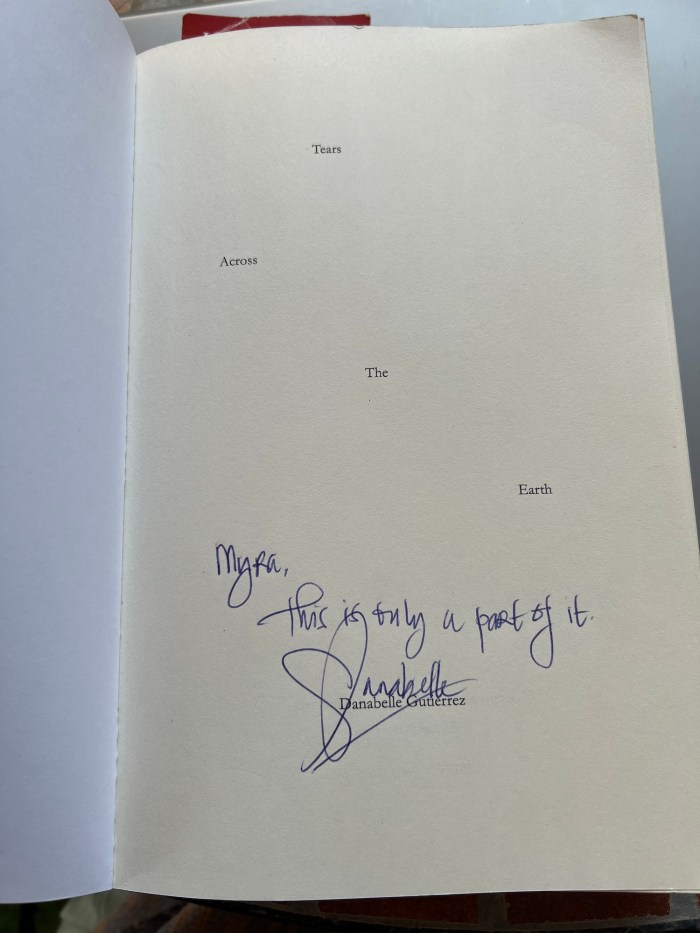
It was only when Danabelle gifted me with a copy of her Tears Across The Earth that I learned how a poetry collection can have an overarching ‘storyline’ as revealed in her brilliant structure that weaves the themes of parallel universes, heritage (and its wisp-like quality when one is in between cultures) and finding (and losing) love (ad infinitum) across the pages.
While I am pretty accustomed to poetry collections being arranged across themes (watch out here for my upcoming review of the poetry collection We Call To The Eye And The Night edited by Hala Alyan and Zeina Hashem Beck), the idea of storythreads linking short stories, vignettes, prose poetry together into a much bigger storyline that traverses time, space, and feeling is new to me; and honestly made me wonder why Danabelle’s poetry has not been discovered yet by huge publishers on the lookout for raw talent.
The Foreword written by Trish Shishikura with such loving detail fully captures this labyrinthine form with a touch of magical realism that holds the poetry collection together:
A keen reader might even find a thread that leads to another poem and consequently realize that everything is interconnected in this universe that Danabelle has written. The poems and short stories are all weaved quietly together with the intent to tell a narrative, not just for the sake of affect, but for the reader to truly realize the diligent crafting of this body of work…
… If this is your first time reading something like this, my advice is to read the entire book. From beginning to end. Choose your favorite short story then find the connection between the works inside the book. It will feel like an easter egg hunt. It will feel like opening a present. It will feel painful and you might cry as I did and connect not just the stories but also maybe even your own experiences.
I also found the play with words very clever: tears as noun, referring to water leaking out of our eyes when we are heartbroken; and verb as in tearing of a letter we wish to get rid of; or tearing as a rupture in the time-space continuum; or tearing as traversing across multiple universes to find and rediscover one’s lost love and one’s self in the process.
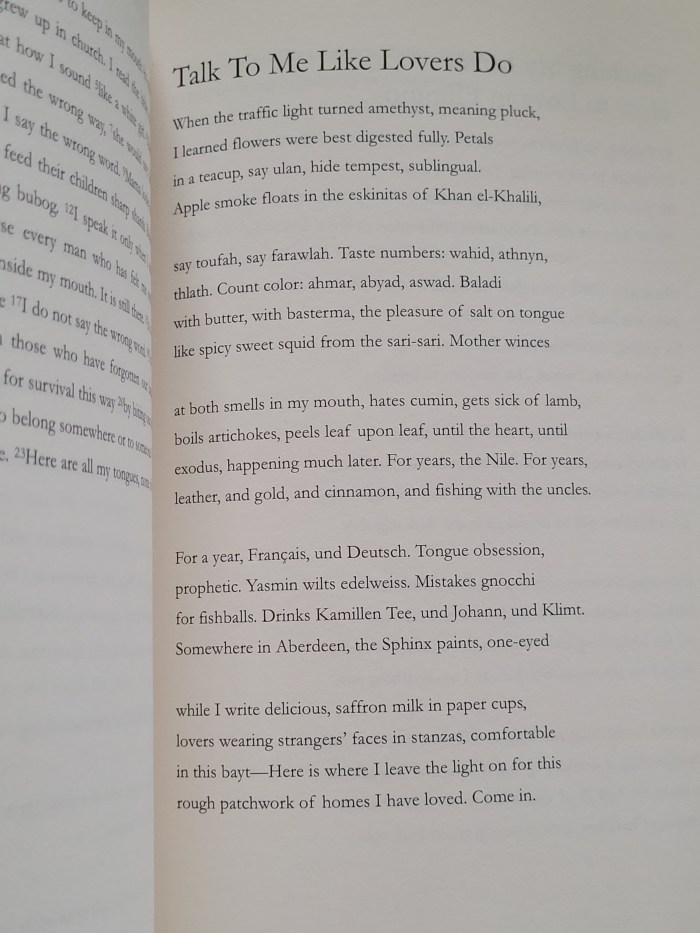
This wordplay frames how language figures prominently in Danabelle’s writing, that is, the many languages or tongues that coalesce to form her multi-layered identities. See her poem Talk To Me Like Lovers Do:
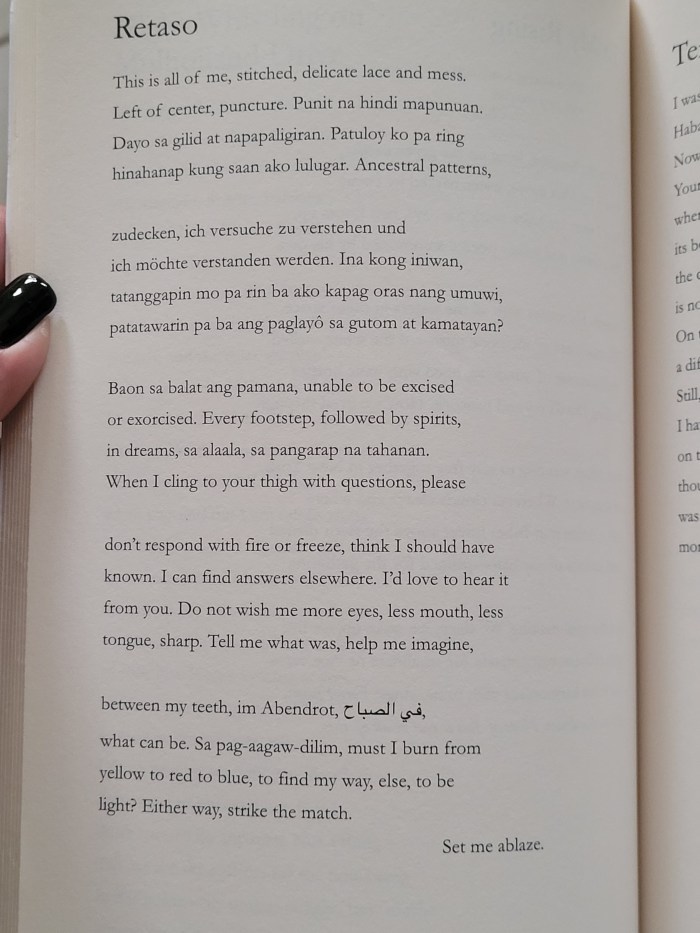
As a transnational Filipina poet who was raised in various cities and has lived in Dubai for more than a decade, this notion of belonging, search for home, and the nature of rootedness becomes more dynamic, transactional, and malleable as fully captured in the various languages she uses in her poems. Here is one of my favourite poems from her collection, entitled “Retaso.”
Her poem, however, that made me tear up – as I listen to her read this aloud during our month-long reading festival last year – is Uwi.
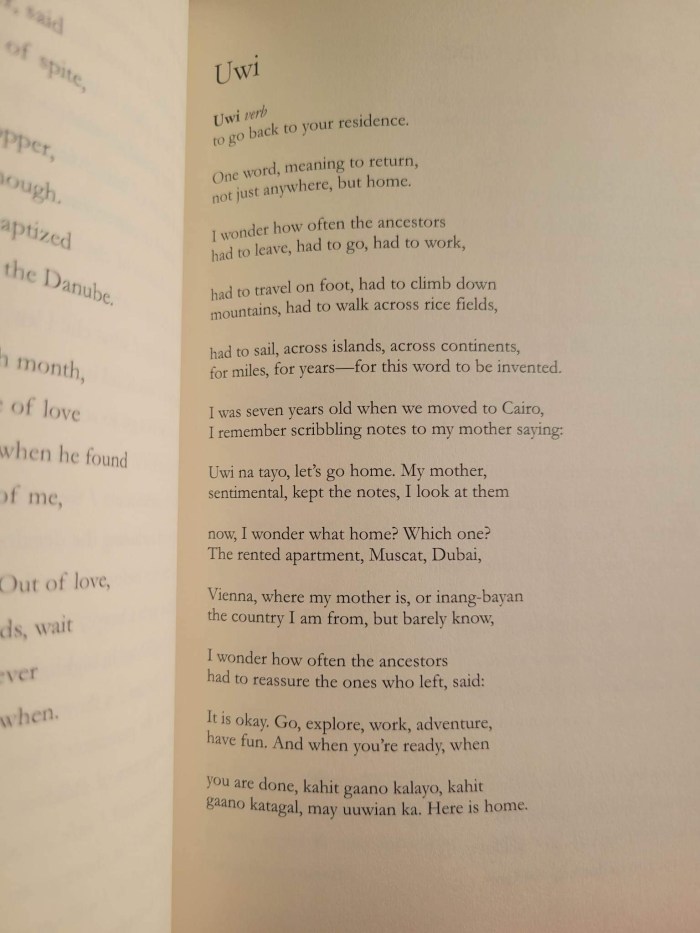
There is something honest and vulnerable yet also very star-like in its steely resolve to find beauty and be the beauty in the way Danabelle strings lines together like twinkling faery lights that serve as lifelines and guideposts to wholeness and truth. I would not categorize the poems as confessional poetry, as confession implies a transgression that one regrets. There are no regrets to be found here, but unapologetic declarations and painstaking reinventions. Needless to say, I will read everything she writes.
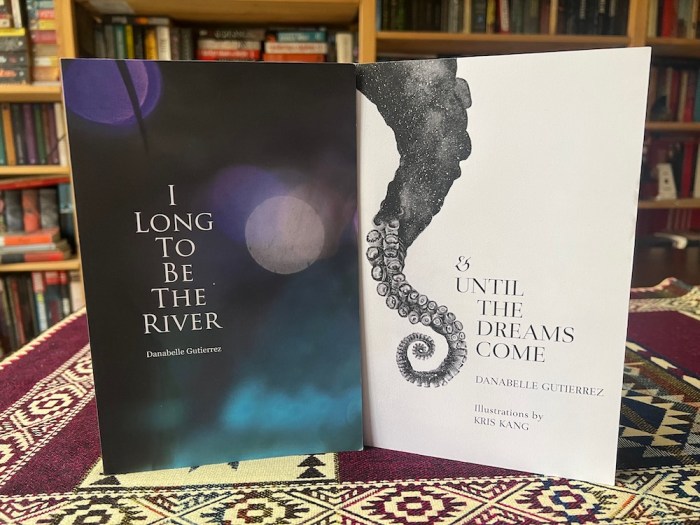
Here are Danabelle’s other poetry collections: I Long To Be The River and & Until The Dreams Come (see my GatheringBooks post here).
More about the Poet Danabelle Gutierrez:
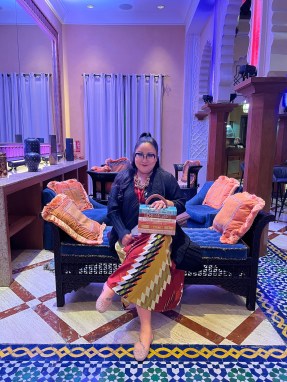
Danabelle Gutierrez is an award-winning artist, writer, actress and photographer. She is the author of Tears Across the Earth, a collection of short stories and poems, as well as poetry books & Until The Dreams Come and I Long To Be The River and chapbooks Eventually, The River Surrenders and Softer.
Her writing has been published in The Common, Cordite Poetry Review, Postscript Magazine, ElectraStreet, WordsDance and in a video for Vogue Arabia recited by Ciara, among other publications. Born in Las Piñas, raised in Cairo, Vienna, and Muscat, Gutierrez currently lives in Dubai. Source here.


#UAEReads strives to be reflective of the diverse demographic population that makes up the country of the United Arab Emirates (see Global Media Insight source of demographics as of 2024). Hence, we will be featuring literature coming from the major nationalities comprising the entire country: Emiratis, Pakistanis, Indians, Filipinos (who comprise 5.56% of the population, earning them a minority status in the country), Egyptians – and other nationalities who have made UAE their home.
About the Guest Editor/Curator for March 2024 [#UAEReads]:
 Myra Garces-Bacsal has served as a teacher educator for 15 years and has led several research projects on reading and social emotional learning, diverse picturebooks and teacher practices, psychology of high creatives and exceptional people, culturally responsive and inclusive education. She is a quintessential lover and creator of booklists (see her Social and Emotional Learning bookshelf here and other publications below). Myra serves as the Assistant Dean for Research and Graduate Studies with the College of Education, UAE University. She is a self-proclaimed nerd who lives and breathes books and enjoys organizing events and festivals where fellow nerds converge and attempt to joyfully change the world.
Publications on booklists:
Garces-Bacsal, R. M., Alhosani, N. M., Elhoweris, H., Tupas, R. (2023). A diverse social and emotional learning booklist for gifted learners and advanced readers. Roeper Review, 45(1), 25-36. https://doi.org/10.1080/02783193.2022.2145397
Garces-Bacsal, R. M., Alhosani, N. M., Elhoweris, H., Al Ghufli, H. T., AlOwais, N. M., Baja, E. S., & Tupas, R. (2022). Using diverse picturebooks for inclusive practices and transformative pedagogies. In M. Efstratopoulou (Ed.), Rethinking Inclusion and Transformation in Special Education (pp. 72-92). IGI Global. https://doi.org/10.4018/978-1-6684-4680-5.ch005
Garces-Bacsal, R. M. (2021). Of grit and gumption, sass and verve: What gifted students can learn from multicultural picture book biographies. In S. R. Smith’s Handbook of giftedness and talent development in Australasian Pacific (pp. 431-453). Singapore: Springer International Handbooks of Education. https://link.springer.com/referenceworkentry/10.1007/978-981-13-3041-4_18
Garces-Bacsal, R. M. (2020). Diverse books for diverse children: Building an early childhood diverse booklist for social and emotional learning. Journal of Early Childhood Literacy, 22(1), 66-95. https://doi.org/10.1177/1468798420901856
 Global Literature in Libraries Initiative
Thank you for introducing me to Danabelle’s work! The Uwi poem resonated with me as well. Happy Poetry Friday!
LikeLike
What an absolutely beautiful selection of poetry- especially Uwi, which just… I am still in the U.S., where I was born, but that question resonates so strongly, as a woman of AfAm ancestry, as a child of parents who were part of the Great Migration from the South, as a person who has lived abroad and moved so much, following work. Where is home? Where do our souls rest? Thank you so much for this introduction to the words and work of Danabelle Guiterrez, and hey – welcome back to Poetry Friday! We don’t all participate every week, but I, too, know that my Poetry Peeps are out there, and leaving the light on for us, however late we get back.
May your weekend be ignited, and may you blaze with inspiration.
LikeLike
Uwi… return home. How does one do this who is without? Where must this be born to have fought its way out of the body and spoken into the world? Where is the justice? Thank you for sharing this.
LikeLike
Myra, I love your description of Danabelle here: “It was Danabelle’s groundedness, piercing and disarming complexity (yet so resonant and accessible) and utter lack of self-consciousness which struck me” Wow! No wonder you wanted to get her for the festival. Thank you for sharing the poems you did. “Uwi” is a beautiful verb. I have experienced a bit of that in my life when I retired in the community of my grandparents and where my mom lived later in life to care for her elders too. Now I’m here and I feel I came home (uwi). Thank you for sharing about her.
LikeLike
Hi Myra, it’s lovely to see you here, sharing your special knowledge of poets we might never know. And, the poems feel so connected to this world we are living in, the movement of so many. That line Danabelle wrote from her seven-year-old self, “Uwi na tayo, let’s go home.” must reflect many, many children. Hope all is well with you & yours!
LikeLike
Thanks for introducing me to a new poet! (Good to see you back again in the Poetry Friday roundup!!)
LikeLike
As someone who lived in several countries growing up, I really related to that last poem. Thank you for sharing!!!
LikeLike
Thanks for this lovely introduction, Myra. I remember my husband introducing me to concept albums–even though I always pay more attention to lyrics than to the melodies, I didn’t listen to the bands doing concept albums that told a story or explored interwoven stories within a universe. Connections upon connections–what we’re usually craving!
LikeLike
Thanks for introducing us to Danabelle and her work, Myra. Her Uwi poem resonates with me, as well. We’ve been abroad almost 7 years and are contemplating one more (5 year?) stint in a new country/culture before we “Uwi”.
LikeLike