“Read me the book about Sheikha, please,” my 6-year-old niece would say whenever we decided to read a picturebook in Arabic. Whether she related to the young female protagonist, the story itself, or the illustrations, من أنا؟ [Who Am I?] always captivated her attention and interest. In fact, it always took us both on a whimsical journey into freedom: freedom from expectations, freedom from society, freedom from social constraints.
من أنا؟ [Who Am I?] is a picturebook by the Omani author and illustrator Ibtihaj Al Harthi (IAH), written in Arabic- the author’s mother tongue. I had the privilege of interviewing her about her writing and illustration journey and Who Am I? in particular. Here is an abridged version of the interview transcript.
Figure 1: Who Am I? Book Cover
من أنا؟ [Who Am I?]
Written and Illustrated by:Ibtihaj Al Harthi Published by:Takeween ISBN:98884891
Fajer: So, I would like to start this interview by exploring your early beginnings. What inspires your writing?
IAH: Well, my life basically, I guess. A lot of it is based on my life, my kids, my surroundings and mostly my upbringing in a traditional Omani village. I was born in the capital. I commuted so I lived this modernity that Oman went through, and I had to see both sides. I lived in the city, and I lived in the village with my grandmother, so all the opposites worked altogether to inspire my writing.
Fajer: You know, when I talk about your art specifically with the people in my circle, I describe it as both original and whimsical. How long have you been drawing and illustrating?
IAH: I have loved drawing ever since I was a kid, but because of culture and because of the hierarchy of education and the supremacy of the written word, I think I was swayed away from that path. I started out as an academic. I studied English as well. I was a language instructor for nine years, before I turned to art. So, I was a university instructor. I worked at Sultan Qaboos University for about nine years. I taught English and after nine years of teaching and doing my masters in education and all that, I decided, well, maybe I should look into my inner child and connect with things that I really loved.
And quite frankly, I’ve always loved drawing, but I never took it seriously because as a child, I loved to read picturebooks and magazines and stuff. But, it never occurred to me that this is actually a job, and there are people responsible for these illustrations. As a child, I never asked this question. I loved animations, specifically Japanese animation and manga, but again that wasn’t an option for a job, and I grew up wanting to be my own person, to have my own income, and to have a job; and being an illustrator and an artist in this part of the world is obviously not going to make you that. So the whole journey took me time to figure out what I wanted to know.
So after I figured it out, I did an MFA, a Master of Fine Arts. I specialized specifically in illustrating for children, and that happened after a dramatic point in my life when my grandmother, who’s like the most important person in my life, passed away. On the day she passed away, I thought I want to write her story and that was my first book. I wrote about her demise and how she left, and because at that time I was an academic. Language was my tool. I didn’t know how to illustrate, and this is why I started a whole new degree, and a whole new path.
Fajer: Thank you for sharing. It’s such an inspirational story. Why was losing your grandmother such a pivotal moment in your career?
IAH: Because my grandmother was like the most important person in my life. To me, she was a mother and a father. Both my mother and my father are important, but my grandmother was the one who raised me because every summer I spent with my grandmother in the village.
I was born and raised in Muscat, which is sort of like a modern city life, but if I sieve my childhood, all is left are the days and the beautiful summers I spent with my granny. So, losing her, I was 27 by that time, and losing her was like a shock. I don’t know how to describe it, but I think I was like a child when I lost her, and this is why I wanted to approach the topic from a child’s point of view and this is what I did.
Fajer: What is usually the medium that you use to do your illustrations? Do you use any special software, pens, colors, inks?
IAH: The books I authored and illustrated are done in traditional India ink and watercolor. And then they’re edited digitally in Photoshop. I use Procreate. I use Indesign. I use lots of programs to reach that final point, but I love traditional mediums. I did a lot of digital illustrations for other books as an illustrator, not as an author. For my own books, I love to go traditionally to watercolor and India ink. That would be my preferred medium.
[Note: Below is a sample image form Who Am I? for which the author/illustrator used traditional india ink and watercolors on Arches paper. IAH reported that it was later scanned and edited via Photoshop with the addition of different layers of textures.]
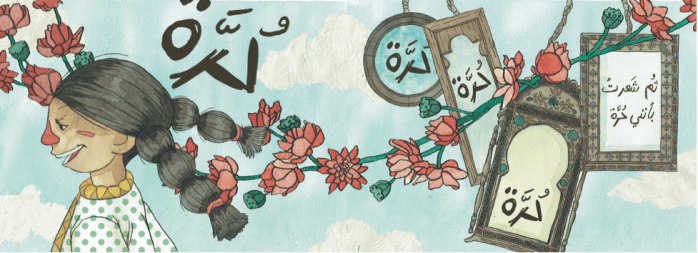
Figure 2: Who Am I? Palm Trees Everywhere.
Fajer: Lovely! So moving on to من أنا؟ or Who Am I? – as an artist, did you make your picturebook to evoke a certain meaning or feeling?
IAH: I would say for من أنا؟ [Who Am I?] it’s more meaning, but if you come to my other book أنا وماه [Mah and Me], I would say it’s more feeling. It came from the heart. I think this one [Who Am I?], a lot of it comes from the mind.
Fajer: Interesting, and so what inspired you to write it?
IAH: My own life. I started out as an academic. I was caught up in this idea of academia and academic excellence. After doing it all, and getting all the degrees, and teaching it, it did not mean much to me. And also because I was like a language instructor. I taught English. I dedicated 15 years of my life to studying English and after all of that time, I wondered about my own language. I come from a family that is obsessed with literature. My father, Mohammed AlHarthi is an author. My grandfather is a poet and to leave all of that and go to another language and dedicate my life to teach that language, at one point of time there was, I don’t know, there was this feeling that, you know, I want to go back to my roots. I want to communicate what I feel in the language that I love.
Fajer: How do you find writing in two languages English and Arabic to be different?
IAH: Now don’t get me wrong. Bilingualism is beautiful. I’m not against it. It enriches your world. You know a lot, but if you reach a tipping point where you start thinking in English, dreaming in English, talking in English, and 90% of your time, it’s only English, I think that is the point I’m talking about. The experience is beautiful like for أنا وماه [Mah and Me] because أنا وماه [Mah and Me] is really the only book that was published in English and Arabic. I did not translate like I wrote it in Arabic, and then I rewrote it in English. So, it’s not an exact translation. And quite frankly, I didn’t find it to be different except for a few expressions and how to get them across.
Fajer: Why was it important to write من أنا؟ (Who Am I?) in Arabic rather than in English?
IAH: I would love to have it published in English. I just didn’t find the publisher, but it is important again because a lot of it is my own journey, and I want to tell it in Arabic. But if there is an opportunity to get the word across in English, I mean why not?
Fajer: How do you see your book and how do you think your readers perceive it?
IAH: I am aware that books are not only read by children. They’re read by their parents, as well. So I try to have something for the parents and for the kids. I believe that at one level the kids read something, they might not get it all, and I’m absolutely fine with this idea. I don’t think that a child should get the whole gist of the book, but at one point of life, if it’s well written, if there is an idea, they’ll remember it. Maybe not now. Maybe down the road. I also think that if there is meaning, even if it’s difficult, parents who read with these kids, they’re going to discuss it. It’s going to be like a safe haven for kids to discuss ideas like with my first book, it tackles death, which is a difficult topic. So it’s like a safe space between parent and child to discuss this idea. This whole idea about finding meaning in one’s life, which I realize it’s not the easiest idea for a kid, but if a child starts to discuss this idea with a parent, then this is all I want. It starts conversation.
Figure 3: Who Am I? And I felt free.
Fajer: Absolutely. What are your thoughts about the portrayal of identity in children’s books in the region, especially in the Gulf region (GCC), comprising of Oman, Kuwait, United Arab Emirates, Qatar, Saudi, and Bahrain? Can you cite some of your favorite books, if any, that capture this sense of identity?
IAH: Two books come to mind. One of them is not really about identity, but it’s about the mother-
Figure 4: Queen Suhaila- Book Cover
daughter relationship, and a lot of it is about identity. It’s called الملكة سهيلة [Queen Suhaila]. This book was important because it doesn’t show this glorified idealistic mother-daughter relationship, where the mother is like a narcissist and the daughter is trying her best to overcome that. By the end, they reach a common ground, and this is something that is not common in Arabic children’s books. So, I like to see like the change, and that is for seven-year-olds. Another book, now the title totally escapes me, but is also about a child who wants to be something different, and she’s a girl who doesn’t want to be a mother. She wants to work, and she doesn’t see motherhood as everybody sees it.
Fajer: Why do you think such topics are rarely spoken about in our region, and by our region, I mean the GCC?
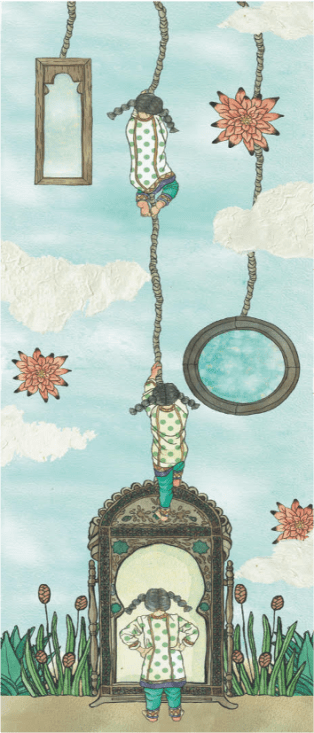
Figure 5: Who Am I? I climbed, climbed, and climbed.
IAH: They are just complex. You have to be careful with what you present to children; and in our region, you don’t really care about success, and you don’t really care like much about popularity because books are not as popular as how they are in the West. So, I wouldn’t really take my sales of books and all of these factors. At least in this region, I don’t think we think about these things.
But I know for example in the West, they would also avoid these topics because they care about sales, and how many parents are going to buy the books and all of that. But, I don’t think this is a factor here. I don’t know. It may be a fear of society, it may be a fear of criticism. I’m only assuming now. I cannot give you numbers or something exact. But, I think it’s that we’re very careful about what we present to children, like we need to make sure that this message is acceptable and appropriate somehow.
Fajer: Do you have any mentors whom you believe to be highly influential in your development as an author and as an illustrator?
IAH: Uh, if you mean by mentors like specific people, no. But I am a fan of quite a few. As an author, as I told you, I come from a family where there are lots of authors, so I am surrounded by them. I read a lot which is beautiful and I’ve known a few authors and I consult them when I’ve got like a text, and they respond back, and most of them are friends.
As an illustrator, and because I studied illustration, I had lots of teachers who taught me. It wouldn’t be fair to mention only one because many taught me something. However, as a fan, I love the classics like the Golden Age of illustration. I love Peter Rabbit, and all the classics. I love that vibe, and I would love to keep it. In terms of like Arabic, I love that period of السلسلة الخضراء [loosely
Figure 6: IAH’s Peter Rabbit’s Illustrations
translated as The Green Series]. In terms of fairy tales, I really love the Arabic in which that was written in the translation and the illustration. I think I got a lot from that as a child. In terms of illustrations, God, I love Norman Rockwell. Norman Rockwell does not illustrate for children, but he’s a famous American illustrator. To me, everybody is a mentor. Many people mentored me not like physically, but in terms of their work.
Fajer: Yeah, in terms of inspiring your work. In the end, I would like to ask about any future projects that you’re currently working on.
IAH: I am working on a graphic novel. It is almost 80 pages now and maybe another hundred pages to go. It’s just time consuming. It is Hans My Hedgehog, which is a German fairy tale by the Brothers Grimm and I am “Omanizing” this fairy tale. I’m turning it into a graphic novel, but from an Omani point of view, and there is lot of psychological analysis as well going on and plots and subplots and all of that, but keeping the timeline of the [original] fairy tale.
Fajer: Who is your target audience? Is it being written for young adults?
IAH: Yes, tweens, I think 12 to 14 young adults, I think this is the right target. I’ve been working on it for the past five years on and off, so I don’t know when I’m going to finish, but yeah, hopefully one day.
Fajer: I thank you again for sharing your insights here. Your work inspires me at a personal level as an educator, as an auntie who reads to her nieces and nephew. Your book is always our first pick when it we decide to read in Arabic. I wish you nothing but the best moving forward.
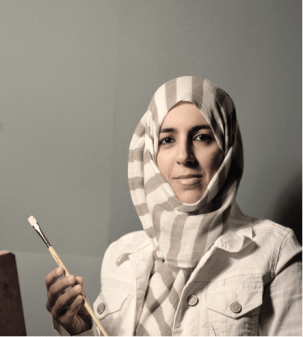
Ibtihaj Al Harthi grew up in Muscat but experienced the best moments of her life during the summers in her small village in the Al Sharqiya region of Oman. In school, she partnered with her best friend and created their first comic book, which was a hit among their classmates. Despite earning two degrees in Education, she discovered her love for art and went on to complete an MFA in Illustration from the Academy of Art University in 2015. Currently, she works as an artist and author in Muscat. Ibtihaj began drawing for children’s books as a hobby and later expanded her passion to writing her own books. She authored “Mah and Me,” a winner of the Itisalat Children’s Books Award for the best text, along with “Who Am I?” She has also illustrated numerous picture books, including “Tales From Jabal Al Alhdhar,” “The Boy and the Sea,” and many others. Currently, she is working on her first graphic novel, “Hans my Hedgehog” by the Brothers Grimm, with an Omani setting and a few plot twists.
About the Guest Contributor for #UAEReads:
Fajer M. Bin Rashed is an avid reader and listener of books. One of the earliest childhood memories she has is of going to a bookstore with her mother and siblings in Kuwait. Fajer has a 13-year experience teaching English as a second language at the tertiary level in Kuwait. Her previous teaching posts include Australian University (formerly known as Australian College of Kuwait), Gulf University for Science and Technology (GUST), Arab Open University (AOU), and The Public Authority for Applied Education and Training (PAAET). She has a bachelor’s degree in English Language and Literature and a master’s degree in Comparative Literature and Cultural Studies from Kuwait University and currently serves as a PhD candidate at United Arab Emirates University, specialized in Language and Literacy Studies. She is a published researcher and is an active reviewer for a multi- and interdisciplinary peer-reviewed journal based on her expertise. Her current research inquiries are centered around (early) literacy education, language acquisition, language teacher and learner identity, bilingualism, multiculturalism, and social-emotional learning (SEL) in education.
#UAEReads strives to be reflective of the diverse demographic population that makes up the country of the United Arab Emirates (see Global Media Insight source of demographics as of 2024). Hence, we will be featuring literature coming from the major nationalities comprising the entire country: Emiratis, Pakistanis, Indians, Filipinos, Egyptians – and other nationalities including people coming from nearby Arab nations and GCC (Gulf Cooperation Council) areas.
About the Guest Editor/Curator for March 2024 [#UAEReads]:
Myra Garces-Bacsal has served as a teacher educator for 15 years and has led several research projects on reading and social emotional learning, diverse picturebooks and teacher practices, psychology of high creatives and exceptional people, culturally responsive and inclusive education. She is a quintessential lover and creator of booklists (see her Social and Emotional Learning bookshelf here and other publications below). Myra serves as the Assistant Dean for Research and Graduate Studies with the College of Education, UAE University. She is a self-proclaimed nerd who lives and breathes books and enjoys organizing events and festivals where fellow nerds converge and attempt to joyfully change the world.
Publications on booklists:
Garces-Bacsal, R. M., Alhosani, N. M., Elhoweris, H., Tupas, R. (2023). A diverse social and emotional learning booklist for gifted learners and advanced readers. Roeper Review,45(1), 25-36. https://doi.org/10.1080/02783193.2022.2145397
Garces-Bacsal, R. M., Alhosani, N. M., Elhoweris, H., Al Ghufli, H. T., AlOwais, N. M., Baja, E. S., & Tupas, R. (2022). Using diverse picturebooks for inclusive practices and transformative pedagogies. In M. Efstratopoulou (Ed.), Rethinking Inclusion and Transformation in Special Education (pp. 72-92). IGI Global. https://doi.org/10.4018/978-1-6684-4680-5.ch005
Garces-Bacsal, R. M. (2021). Of grit and gumption, sass and verve: What gifted students can learn from multicultural picture book biographies. In S. R. Smith’s Handbook of giftedness and talent development in Australasian Pacific (pp. 431-453). Singapore: Springer International Handbooks of Education. https://link.springer.com/referenceworkentry/10.1007/978-981-13-3041-4_18
Garces-Bacsal, R. M. (2020). Diverse books for diverse children: Building an early childhood diverse booklist for social and emotional learning. Journal of Early Childhood Literacy, 22(1), 66-95. https://doi.org/10.1177/1468798420901856




 Ibtihaj Al Harthi grew up in Muscat but experienced the best moments of her life during the summers in her small village in the Al Sharqiya region of Oman. In school, she partnered with her best friend and created their first comic book, which was a hit among their classmates. Despite earning two degrees in Education, she discovered her love for art and went on to complete an MFA in Illustration from the Academy of Art University in 2015. Currently, she works as an artist and author in Muscat. Ibtihaj began drawing for children’s books as a hobby and later expanded her passion to writing her own books. She authored “Mah and Me,” a winner of the Itisalat Children’s Books Award for the best text, along with “Who Am I?” She has also illustrated numerous picture books, including “Tales From Jabal Al Alhdhar,” “The Boy and the Sea,” and many others. Currently, she is working on her first graphic novel, “Hans my Hedgehog” by the Brothers Grimm, with an Omani setting and a few plot twists.


 Myra Garces-Bacsal has served as a teacher educator for 15 years and has led several research projects on reading and social emotional learning, diverse picturebooks and teacher practices, psychology of high creatives and exceptional people, culturally responsive and inclusive education. She is a quintessential lover and creator of booklists (see her Social and Emotional Learning bookshelf here and other publications below). Myra serves as the Assistant Dean for Research and Graduate Studies with the College of Education, UAE University. She is a self-proclaimed nerd who lives and breathes books and enjoys organizing events and festivals where fellow nerds converge and attempt to joyfully change the world.
 Global Literature in Libraries Initiative
Nice post 🙏
LikeLike