Eqlima Ali Dinar and Mariam Aljaberi here.
Poetry Friday consists of wonderful people (teachers, librarians, authors, poets, book lovers) from the blogosphere who are committed to sharing life-nourishing poems every Friday. It is hosted voluntarily by various people every week. As explained by Mary Lee Hahn here, it serves as “a gathering of links to posts featuring original or shared poems, or reviews of poetry books. A carnival of poetry posts. Here is an explanation that Rene LaTulippe shared on her blog, No Water River, and here is an article Susan Thomsen wrote for the Poetry Foundation.”
A special thanks and shout-out to poet Laura Purdie Salas for hosting this week.
The late Sheikh Zayed bin Sultan Al Nahyan
May his soul rest in peace.
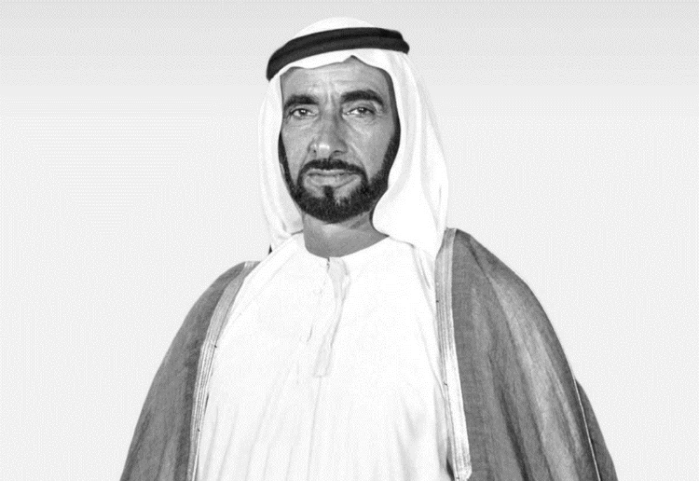
His Highness Sheikh Zayed bin Sultan Al Nahyan, the visionary founder of the United Arab Emirates, led Abu Dhabi in 1966 and united the seven Emirates in 1971. Renowned as the “Father of the Nation,” his leadership focused on education, healthcare, infrastructure, and shaping the UAE into a modern, prosperous country. HH Sheikh Zayed’s legacy is seen in sustainable initiatives, philanthropy, and a commitment to tolerance and unity that continues to define the UAE.
In addition to his leadership, HH Sheikh Zayed was a poet. He expressed his ideas and vision in poetry, demonstrating his strong connection to the land and the ideals he held dear, which add to his varied legacy. His poetry was written originally in Emirati Arabic but can be found showcased and translated in this encyclopedia.
In this post we will highlight our most beloved poem of his; titled “حبكم وسط الحشا” or in English “Your love resides”.
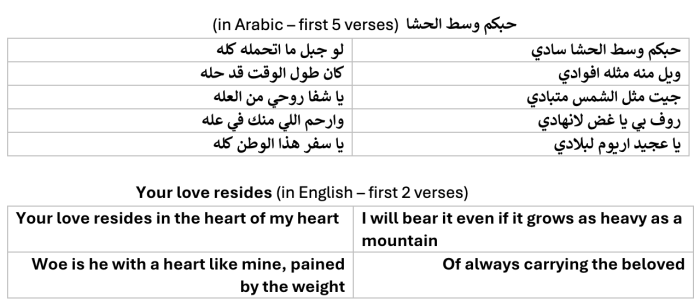
This is a love poem that is dear to the heart of Emiratis. Its words carry deep, romantic feelings that are hard to capture when translating from Arabic to other languages. I believe that Arabic is the most romantic language in the world. It is a diverse language to the point that, as this poem is written in Emirati Arabic, it has words not spoken by other Arabic-speaking nations. This poem was turned into a song by Saudi singer Rashed Al Majid. Traditional Emirati tunes and instruments were used to produce the song to truly capture the poem’s essence that is embedded in Emirati culture and lyricism. You can listen to the poem in English here.
His Highness Sheikh Hamdan bin Mohammed bin Rashid Al Maktoum the Crown Prince of Dubai is a Nabati poet under the pen name Faza’a which means a person who always helps others in need.

In Nabati poetry, colloquial Arabic is used instead of Modern Standard Arabic. The origins of this can be traced back to the Bedouin people of the Arabian Peninsula and referenced in Ibn Khaldun’s 14th-century work Al Muqqadimah. The themes explored in this poetry typically revolve around pride, chivalry, longing, unity, admiration for esteemed Arab leaders, and a deep affection for one’s tribe. This is often conveyed through a clear and engaging storytelling style.
An example of this is the poem that Faza’a dedicated to His Highness (HH) Sheikh Mohamed bin Zayed Al Nahyan, the President of the United Arab Emirates and Ruler of Abu Dhabi on his birthday.

The eloquent Arabic poem beautifully captures the essence of praising HH Sheikh Mohamed and his exceptional achievements as a leader. Faza’a captures the essence of Nabati style by portraying a conversation between the Earth and Mars, where they engage in a friendly rivalry, boasting about the remarkable achievements of HH Sheikh Mohamed. The poem also showcases the strong bond and admiration Faza’a has for the President, as he refers to him by his eldest son’s name, Abu Khaled. Here‘s where you can find an Arabic recital of the poem.
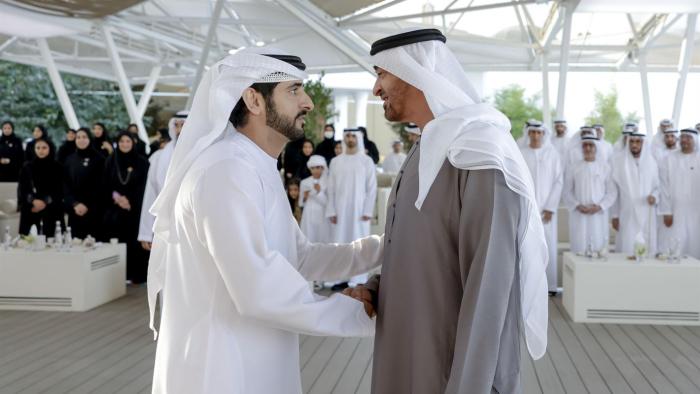
In this post, we could only give you a drop from the vast ocean of Emirati poets with beautiful poetry. The late Sheikh Zayed Al Nahyan and Sheikh Hamdan Al Maktoum are the two most well-known Emirati poets globally and are both members of royal families in the UAE.
About the Guest Contributors for #UAEReads:
 Eqlima Ali Dinar is a PhD Candidate in Education Leadership at the United Arab Emirates University. Within her research, she explores topics such as research self-efficacy, and the wellbeing of teachers. Presently, she serves as a tutor in science and biology, as well as a freelance assessor for a Diploma in Education Studies. Initially embarking on her career as a cardiac nurse, she eventually discovered her true passion in the realm of education. She held a position as an Educational Consultant, providing training to nursery teachers and directors. Prior to that, she had a career as a preschool teacher for nearly a decade. She completed her Bachelor of Science in Nursing at the University of Sharjah, followed by a Master of Education Management, Leadership & Policy at the British University in Dubai. She enjoys reading books, picture books, and manga. Among her other interests are crocheting amigurumi and origami.
Mariam Aljaberi is an undergraduate student at UAEU majoring in Special Education with a concentration on Mild and Moderate disabilities and is a part-time SURE+ research assistant. She was born and raised in Al Ain, Abu Dhabi. She has a passion for improving the special education system in her country.


#UAEReads strives to be reflective of the diverse demographic population that makes up the country of the United Arab Emirates (see Global Media Insight source of demographics as of 2024). Hence, we will be featuring literature coming from the major nationalities comprising the entire country: Emiratis, Pakistanis, Indians, Filipinos, Egyptians – and other nationalities who have made the UAE their home.
About the Guest Editor/Curator for March 2024 [#UAEReads]:
 Myra Garces-Bacsal has served as a teacher educator for 15 years and has led several research projects on reading and social emotional learning, diverse picturebooks and teacher practices, psychology of high creatives and exceptional people, culturally responsive and inclusive education. She is a quintessential lover and creator of booklists (see her Social and Emotional Learning bookshelf here and other publications below). Myra serves as the Assistant Dean for Research and Graduate Studies with the College of Education, UAE University. She is a self-proclaimed nerd who lives and breathes books and enjoys organizing events and festivals where fellow nerds converge and attempt to joyfully change the world.
Publications on booklists:
Garces-Bacsal, R. M., Alhosani, N. M., Elhoweris, H., Tupas, R. (2023). A diverse social and emotional learning booklist for gifted learners and advanced readers. Roeper Review, 45(1), 25-36. https://doi.org/10.1080/02783193.2022.2145397
Garces-Bacsal, R. M., Alhosani, N. M., Elhoweris, H., Al Ghufli, H. T., AlOwais, N. M., Baja, E. S., & Tupas, R. (2022). Using diverse picturebooks for inclusive practices and transformative pedagogies. In M. Efstratopoulou (Ed.), Rethinking Inclusion and Transformation in Special Education (pp. 72-92). IGI Global. https://doi.org/10.4018/978-1-6684-4680-5.ch005
Garces-Bacsal, R. M. (2021). Of grit and gumption, sass and verve: What gifted students can learn from multicultural picture book biographies. In S. R. Smith’s Handbook of giftedness and talent development in Australasian Pacific (pp. 431-453). Singapore: Springer International Handbooks of Education. https://link.springer.com/referenceworkentry/10.1007/978-981-13-3041-4_18
Garces-Bacsal, R. M. (2020). Diverse books for diverse children: Building an early childhood diverse booklist for social and emotional learning. Journal of Early Childhood Literacy, 22(1), 66-95. https://doi.org/10.1177/1468798420901856
 Global Literature in Libraries Initiative
Gosh, thank you for this introduction to poetry from UAE, Myra. It must be fascinating to teach (and learn) in a country so different than where you were raised. And thank you for the reminder that love of the written and spoken word spans the globe!
LikeLiked by 1 person
Myra, wow, I learned so much here. I didn’t realize the royalty in U.A.E. are also poets. I enjoyed the links to the readings, as well.
I can appreciate what you say about the romantic and poetic style of Arabic. I lived for eight years in Bahrain, and I heard so often about all that is lost in translation. When we wrote poems in English class, my students realized the limitations they had. Not from a lack of English skill, but they would explain that it was just the language. Arabic was made for poetry, they thought.
LikeLiked by 1 person
How interesting, Myra! It makes me wish that I spoke Arabic. Arabic text itself is beautiful to behold with it’s swirls and curls.
LikeLiked by 1 person
Thank you for sharing, and happy Poetry Friday! The first poem you shared reminds me how I was taught that in Scottish Gaelic the words for “I love you” as said to a romantic partner translate literally to “I put my love upon you.” Love can absolutely be a weight, and it’s so neat to see this sentiment shared across cultures.
LikeLiked by 1 person
Myra, thank you for this peek into Emirati poetry. That first poem feels weighty and loving and…considered? It’s amazing to see a history of leaders who are also poets. Thank you!
LikeLiked by 1 person