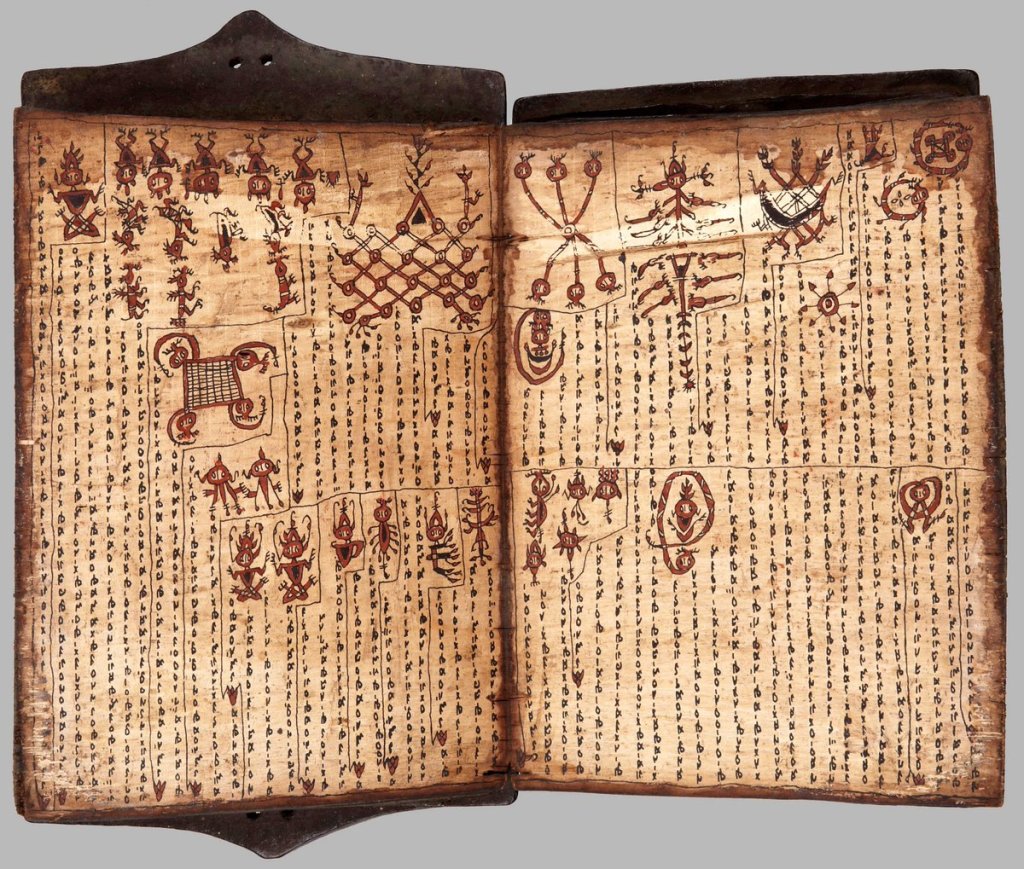
Batak pustaha. Image courtesy of the Incunabula Library.
I was on Twitter the other day and came across a tweet from Philip Boyes of the University of Cambridge, an archaeologist and linguist working on the Bronze and Iron Age Levant. He had been researching early Chinese handwriting manuals and came across this passage:
“Strangely, it was not men themselves who were worried about the invention of writing but the ghosts. The relationship between the ghosts and writing is particularly interesting. The fact that they were disturbed by the invention of writing, just as the dragons (who lived in the valleys) were troubled by the digging of wells, suggests that writing had a certain power over them ot at least intruded on their territory. Different interpretations of these phenomena have been proposed. According to Gāo Yùo, the ghosts started crying during the night because they `feared they would be impeached.’ But it is hard to see why the ghosts would be impeached by written documents and why this would not also affect men.”
(Bottéro, Françoise. 2006. ‘Cāng Jié and the Invention of Writing: Reflections on the Elaboration of a Legend.’ in Christorph Anderl and Halver Boyesen (eds.), Studies in Chinese Language and Culture.)
Okay. So why would a ghost be impeached by the invention of writing? Dramatic pause. Draw deep breath.
Let’s be radical.
Let’s define writing as the act of intentionally making recognizable marks, shapes, patterns, or designs with one’s hands and/or tools and/or materials as a way of manifesting intent or meaning.
It’s a broad and inclusive definition, to be sure, but then again writing has developed in different places at different times for different purposes, and I want to try to respect and embrace all of them.
Writing has developed out of what appear to be property marks, maps, calendars, almanacs…and the paraphernalia of magic.
I have a whole chapter on Writing and Magic in Writing Beyond Writing (and if you haven’t bought a copy yet, there’s no hope for you) in which I quote Philip several times, while also examining magical documents from Indonesia and elsewhere.
I don’t have time or space to get into every aspect of this fascinating relationship, so instead I want to zoom in on a single word in that definition I offered you—the word “manifesting.”
Here’s the thing: writing is an astonishing, transdimensional act. It takes something invisible, intangible, interior, evanescent—a thought—and makes it visible, even tangible. It extrudes from the immaterial world into the material world, where it pauses, shimmering with the power of an idea. And that’s a power that in turn can affect, even transform, someone else’s interior life, and thus their material life.
Writing is a manifestation of meaning and intent, and in magic, I suspect, especially intent. Once writing exists, the power of the magician’s mind becomes infinitely more powerful because he (usually he) can use it to cross that dimensional void and work in both the material and immaterial worlds.
I’m guessing, now, but we know that in various magic traditions, to name a spirit was to summon it. To name it in writing, I suspect, was to summon it from the spirit world and trap it in physical space, impeached in a cage of letters.
We see this combination everywhere, time and again, as in the Batak pustaha from Indonesia, pictured above: to make a visual likeness of a spirit showed that the magician not only know and could single it out but, in creating it in miniature in the physical world, could demonstrate mastery over it.
The writing, then, is not just a record of chants or spells; if is a manifestation of the magician’s will and intent, released from the dark, invisible realm of the mind and projected like a previously hidden deadly spear out into the material world, onto the page.
No wonder the ghosts were terrified.
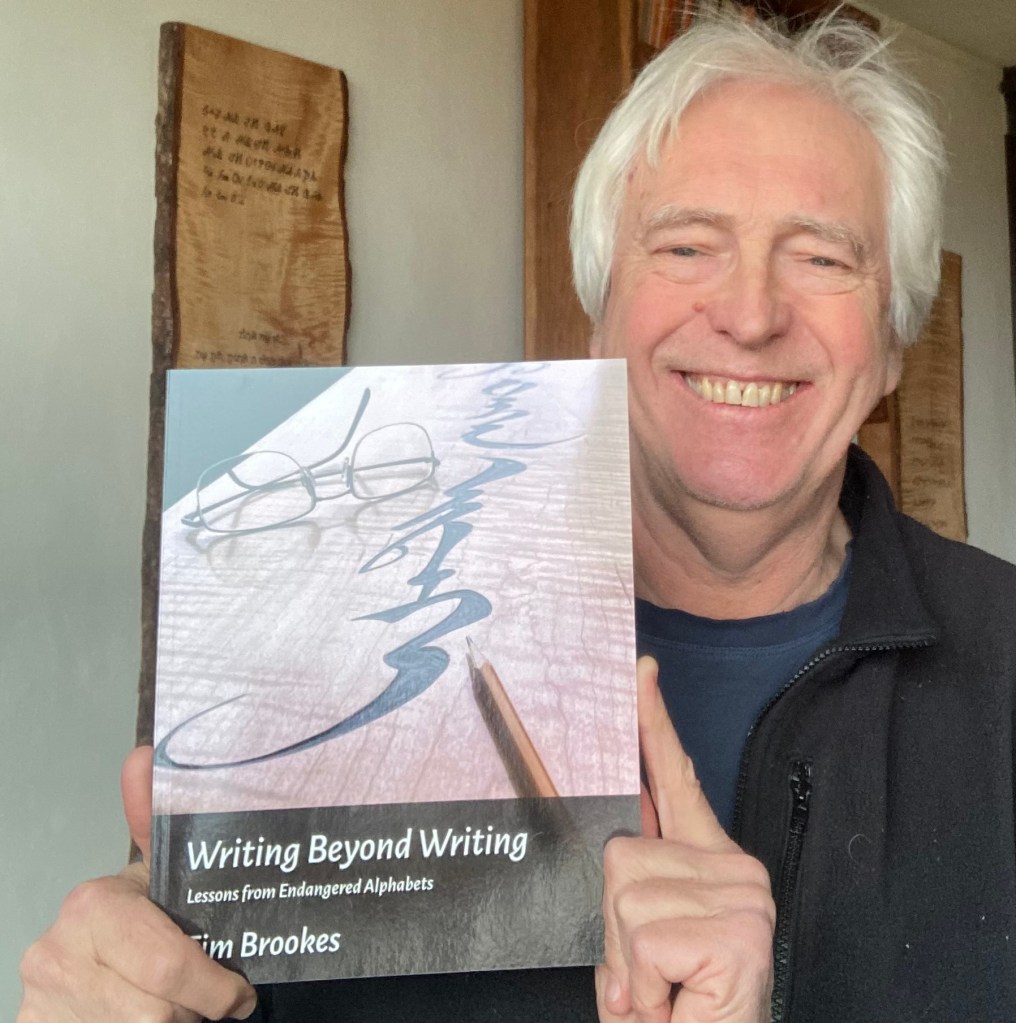
Tim Brookes is the founder and president of the non-profit Endangered Alphabets Project (endangeredalphabets.com). His new book, Writing Beyond Writing: Lessons from Endangered Alphabets, can be found at https://www.endangeredalphabets.com/writing-beyond-writing/.
 Global Literature in Libraries Initiative