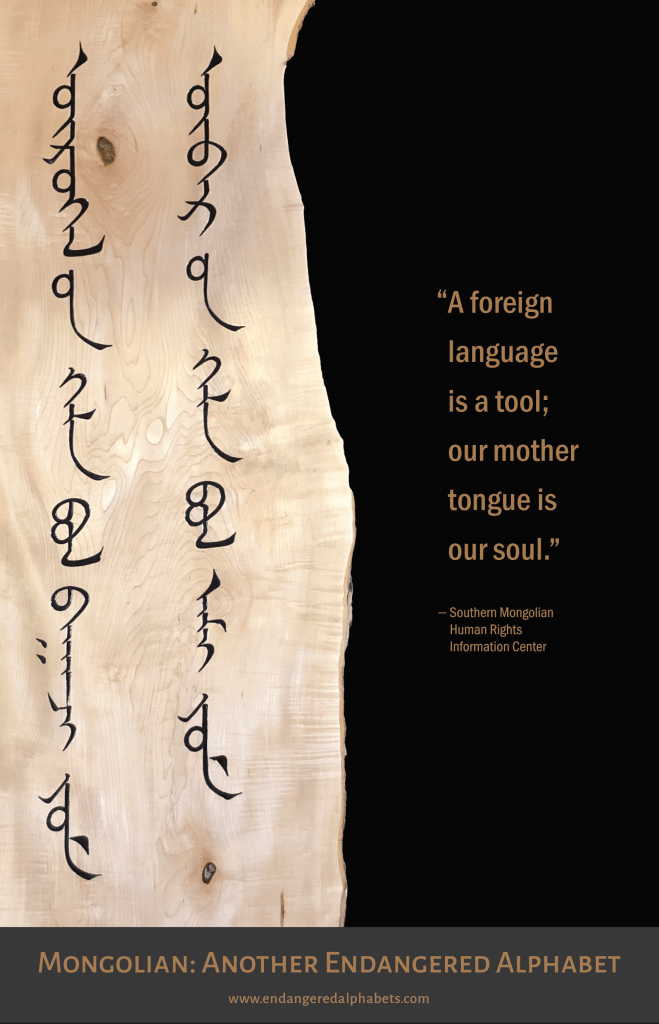
Endangered Alphabets Project poster, 2020. Design by Alec Julien, carving and photo by the author.
The elegant maps that illustrate the spread of writing take at best a satellite’s-eye view of what really happens when one culture adopts writing from another. It may look as though writing spreads like a good idea (and there are a few cases where indeed that has happened) but in most cases writing spreads with an army, or a religion with an army.
This leads to a fascinating and ironic metric that occurred to me only a week ago, perhaps even a law, that we can call Brookes’s Stockholm Law of Script Proponence. It goes like this: the longer ago a nation was conquered, the more likely they are to take pride in their script.
In Western Europe, the ubiquitous and unifying fact of the Latin or Roman alphabet is seen as a good and natural thing. Which led me to ask what would happen if I stood up in Brussels to address the EU and said “You all write the same script because you were all brutally overrun and subjugated by the same people at roughly the same time. Where’s your pride?”
The British, for example, were conquered and overrun by the Romans so long ago we have fallen into a kind of Stockholm Syndrome admiration for them. It’s like one of those Monty Python old-folk conversations:
Old Woman: Ooooh, the Romans! They built those lovely straight roads, didn’t they?
Old Man: Dead straight. Straight as the eye can see.
OW: They can’t build roads that straight nowadays.
OM: Well, they can, but they have to use equipment.
OW: (disgusted) Equipment. The Romans could build roads with their bare hands.
OM: And baths. The Romans made great baths.
OW: Just think! If it weren’t for the Romans we’d be filthy!
OM: And columns. The Romans made a nice column, you have to give them that.
OW: (sighing wistfully) Roads and columns and baths.
OM: They also invented football, you know.
OW: So I heard! Kicking the heads of captives around the camps. Clever!
OM: You just got to hand it to them. No roads, no columns, no football—we’d be nothing without the Romans.
OW: Still living in the mud.
Joking aside, those in Latin America (those I know, at least) have a less supine attitude toward the Spanish, partly because that conquest happened 1500 years more recently (and because Spanish engineers never found a way to build a straight road through, say, the Darien Gap). The collective memory of conquest and destruction is much fresher—but again, the Spanish did not leave the civilizations of South and Central America with any viable alternative scripts.
We don’t know much about British writing at the time of the Roman Conquest, and whether any local scripts were suppressed, but we certainly know about the events of 1562, when Bishop Diego de Landa ordered an Inquisition in Mani, ending with an auto de fé in which almost every Mayan codex (book) and approximately 5000 Maya sacred images were burned.
Tibetans nowadays are a much more difficult position, the position of the far-more-recently conquered. Anyone who wants to continue using the traditional Tibetan script rather than Chinese may come across as an old fogey, or a political troublemaker, or both.
Mongolians living in what they call Southern Mongolia and the Chinese call the Inner Mongolia Autonomous Region are likewise all too keenly aware that the recent decision by the Chinese government to remove Mongolian script from the education system and replace it with Chinese is a deliberate act of cultural genocide.
When that decision was announced in 2020, Mongols took to the streets holding up banners of handwritten calligraphy in the classical Mongol script.
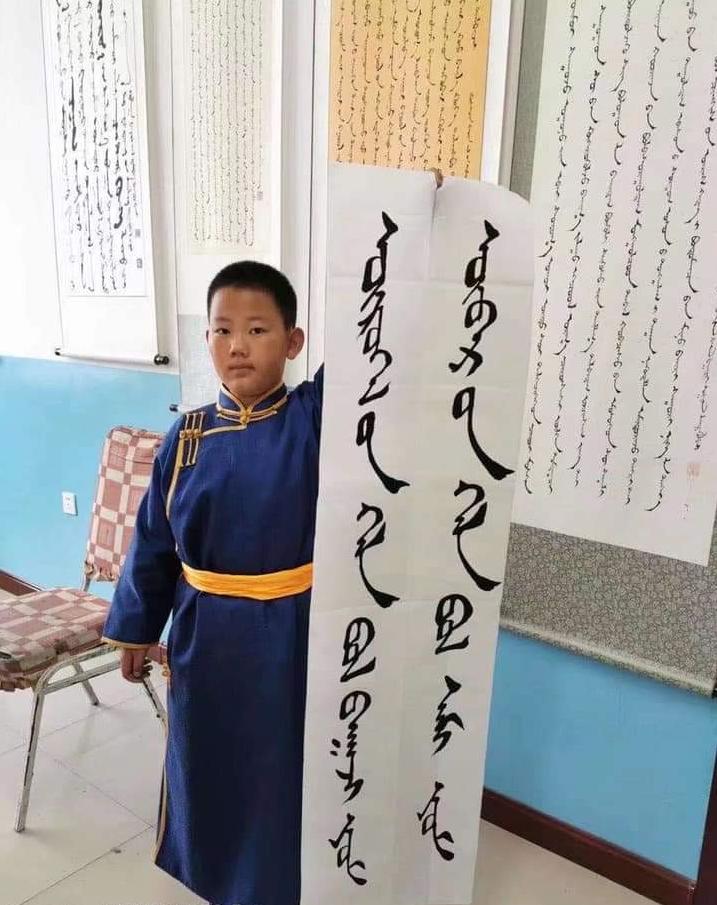
A young Mongol calligrapher protesting. His was the text I took and carved, and then presented to the director of the Southern Mongolia Human Rights Information Center.
No Stockholm Syndrome there.
Tim Brookes is the founder and president of the non-profit Endangered Alphabets Project (endangeredalphabets.com). His new book, Writing Beyond Writing: Lessons from Endangered Alphabets, can be found at https://www.endangeredalphabets.com/writing-beyond-writing/.
 Global Literature in Libraries Initiative