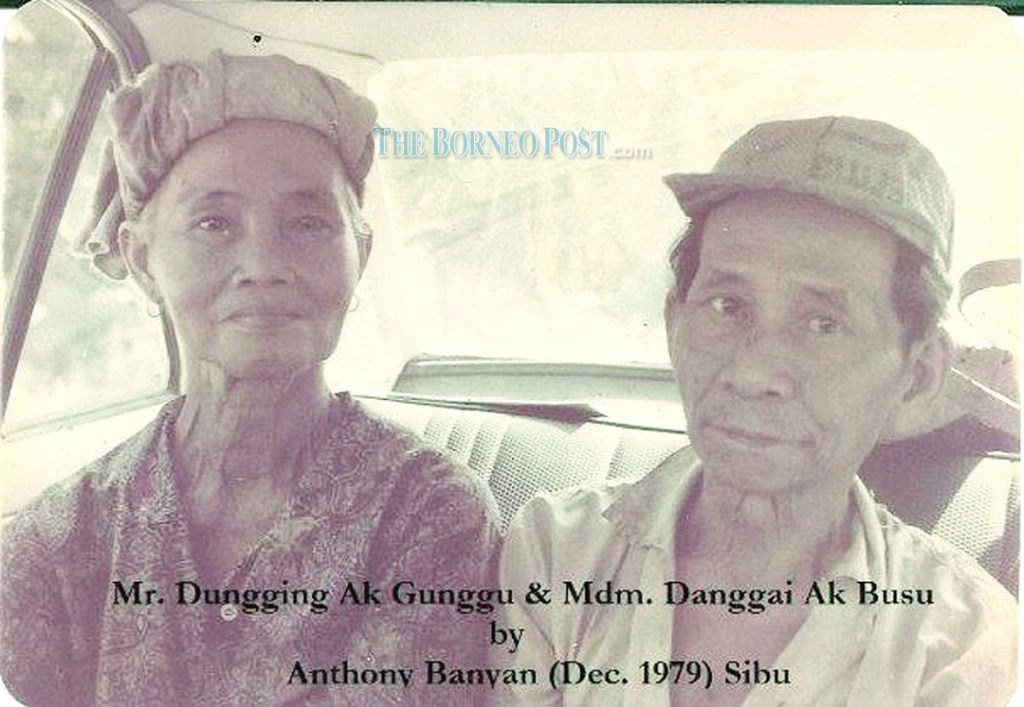
Photo courtesy of the Borneo Post
Authors of writing systems need to be as creative as they are linguistically knowledgeable. A little self-promotion helps, and a lot of perseverance is vital.
Of all the script creators we know about, though, nobody was as inventive as Dunging Anak (son of) Gunggu, known as “Aki,” creator of the Iban Dayak script that now bears his name.
The Iban are the largest indigenous group in Malaysia, with a population of more than a million, most of whom live in the state of Sarawak.
According to legend, the Iban language once had its own script. In a remarkably common creation-and-loss narrative, the Iban recount that once upon a time, Renggi, their ancestral figure, fled from a great flood carrying a piece of bark containing the Iban alphabet. However, because it was exposed to water, the alphabet recorded on the bark was lost. Renggi then swallowed the bark, it is said, since when the Iban Dayak developed the tradition of telling their traditional tales by rote memory.
Born in 1904, when education was almost non-existent in rural Sarawak, Dunging taught himself how to read and write Malay and Iban in Latin and Jawi scripts. He invented the first Iban alphabet in 1947, teaching it to his nephews and, briefly, at a local school, but at the time he was better known for other inventions.
By the age of twenty-one, he had already shown his skills in Iban traditional ukir designs, making utensils such as plates and bowls from tapang hardwood, and various Iban traditional musical instruments from wood, bamboo, gourd and palm leaves.
Dunging’s bilik (apartment) of the longhouse was designed and decorated so it looked like a small museum. On the door, Dunging had written, in his own script, “Raja Menua Sarawak” — King of Sarawak.
During one grand festive celebration, Festival of the Departed (Gawai Antu), he cooled this home/gallery/workshop with a fan of his own invention, powered by a bicycle, which was so strong it is said to have blown the traditional Iban headgear off the heads of passers-by.
One of his original creations was the rebab musical instrument made out of a coconut shell cut in half. He also made bamboo flutes and created a two-string (out of rattan) wooden nyakun that he played to entertain himself.
He planted his own cotton and spun it into thread, which was used by a substantial number of women weavers around the Rimbas, Layar, Paku and Padeh basins.
He also made hats from the light empalaie wood and the kerupuk palm, which were popular and said to be quite durable and comfortable. He experimented with making hats, trousers and jackets from the bark of the tekalung tree that he flattened by pounding, tailoring the items on himself and walking around as his own model to sell his creations.
Valentine Tawie Salok, a writer with the New Sarawak Tribune, wrote: ‘I remember when encountering him in Sarikei in 1982, he used an orange outfit made out of the tree bark, including the hat. In fact he looked resplendent in the outfit with matching orange tekalung footwear, then possibly one and only pair of such kind in the world.’
Another invention was his own brand of perfume, created by gathering local wildflowers, including wild orchids, boiling them and then filtering the liquid. He enjoyed brisk sales, but ran out of the raw materials and abandoned the project — as he also abandoned his plans to mass-manufacture bicycles made out of local plant materials, which unfortunately turned out to be too bumpy, unsafe and uncomfortable.
More successful were a hydro-powered rice mill he designed and built himself, and his use of the local rubber plantations to invent a laundry mangle (to press water out of newly washed clothes) made of rubber and the hardwood tapang tree. These were lighter and cheaper than the usual metal mangles. He also donated many to his employees and to the local community.
This colorful context suggests he saw writing — specifically, an indigenously created writing system — as more than a linguistic exercise, but as part of a broader range of efforts to contribute to and improve the lives of those in his community.
His most lasting legacy was his alphabet, though that might have gone the way of the tree-bark outfit, as initial efforts to teach it fizzled out. In 1981, shortly before his death, an Iban-English dictionary compiled by Anthony Richards recognized Dunging’s work. In 1990, Bagat Nunui, Dunging’s adopted son, compiled information about the script in an unpublished book, and in 2001, the Tun Jugah Foundation published an encyclopedia of the Iban Dayak, including Dunging’s alphabet.
The Malaysian government began to support the teaching of what is now called either Iban Dunging or Iban Dayak, most of Dunging’s creations were then taught to non-Dayak Iban people through universities, schools, and several literacy-related communities. In 2010 Dunging’s grand-nephew, Dr Bromeley Philip, an associate professor of applied linguistics and ethnolinguistics at the Academy of Language Studies, Universiti Teknologi MARA (UiTM) Sarawak, developed computer fonts for the Iban alphabet, called LaserIban, using which he launched a course called the ‘Training Unto LaserIban System’, or TULIS, Program. (TULIS means ‘writing’ in Iban.)

Photo courtesy Dr. Bromeley Philip
According to the Borneo Post, “Aki Dunging’s final words regarding his creation were: “Sayau enti surat tu lenyau ke dua kali. Kada ulih giga agi.” (It would be a pity that if the alphabet were to be lost the second time around. It would be impossible to find it again.)
As if to underscore the point, Dunging wrote a poem on the subject:
An excerpt of a ‘pantun’ (poem) by Aki Dunging
Tesat nyau surat bansa kitai Iban,
Dibuai Aki Tuai Apai Lang Bulan,
Laban dunya kudi ujan tiga bulan,
Tasah laban bah dunya kudi garam,
Tulis lalu abis lela laban ujan,
Dipakai Aki Tuai disuap lalu telan,
Keretas abis ayas nadai agi ayan,
Dudi uchu nganti peturun bansa Iban…
*Loosely translated as: “Our alphabet is lost; swallowed by Aki Tuai Apai Lang Bulan; to avoid being washed away by the Great Flood; we hope the next generation would be able to find it…”
Further reading:
https://dayakwithgoldenhair.wordpress.com/2011/10/03/dungings-legacy-the-iban-alphabet

Tim Brookes is the founder and president of the non-profit Endangered Alphabets Project (endangeredalphabets.com). His new book, Writing Beyond Writing: Lessons from Endangered Alphabets, can be found at https://www.endangeredalphabets.com/writing-beyond-writing/.
 Global Literature in Libraries Initiative