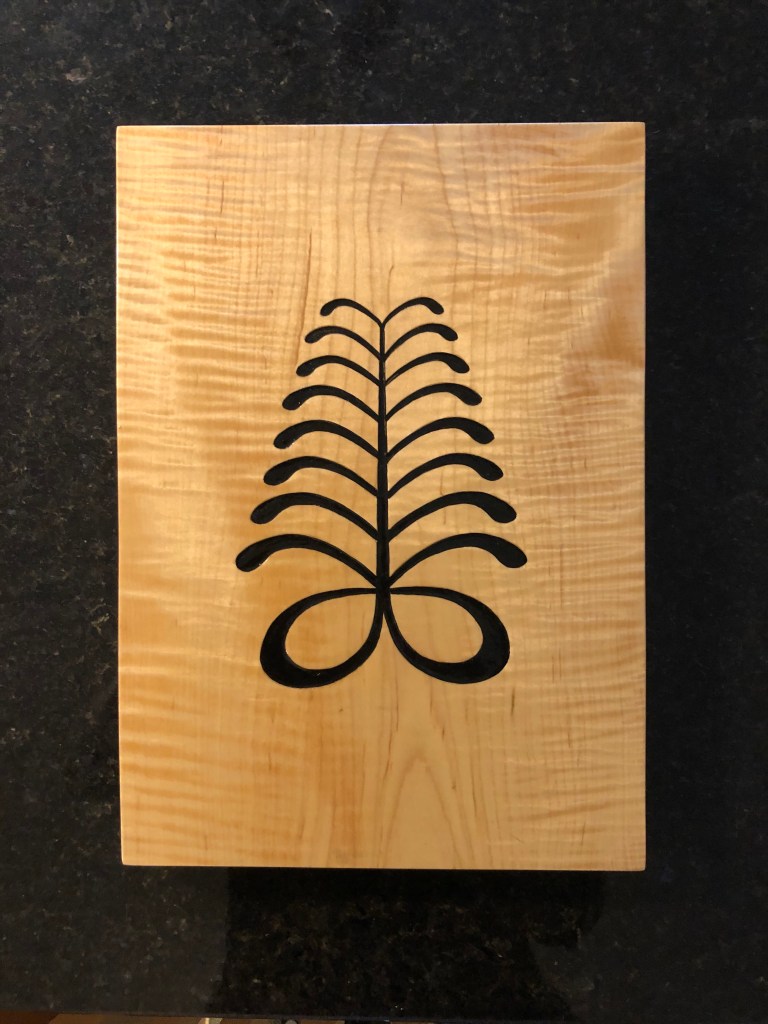
The Adinkra symbol Aya, the fern, which stands for resilience and resourcefulness. Carving and photo by the author.
My book Writing Beyond Writing came about because of the Adinkra symbols of Ghana. These are remarkable symbols, each of which is a kind of graphic shorthand for a proverb or piece of traditional wisdom—not a letter or a word, but something more like a visual prompt, maybe the ancestor to an infographic.
I finished carving one, and posted it on Facebook—whereupon to my surprise a very distinguished linguist posted in reply, “Very nice, but this isn’t writing.”
This reply was so absolute and so dismissive it took me aback, and made me dive into the entire twisted history of the definition of writing—in particular, who has decided what writing is (namely, the world’s most powerful nations, especially European and North American) and what kinds of amazing, rich forms were deliberately excluded from consideration because they came from cultures that were seen as primitive, backward, childish. For more on this theme, read the book!
Adinkra symbols, like pictograms and emoji, exist in a broad hinterland of writing forms that lies beyond the clear, organized, well-defined street maps of alphabets. Likewise, their use goes well beyond the page or the computer screen, and they flourish in woodcuts, screen prints, architectural design, clothing fabrics, gold weights, jewellery, and even furniture.
On the other hand, Adinkra are not simply visual designs or patterns. Individual Adinkra represent concepts, sayings, or proverbs, and as such are bearers of traditional wisdom.
Pictograms and ideograms have significant advantages, especially in areas where multiple languages are spoken: the very fact that the symbols don’t indicate specific sounds of speech enables them to travel beyond the borders of specific language groups, like passports of meaning. This is exactly why Europe has universal traffic signs that display symbols rather than give verbal instructions.
Adinkra are thought to have originated among the Ashantis during the wealthy, pre-colonial Asante Empire, along the Lake Volta and Gulf of Guinea, in present-day Ghana. The empire was founded in 1670, its capital Kumase standing at a strategic crossroads of the Trans-Saharan trade routes. Ashanti oral tradition holds that Adinkra may be even older, originating in Gyaman, a state that existed for some four centuries before being subjugated by the Ashanti in the nineteenth century.
The oldest known Adinkra symbols were printed on a piece of cloth collected by an Englishman, Thomas Edward Bowdich, in Kumase in 1817. The patterns feature fifteen stamped symbols, including nsroma (stars), dono ntoasuo (double Dono drums), and diamonds, printed using carved calabash stamps and a vegetable-based dye.
Many writing systems were originally used by a specific minority within their culture, and Adinkra is no exception, although a different kind of exception. Adinkra-printed clothing was traditionally only worn by royalty and spiritual leaders for funerals and other very special occasions. Over time, their use broadened, as did their background: when once they were typically hand-printed on undyed, red, dark brown or black hand-woven cotton fabric, depending on the occasion and the wearer’s role; they are now frequently mass-produced on brighter-colored fabrics, literally woven into the fabric of society.
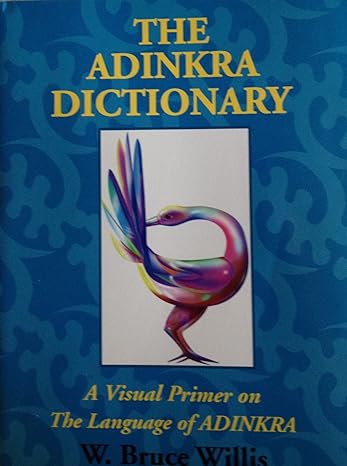
A variety of books explicate the Adinkra symbols, notably The Adinkra Dictionary by W. Bruce Willis
- Publisher : Pyramid Complex (January 1, 1998)
- Language : English
- Paperback : 314 pages
- ISBN-10 : 9780966153200
- ISBN-13 : 978-0966153200

A fine introduction to indigenous writing systems of the continent is Afrikan Alphabets by Saki Mafundikwa
Publisher : Mark Batty Publisher; First Edition (October 1, 2006)
Language : English
Hardcover : 192 pages
ISBN-10 : 0972424067
ISBN-13 : 978-0972424066
Item Weight : 1.6 pounds
Dimensions : 8.25 x 1 x 8.25 inches
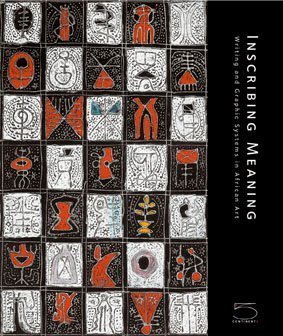
A more scholarly approach is offered by Inscribing Meaning: Writing and Graphic Systems in African Art by Christine Mullen Kreamer et al
Paperback – September 18, 2007
Publisher : 5 Continents Editions Srl (September 18, 2007)
Language : English
Paperback : 256 pages
ISBN-10 : 8874393776
ISBN-13 : 978-8874393770
Reading age : 13 years and up
Grade level : 8 and up
Item Weight : 3.1 pounds

Tim Brookes is the founder and president of the non-profit Endangered Alphabets Project (endangeredalphabets.com). His new book, Writing Beyond Writing: Lessons from Endangered Alphabets, can be found at https://www.endangeredalphabets.com/writing-beyond-writing/.
 Global Literature in Libraries Initiative