
“At the Edge of the Wood” (2009) by Irish sculptor Fidelma Massey. It spells TAOBH NA COILLE, the name of the Gaelscoil in Beallairmín, An Chéim / Belarmine, Stepaside, Co. Dublin, in vertical Ogam.
http://www.fidelmamassey.com/large-works
Today’s post has a serious part and a light-hearted part. Leave ’em laughing, they say, though whether what goes for vaudeville also goes for social media is yet to be decided. I’ll start with the serious part.
We’re talking about Ogham or Ogam, the still-only-partly-deciphered script used to write Irish roughly between 1300 and 1600 years ago. It’s one of several scripts that generally speaking is no longer written or read, but still retains extraordinary potency for its community. In any gift shop in Cork you can buy Ogham earrings, pendants, bracelets, T-shirts–memorabilia in more senses than one.
Here’s how it is described on the website of the Heritage Council of Ireland. Having pointed out that Ogham was written on stone before anyone in Ireland starting using vellum manuscripts, the Council continues:
“Ogham is highly unusual among world writing systems. It consists solely of parallel lines in groups of 1-5, their value depending on their position relative to a stemline. Unlike later inscriptions in the Latin script, which were carved on the face of the stone, ogham inscriptions were usually carved vertically along the natural angle or edge of the stone, which served as a natural stemline. Ogham generally reads upwards, starting at the bottom left-hand side of one of the faces, across the top and down the right-hand side (up-top-down), depending on the length of the inscription. … The manner in which the script wraps around the edge of the stone makes it a uniquely three-dimensional script.”
“Highly unusual,” “uniquely three-dimensional”–This is ours, the text implies, and beyond that, this is something unique to us. Not simply a bygone medium of communication but part of our history, our architecture, our art. It’s also part of our mystery, this enigmatic form, something long lost—not just the writing but our own pure, essential identity as Irish, before Christianity, before the bloody English.
Okay. Now the other question: how to spell to pronounce it?
I wouldn’t dare venture into this territory (especially as a bloody Englishman) without the guidance of David Stifter, the Irish Principal Investigator of a collaborative research project called, and I am copying this carefully from their website, The OG(H)AM Project: “harnessing digital technologies to transform understanding of ogham writing, from the 4th century to the 21st.”
Clearly, even in the project’s title the issue of the name of the Irish script is complex enough to warrant a parenthesis, a rare sighting in official names of academic research projects. Ogham, the organization’s name is asking, or Ogam? What the H?
It gets tricker still: there’s not only a spelling issue but a capitalization issue. There are actually four legitimate possibilities: Ogham, Ogam, ogham and ogam.
Well. It turns out that what we’re seeing is a problem older than spelling itself. (Not that old, when you think of it. Widespread consistent spelling is only a little over a century old even in Europe and the Americas.)
Ogam, David informs us, keeping a level head, is the spelling in Old Irish, though ogom and ogum can be found. So far, so good.
On the other hand, in Modern Irish and Scottish Gaelic orthography the spelling is ogham. Just when you thought it was safe….
Okay, well should it be Ogam or Ogham with a capital letter or ogam or ogham in lower case? Depends on whether you think of it as a national script deserving of being thought of as a proper noun (e.g. French, Manx) or a generic word describing a form of writing (e.g. runes, hieroglyphics). Either is acceptable.
Well, you conclude, this is all quite relaxing. This Og(h)am feller is clearly an easygoing sort, partial to a drop of Jameson’s and agreeable to one and all unless you come up against him in an All-Ireland final with a hurley in his hand.
Not quite. The line has to be drawn somewhere. You can capitalize and spell however you like, but whatever you do, don’t pronounce it “ogg-um.”
The G, he tells us, is either silent, or “pronounced like G in Spanish or in Dutch, i.e. almost like English H, but a bit raspier (almost as if you were gargling).” Like Okham, almost.
The hard G, David says firmly, “is just plainly wrong. At no period of the Gaelic languages ever did authentic speakers pronounce it so.”
You heard it here last.
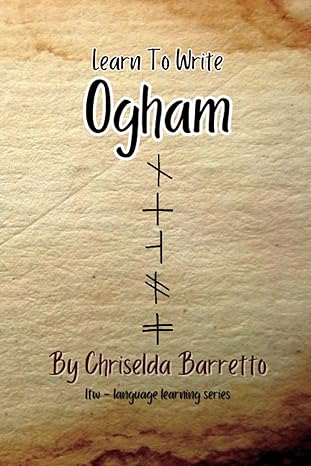
Learn To Write Ogham (Illustrated): Foreign Language Learning Workbook. Ancient Languages. Historical Script. Old Irish. Primer Language Learning Book. Workbook (LTW Language Learning Series) by Chriselda Barretto.
- Publisher : Independently published (June 29, 2023)
- Language : English
- Paperback : 136 pages
- ISBN-13 : 979-8850316112
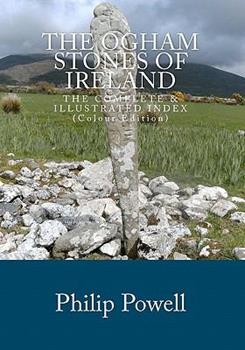
The Ogham Stones of Ireland: The Complete & Illustrated Index by Philip I Powell.
- Publisher : CreateSpace Independent Publishing Platform (June 15, 2011)
- Language : English
- Paperback : 452 pages
- ISBN-10 : 1463593821
- ISBN-13 : 978-1463593827
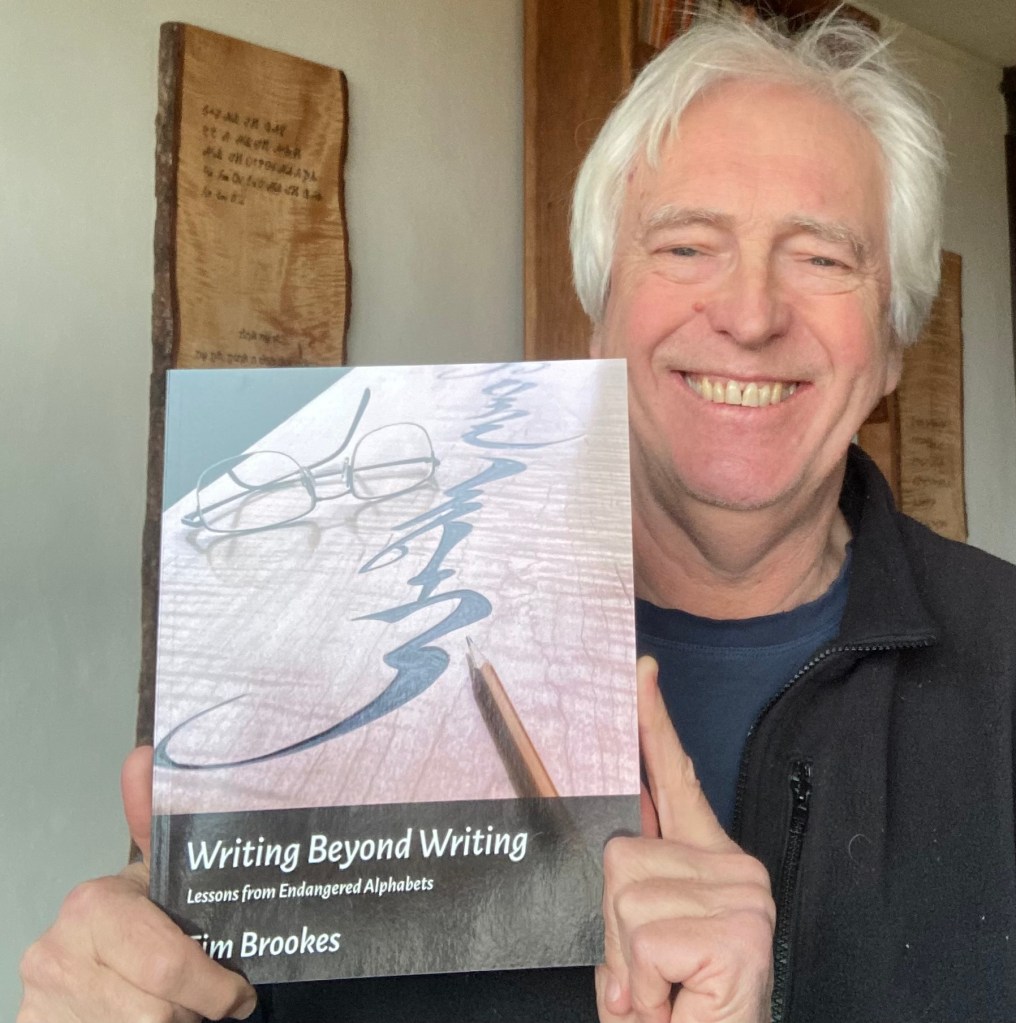
Tim Brookes is the founder and president of the non-profit Endangered Alphabets Project (endangeredalphabets.com). His new book, Writing Beyond Writing: Lessons from Endangered Alphabets, can be found at https://www.endangeredalphabets.com/writing-beyond-writing/.
Global Literature in Libraries Initiative is committed to publishing a diversity of thought. Individual posts are representative of each individual creator rather than GLLI as an organization.
 Global Literature in Libraries Initiative