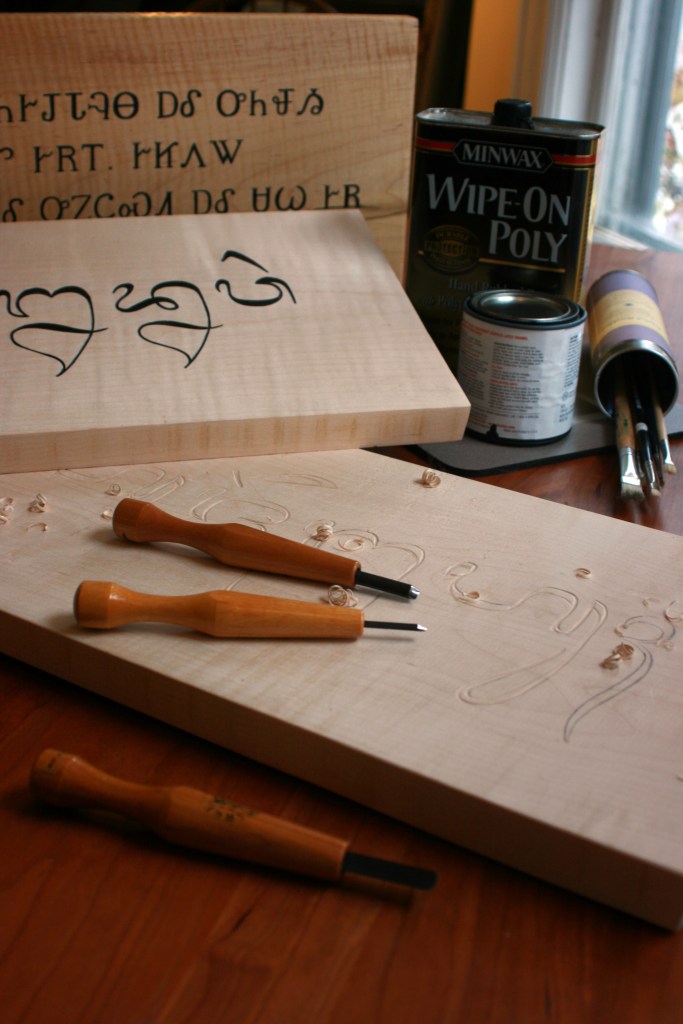
Fourteen years ago, for reasons so odd and random they don’t bear explaining in brief, I began to carve pieces of text in endangered alphabets.
I couldn’t read or pronounce any of the words or phrases I was carving. I wasn’t an anthropologist or a linguist—I wasn’t even a woodworker. What I didn’t yet suspect was that this ignorance would turn out to have its own strange value, and I would ask myself all kinds of questions that, it turned out, not many other people were asking.
Why were the letters of Baybayin so thin? Why did Bugis consist of the same shape, repeated time and again in slightly different combinations? Why did Cree and Inuktitut consist of such precise and geometrical shapes, so hard to carve and so unnatural to the movement of the wrist?
Was it a coincidence that the scripts of island nations seemed to look like mountains and waves?
Why did Samaritan keep making me think of reminding me of the Sherlock Holmes story “The Case of the Dancing Men”?
Did right-to-left writing predispose the writers in that culture to develop left-handedly?
In short, what could I learn about a written language and its culture of origin by the act of carving it?
What I was starting to discover was a core truth that was to become the credo of the embryonic Endangered Alphabets Project, an insight that underlies everything else in this book: that a script is the product and manifestation of its culture, and it embodies and displays the aesthetics, the values, the history and the beliefs, the materials, the tools, even the climate, that have shaped it. You can never sensibly discuss a script without its human context, just as you can never remove a script from its people without incalculable loss.
During the course of this month I’ll be bringing you a wide variety of examples from around the world of that illustrate this truth—and, whenever possible, books that may help to explore these scripts, their cultures, or the nature of writing itself.
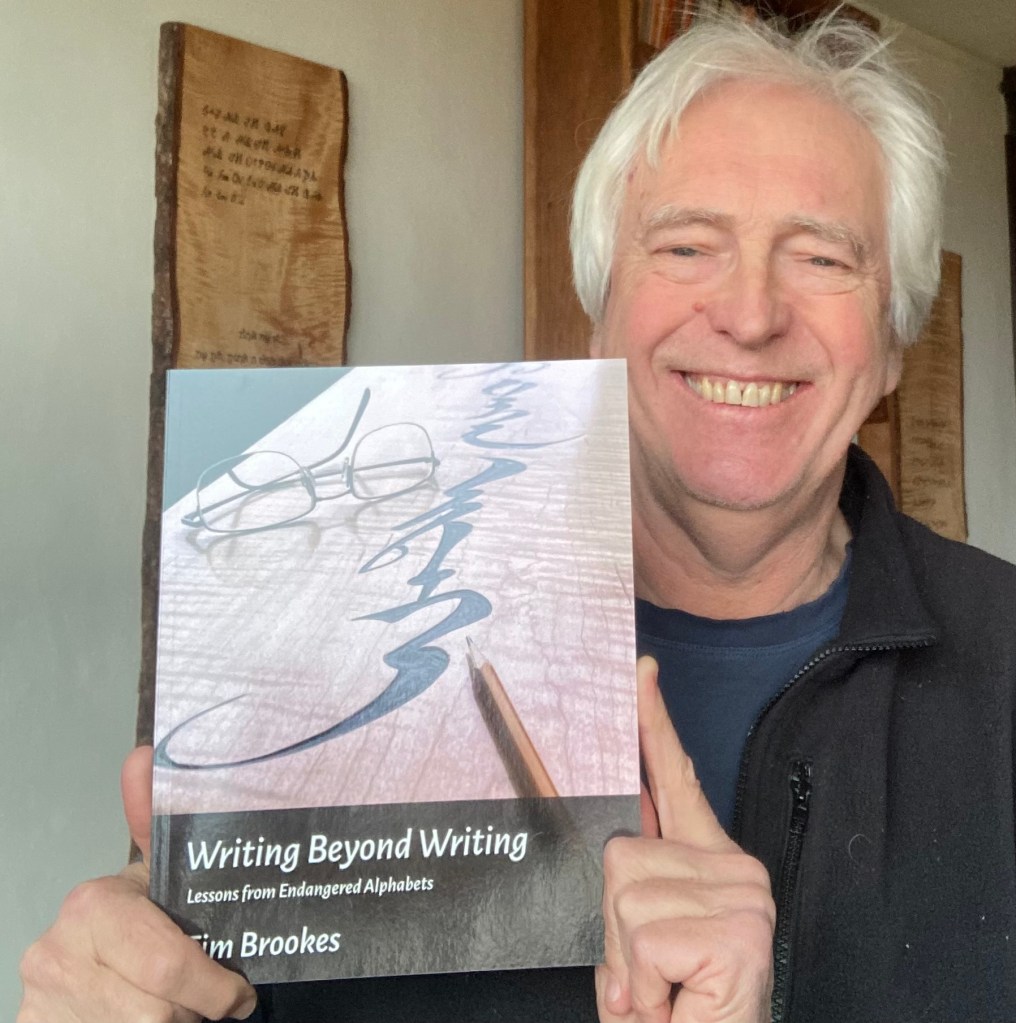
Tim Brookes is the founder and president of the non-profit Endangered Alphabets Project. His new book, Writing Beyond Writing: Lessons from Endangered Alphabets, can be found at https://www.endangeredalphabets.com/writing-beyond-writing/.
 Global Literature in Libraries Initiative