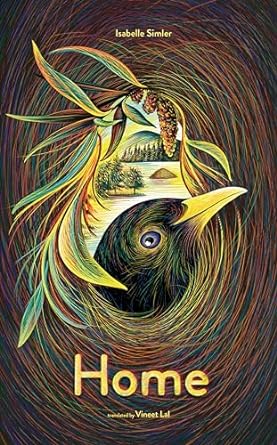
I’m a big fan of nonfiction picture books. And a translated book is bound to get my attention. Home, forthcoming from Eerdman’s Books for Young Readers, combines both to make a standout text.
Written and illustrated by French born artist Isabelle Simler, Home is a survey of over 25 different animals from around the world and their homes—nests, dens, hives, webs, and more. Written in free verse, each brief chapter presents an animal and the salient qualities of its home. The tadpoles of the the Foam-Nest Tree Frog, for example, live in a “foam hiding place made” from a slimy secretion that the mother produces. Cathedral termites make “clay skyscrapers” that house thousands of their brethren, while hummingbirds sit on their pea-sized eggs in “mossy miniature homes” tiled with bits of moss and lichen. Mammals, reptiles, insects, arachnids, birds, crustaceans, amphibians, and aquatic animals are all represented; reptiles are not, however. This book is not meant to be an exhaustive overview of animal homes, but rather an introduction to hopefully spark imagination and further exploration. To that end, back matter includes a glossary and recommended resources.
But the real draw here is the illustrations. Each two-page spread features an animal and its home, painted by Simler in luminous, almost jewel toned color. There is movement in the illustrations; the tentacles of the octopus spread out from its “stony villa,” and the Eurasian Harvest Mouse swings by its tail from a blade of grass. Other animals look out at the reader from their homes, such as the cactus dwelling Elf Owl and the Sumatran Orangutan reclined in its leafy bough. The end papers emphasize the theme of homes and their construction, representing blueprints of various human dwellings.
Translated by Vineet Lal, the short bursts of text give it great accessibility for all sorts of young readers. Some of the more rare words in the text (passerine, for example, which I learned!) provide excellent opportunities for vocabulary building crucial for language development. The lack of a cohesive narrative (each poem stands on its own, the organizing theme notwithstanding) make this book more well suited for children in kindergarten and above.
I see several curriculum opportunities in the elementary or primary school classroom, including units on animal habitats, construction, and poetry. Children can make dioramas, for example (do kids still make dioramas? I loved making dioramas as a kid.), replicating some of the techniques used by the animals in the book, or try their hand at free verse poetry. That’s part of what makes a good nonfiction picture book: it teaches and it inspires one to learn even more.
Title: Home
Written and illustrated by Isabelle Simler
Translated from French by Vineet Lal
Eerdman’s Books for Young Readers, forthcoming March 26, 2024
Originally published as Maison, 2022, Éditions courtes et longues
ISBN: 9780802856203
You can purchase this book here.*
Reviews: Kirkus
*Book purchases made via our affiliate link may earn GLLI a small commission at no cost to you.
Klem-Marí Cajigas has been with Nashville Public Library since 2012, after more than a decade of academic training in Religious Studies and Ministry. As the Family Literacy Coordinator for Bringing Books to Life!, Nashville Public Library’s award-winning early literacy outreach program, she delivers family literacy workshops to a diverse range of local communities. In recognition of her work, she was named a 2021 Library Journal “Mover and Shaker.” Born in Puerto Rico, Klem-Marí is bilingual, bicultural, and proudly Boricua.
 Global Literature in Libraries Initiative