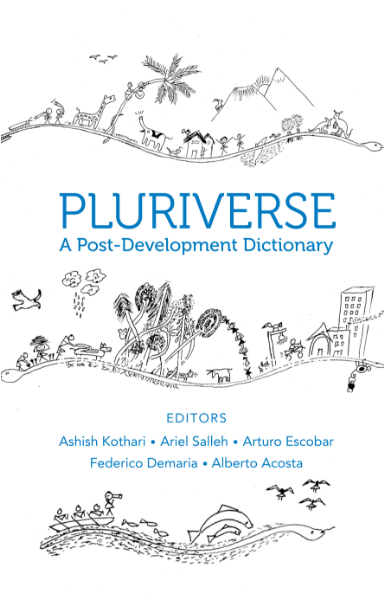
Pluriverse: A Post-Devlopment Dictionary, by Ashish Kothari, Ariel Salleh, Arturo Escobar, Federico Demaria, Alberto Acosta.
- Published by Tulika Books in association with AuthorsUpFront
- July 2021
- (xlii + 342) 384 pages
- ISBN : 978-81-937329-8-4
This is a gorgeous collection of 1,000 word essays on a broad range of topics that fall under the umbrella heading of “pluriverse”. Each essay is written by an expert on the topic, and the essays are broken up into three key sections:
- Development and its crises: global experiences
- Universalising the Earth: reformist solutions
- A people’s pluriverse: transformative initiatives
The essay on Degrowth, by Federico Demaria and Serge Latouche has informed a lot of my thinking on the topic, but the beauty of this book is that it reveals a plethora of alternative ways of living beyond the Western notion of ‘development’ that we can use to create the world that comes next.
This book is free to download on the Radical Ecological Democracy website.
Praise for Pluriverse:
A way to understanding an alternative future. – Juliet Schor, Sociology, Boston College A book of dazzling breadth, provocative and persuasive scholarship.
– Sylvia Marcos, Mexican feminist activist and scholar
For too long the North has imposed its one-size-fits-all agenda on the South.
– Dan O’Neill, economist, University of Leeds
This Dictionary charts pathways for transition to an ecologically sane, politically more egalitarian, and socially more inclusive world.
– Erik Swyngedouw, geographer, University of Manchester
A real breakthrough in post-development thinking.
– Gilbert Rist, Graduate Institute of International and Development Studies, Geneva
It is about a future that died long ago . . . and about the urgency of nurturing the manifold worlds that breathe seditiously.
– Bayo Akomolafe, author of These Wilds Beyond Our Fences
A delight: stimulating, important.
– John Holloway, author of Change the World Without Taking Power
May the Pluriverse open our minds to what we could not see. . . . – Frances Moore Lappé, founder of the Small Planet Institute
This Post-Development Dictionary addresses the systemic crisis we are living in by honouring cultural visions from all over the world.
– Pablo Solon, co-author of Systemic Alternatives
A wild generosity of ideas marks this book. It is a gift to celebrate and gossip about. – Shiv Visvanathan, Jindal Global University
Calls out the free-market economic delusion that the imperative for survival demands. – Mogobe Ramose, author of African Philosophy Through Ubuntu
Pluriverse helps us to re-think our societies and the meaning of being human. – Jingzhong Ye, Humanities, China Agricultural University
A valuable contribution towards building a counter-epistemic community. – Debal Deb, author of Beyond Developmentality
Development as a solution to global crises has long been criticized but a plethora of alternatives exist. – Saral Sarkar, author of Eco-Socialism or Eco-Capitalism?
A menu of narratives that supply meaning and nurture hope.
– Marina Fischer-Kowalski, University of Natural Resources and Life Sciences, Vienna
Whether you agree with the wisdom of plurality or not, this book will leave you thinking about radical social transformations.
– Lourdes Beneria, Regional Planning, Cornell University
This book’s magnificent content puts forth real possibilities for building a future where we can live in peace with each other and the planet.
– Medea Benjamin, Co-Director, CODEPINK: Women for Peace
About Erin Remblance, your host during #DegrowthLitMonth:
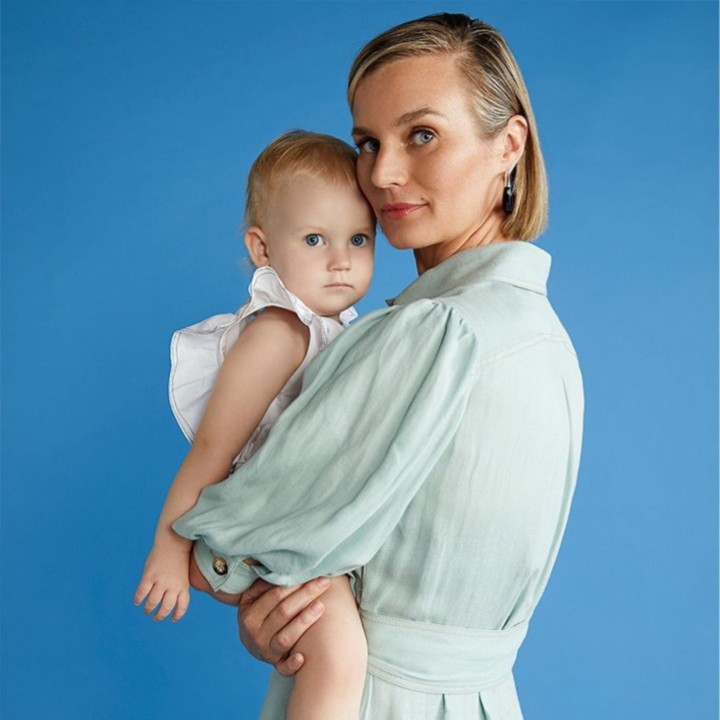
Erin Remblance established her early career in blue-chip fast-moving consumer goods companies in Sydney & London, but always sensed there was more important work to be done. Having children gave her the space to explore the environmental and cultural crises on the planet that need to be urgently addressed. She shifted her focus to dedicate her life towards educating people on climate change, degrowth, planetary boundaries, modern monetary theory and more. Erin is a writer, researcher, co-creator of (re)Biz, wife, and mother of three children. She lives north of Sydney, Australia with her family, on the occupied ancestral country of the Gayemagal people.
Follow Erin on Substack, LinkedIn, (re)Biz and X (formerly Twitter).
#DegrowthLitMonth
 Global Literature in Libraries Initiative